When We Scream at the One Who Holds Us
When We Scream at the One Who Holds Us
🎧 Listen to the Devotional
Click the play button to hear an audio reading of this week’s devotional: “When We Scream at the One Who Holds Us.”
When We Scream at the One Who Holds Us—and Trust Anyway
There’s a belief—often unspoken—that if we trust God, He will make things better. That prayer will shield us. That faith will smooth the road.
But then a flood comes.
And it takes a Christian summer camp filled with children.
And the question is spoken aloud:
“Where was your God?”
These are the moments when clichés collapse. When bumper-sticker faith peels off in the rain. When the phrases we’ve rehearsed—“God has a plan,” “Everything happens for a reason”—start to feel more like salt than salve.
What do we do when trusting God doesn’t stop the pain?
What do we do when He could have stopped it—and didn’t?
Trust and Suffering Are Not Opposites
This is where many lose their faith. But it’s also where the Bible gets brutally honest.
Job was a good man. Blameless, in fact. And yet he lost everything—his children, his wealth, his health, even the respect of his friends. His wife, devastated by the suffering, looked at him and said, “Curse God and die.”
She wasn’t weak. She was human. And I understand her.
Job didn’t receive answers. God didn’t explain Himself. He didn’t offer reasons. He just was. And Job, sitting in the ashes said:
“Though He slay me, yet will I trust Him.” (Job 13:15)
Not because it made sense. Not because it felt good. But because Job trusted in the fact that God is beyond our understanding. And that was enough to keep holding on.
Habakkuk: The Prophet Who Screamed and Stayed
Another voice from the pages of Scripture—Habakkuk—didn’t just cry out to God. He screamed in anguish and frustration:
“How long, Lord, must I call for help, but You do not listen?
Or cry out to You, ‘Violence!’ but You do not save?” (Habakkuk 1:2)
He saw chaos, injustice, silence, and he said so – boldly. But here’s what’s so staggering:
He screamed at the very One he was still clinging to.
He planted himself on the watchtower and waited for an answer. And when God finally spoke, it wasn’t the answer he wanted.
Yet by the end of the book, Habakkuk said this:
“Though the fig tree does not bud
and there are no grapes on the vines…
yet I will rejoice in the Lord.” (Habakkuk 3:17–18)
He didn’t say this because things had improved.
He said it in spite of the fact that they hadn’t.
Habakkuk didn’t walk away. He rested in the One he had shouted at.
This is not easy faith. This is faith with a limp.
Crimson Cord Faith
I won’t make excuses for God. I won’t pretend to understand His ways.
But I believe—no, I cling—to the truth that He is still who He says He is. He does not change. He is just. He is love. And somehow—through agony, through silence, through death—He is working redemption that I cannot yet see.
The Hebrew word for hope is tikvah—which also means cord or rope. It’s the word used for the scarlet cord Rahab tied in her window. A symbol of rescue. A thread of survival.
That’s what I’m holding on to. Crimson cord faith.
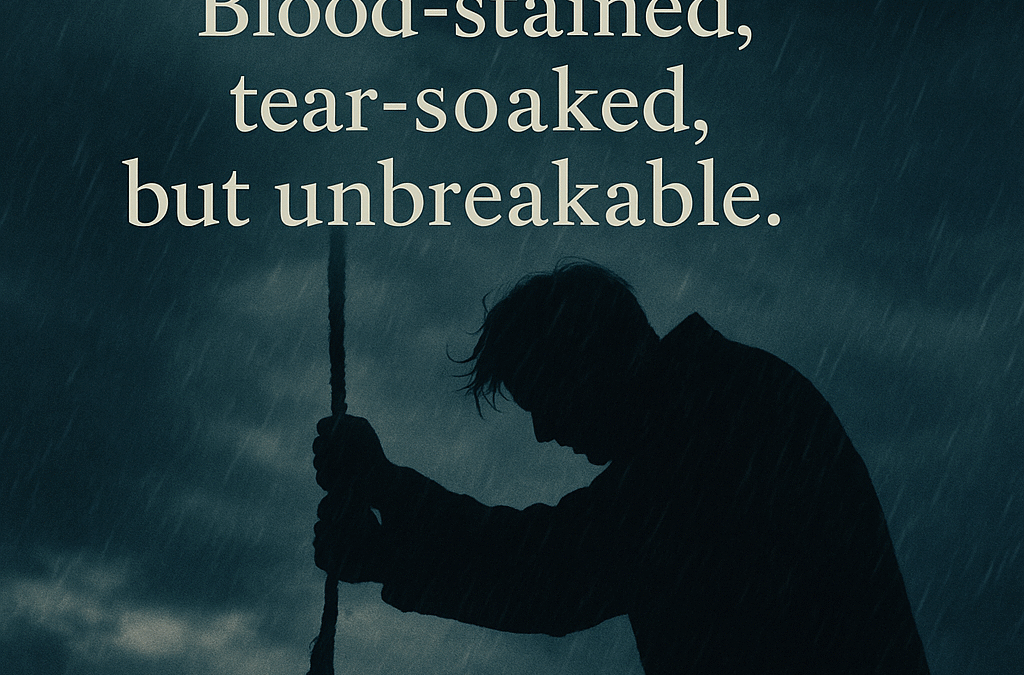
Blood-stained, tear-soaked, but unbreakable.
The Mirror in the Doctor’s Office
Years ago, Dr. James Dobson told a story about his small child suffering from a serious ear infection. The doctor had to act fast—no anesthesia, no preparation. He had to cut something out immediately.
Dobson held his son across his knees while the child screamed, unable to comprehend why his father was letting this happen.
But in the room was a mirror. And in that mirror, the child caught his father’s eyes.
Eyes full of pain.
The child didn’t understand the why.
But he was being held.
And he saw the face of love.
That image stays with me. Because sometimes we are that child. Screaming in pain. Helpless. Confused. Asking why the One who claims to love us allows such agony.
And sometimes all we get is a glimpse of His eyes.
And the knowledge that He hasn’t let go.
When the Hurt Is Yours—or Someone You Love
Maybe you’ve carried a deep loss.
Maybe someone you love has suffered unfairly, unbearably, and you have no answers—just ache.
You don’t have to pretend it’s okay. The Bible never asks you to. In fact, it gives you permission to scream at the God who holds you.
Because real faith doesn’t mean silence.
It means still facing Him, even when you don’t understand.
You don’t have to explain it.
You don’t have to fix it.
You just have to hold on.
Dig in your heels.
Clutch the crimson cord.
And whisper with every shred of hope left:
“Though He slay me, yet will I trust Him.”
Because I’ve seen His eyes in the mirror.
And I know—He’s still there.
💬 Know someone who’s suffering right now?
Send them this post—or just sit with them and be present.
Sometimes trust sounds less like answers, and more like being there.
Daily Armor: Living Fully Armored in Union with Christ
When Faith Finds You
When Faith Finds You
🎧 Listen to the Devotional
Click the play button to hear an audio reading of this week’s devotional: “When Faith Finds You.”
When Faith Finds You
Key Verse:
“Without faith it is impossible to please Him, for he who comes to God must believe that He is, and that He is a rewarder of those who diligently seek Him.”
— Hebrews 11:6
We hear the word faith a lot.
In church, in songs, on coffee mugs.
But what does it really mean?
Is it just hoping things get better? Is it believing harder? Trying to stay positive when life feels anything but?
No. It’s deeper than that. It’s more personal.
Faith is not about trying harder.
It’s about hearing God’s voice—and responding.
Faith isn’t a feeling.
It’s not something we manufacture on our own.
It’s something that rises up in us when we finally see Him for who He is.
That may happen in a moment of desperation.
Or in the middle of a song. Or a memory. Or someone else’s story.
It could be a grandmother’s prayer whispered over a child’s crib.
A friend’s late-night testimony of how God pulled them out of the dark.
A sermon that unexpectedly stirs your heart.
A moment when Scripture feels like it was written just for you.
Or even a stranger sharing something they didn’t know you needed to hear.
That’s how faith often comes—by hearing.
And the One speaking is God Himself.
It’s always been that way. From the very beginning.
Adam and Eve knew God. They walked with Him, talked with Him. They passed on what they knew.
Their children—and their children’s children—carried that spark of knowing.
- Abel brought a faithful offering.
- Enoch walked so closely with God that he never died.
- Noah trusted God when the no one else would.
- And from Noah came Abraham—who believed God’s promise, even when everything around him said it was impossible.
These weren’t perfect people.
But they heard God.
And they trusted Him.
Faith was born.
That same thread of faith still runs through history—through people like you and me. Through those who have walked with Him. Through those who have hurt and hoped and prayed and wondered.
We don’t start from scratch.
We’re part of a story that began long before us.
And now, you’re here.
Reading these words. Maybe remembering something. Maybe feeling something rise inside you.
Could it be… that He’s speaking to you, too?
You don’t have to clean yourself up first.
You don’t have to fix your life or pretend you’re okay.
You don’t even have to understand everything.
You just have to listen.
Because He’s already near.
He’s already reaching.
You don’t have to go searching for Him across some spiritual landscape—
He’s the one who comes after you.
Jesus said He would leave the ninety-nine to go find the one.
He’s still doing that.
And maybe today, you’re the one.
“Come to Me, all who are weary and burdened, and I will give you rest.”
— Matthew 11:28
“Draw near to God, and He will draw near to you.”
— James 4:8
Faith begins when we hear Him—and we say yes.
Maybe today… you just heard Him.
A Prayer for Today
Lord, I don’t want to keep running or hiding.
I believe You are who You say You are.
I believe You’re calling me to something deeper.
Help me hear Your voice.
Help me trust You.
Let my life become a part of the story You’re telling—one that draws others to You, too.
In Jesus’ name, Amen.
Created for Relationship
Created for Relationship
🎧 Listen to the Devotional
Click the play button to hear an audio reading of this week’s devotional: “Created for Relationship.”
Created for Relationship
“Then God said, ‘Let us make man in our image, after our likeness.’” – Genesis 1:26 (ESV)
From the very first page of Scripture, we see it—God’s desire is not for systems or servants, but sons and daughters. Before He spoke galaxies into motion, He envisioned a people who would know Him and be known by Him. You and I were not created to merely function—we were created to belong.
God’s image in us isn’t about power or perfection—it’s about relationship. We were made to reflect His love and live in communion with Him and with one another.
All throughout the Bible, this longing pulses like a heartbeat. In Eden, He walked with Adam and Eve in the cool of the day. At Sinai, He bound Himself to Israel with a covenant—calling them His bride. And in the Gospels, Jesus weeps, heals, forgives, and ultimately lays down His life to restore the relationship sin had shattered.
This is why broken relationships grieve God so deeply.
“I hate divorce,” says the Lord… (Malachi 2:16)
Not because He hates those who’ve experienced it, but because He knows what it costs. Divorce is not just a legal term—it’s the language of loss. It mirrors what happened when humanity turned away, trading intimacy for independence, covenant for control.
But God’s response is not revenge—it’s redemption.
Through Jesus, the divine Bridegroom, God didn’t just court us—He came to rescue us. And even in the shadow of the cross, Jesus prayed:
“Father, I desire that they also, whom You have given Me, may be with Me where I am, to see My glory…”
— John 17:24 (ESV)
Can you hear the longing in His words? This is not the voice of obligation—it’s the voice of love. He doesn’t just want to save us. He wants us with Him.
So where does that leave us?
It calls us to live differently. To treasure the relationships in our lives. To forgive as we’ve been forgiven. To love with covenant-keeping love, even when it’s costly.
And most of all, to return—again and again—to the God who still longs to walk with us.
Reflection
- Are you walking with Him?
- Are there relationships in your life in need of healing, repentance, or reconnection?
- God’s heart is not just to be near you… but with you—faithfully, intimately, forever.
Prayer
Lord,
Thank You for creating me in love and for love.
Forgive me for the times I’ve turned away from You, or from others You’ve placed in my life.
Heal what’s been broken. Strengthen what remains.
Teach me to reflect Your heart in my relationships—with steadfastness, grace, and joy.
In Jesus’ name… Amen.
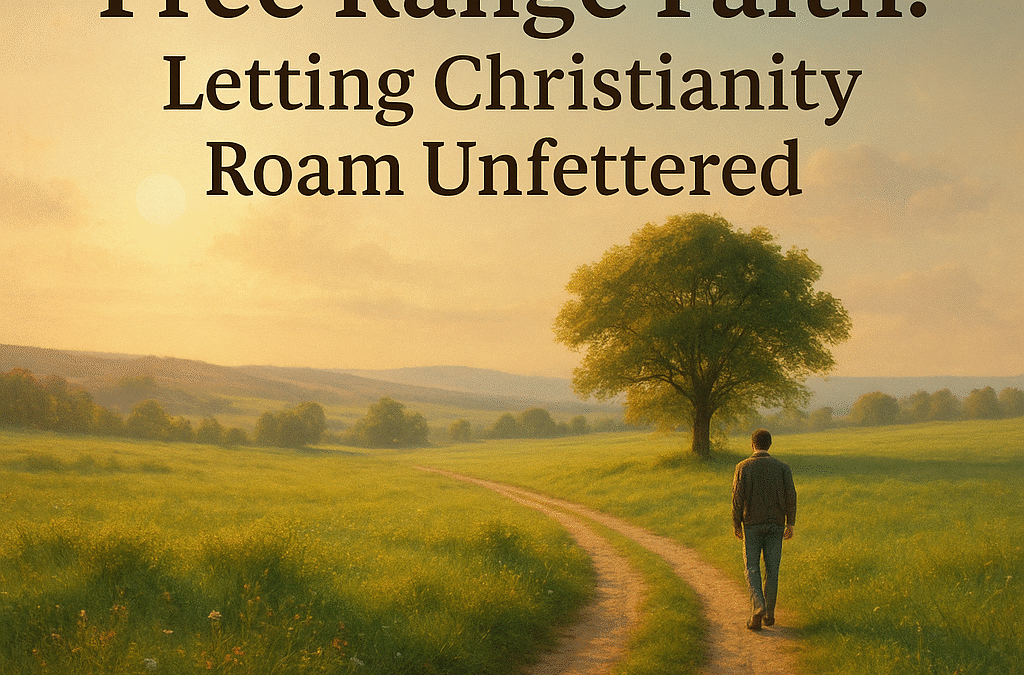
Free Range Faith: Roaming Beyond the Fences
Free Range Faith: Roaming Beyond the Fences
Free Range Faith: Letting Christianity Roam Unfettered
For many Christians, faith has long been defined within the walls of a church — Sunday services, familiar hymns, and established creeds shaping their spiritual lives. But there is a growing number of believers who are gently stepping beyond those walls. Not out of rebellion, but out of a desire for something more authentic. They are part of a movement that practices what some have come to call Free Range Faith.
Free Range Faith untethers Christian belief from formal institutions and rigid denominational boundaries. It doesn’t dismiss the church — it reimagines it. This kind of faith doesn’t always come with a dedicated building, a pulpit, or a scheduled Sunday service. Instead, it grazes across biblical teaching, draws insight from varied traditions, and finds God’s fingerprints in philosophy, nature, music, laughter, tears, and shared meals with fellow seekers.
Those living out Free Range Faith often curate their own rhythms of devotion. One may begin the morning in prayerful solitude, spend the afternoon serving others in their community, and close the day immersed in the words of Jesus. Their worship may happen around campfires, over kitchen tables, or during long walks in the woods. The pasture is wide open, and the Shepherd is still near.
This kind of spiritual freedom comes with both beauty and challenge. Without a traditional congregation or clergy to lean on, the responsibility to grow spiritually rests heavily on the individual. Questions can linger longer. Community can be harder to find. Yet for many, the joy of discovering a faith that breathes and moves with real life is worth the effort.
And it’s important to say — Free Range Christians are not spiritual loners. They are still part of the Church — the true Church — the one that worships in spirit and in truth. They long for meaningful relationships, but those relationships are centered around the person of Jesus, not an institution. Their bonds are not built on shared bulletins or matching pews, but on shared burdens, honest prayer, and deep love for God.
As institutional attendance declines and people question old paradigms, Free Range Faith offers another way. It’s a path of listening to the Spirit within, marveling at God’s handiwork in creation, and walking out Jesus’ love in real, tangible ways. It’s flexible, deeply personal, and full of possibility.
For those who have felt stifled by manmade systems, yet still crave a life shaped by Christ, Free Range Faith gives permission to follow Him through open gates and unfamiliar paths. It’s not about wandering aimlessly — it’s about being led, daily, by the One who knows every pasture by name.