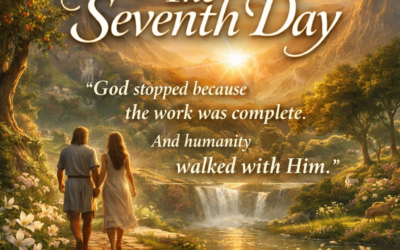

The Seventh Day

The Seventh Day

His-Story

The Seventh Day

Genesis 2:1–3
Listen to the Devotional
Press play below to listen to The Seventh Day.
“Thus the heavens and the earth were finished, and all the host of them. And on the seventh day God finished his work that he had done, and he rested on the seventh day from all his work that he had done. So God blessed the seventh day and made it holy…”
Genesis 2:1–3

Everything that was intended had now been spoken into being. Light and darkness had been separated. The sky stretched over the waters. Dry land appeared and brought forth life. Living creatures filled the seas and the air and the earth. Humanity was created intentionally, bearing the image of the One who made them. At each stage of creation, God saw what He had made and called it good, and at the completion of the sixth day, He declared it very good.

Then the story slows.

On the seventh day, God finished the work He had been doing, and He rested. This rest is not presented as recovery from fatigue, as though the Creator had reached the limits of His strength. Scripture consistently describes God as one who does not grow weary or faint.

“The everlasting God, the LORD, the Creator of the ends of the earth, does not faint or grow weary…”
Isaiah 40:28

The rest of the seventh day is about completion. The work that was intended had been brought to its full expression. Nothing had gone wrong. Nothing needed repair. Nothing was lacking. Creation was whole, ordered, and good.

God stops because the work is complete.

For six days the narrative has moved forward in a steady rhythm — evening and morning, evening and morning — each day unfolding in response to the voice of God. Now, for the first time, the movement pauses. God blesses the seventh day and sets it apart. The text tells us that God makes this day holy.

The first thing in scripture called holy is not a place, not a mountain, not a temple, not a ritual. The first thing called holy is time — a day set apart within the flow of human existence.

Rest appears in the story before anything has gone wrong. It exists before sin enters the world, before law, before religion, before humanity attempts to repair anything. Rest is not introduced as a remedy for brokenness, but as part of the goodness of creation itself.

Humanity does not begin in a state of pressure or demand. They awaken into a world already prepared for them, already declared good, already complete. Their first experience is not labor, but presence.

The text gives no indication that humanity’s first full day was spent building or producing or proving themselves. Instead, the narrative suggests something quieter and far more relational.

Humanity’s first full day was not spent working for God,
but walking with Him.

Later, the story describes God walking in the garden in the cool of the day.

“And they heard the sound of the LORD God walking in the garden in the cool of the day.”
Genesis 3:8

The language suggests familiarity, not interruption. The Creator present within His creation, near to the humans He has formed, sharing in what has been made.

Rest does not necessarily mean inactivity. Rest may instead describe unhindered relationship — time shared together within the goodness of creation. The seventh day reflects a world in which nothing stands between God and humanity. No fear. No shame. No hiding. No distance.

Before humanity ever does anything for God, they are with Him.

This order is foundational to the story that follows. The relationship does not begin with obligation, but with shared presence. Humanity is not first introduced as laborers, but as companions — invited to live within what God has made and to know the One who formed it.

From the beginning, God creates space to be with humanity.

There is something in the human heart that recognizes this kind of rest, even if we have never fully experienced it. We long for peace that is deeper than the absence of conflict. We long for a sense that things are as they should be. We long for a world where nothing is fractured and nothing threatens what is good.

More deeply still, we long for nearness — the kind of unhindered presence described in the opening pages of the story.

The seventh day reveals a world in which humanity walks with God without fear, without shame, without distance. A world in which nothing interrupts relationship. A world in which the Creator is not hidden, and humanity is not hiding.

Yet the story does not remain there.

The pages that follow describe distance, conflict, sorrow, and longing. Humanity experiences separation, and with that separation comes an awareness that something has been lost. Across generations, people continue to seek peace, security, meaning, and belonging, often without fully understanding why the desire runs so deep.

Scripture repeatedly speaks of a future restoration that echoes the beginning of the story.

“They shall not hurt or destroy in all my holy mountain.”
Isaiah 11:9
“He will swallow up death forever; and the Lord GOD will wipe away tears from all faces.”
Isaiah 25:8

Jesus speaks to the thief beside Him using the language of paradise:

“Today you will be with me in paradise.”
Luke 23:43

Revelation makes the connection unmistakable:

“To the one who conquers I will grant to eat of the tree of life, which is in the paradise of God.”
Revelation 2:7

The final pages of scripture return again to the imagery of shared presence:

“Behold, the dwelling place of God is with man. He will dwell with them, and they will be his people.”
Revelation 21:3
“Then the angel showed me the river of the water of life… also, on either side of the river, the tree of life.”
Revelation 22:1–2
“No longer will there be anything accursed… they will see his face.”
Revelation 22:3–4

The story that begins with God present among humanity ends with God present among humanity.

The longing many people feel for peace, for wholeness, for belonging, reflects both a memory of what was lost and a quiet awareness that the story is not yet finished.

Scripture points forward to a restoration in which nothing separates humanity from the presence of God. Not merely a return to a place, but a return to unhindered relationship. Not only the beauty of creation restored, but the nearness of the Creator known again.

The seventh day reminds us that rest is not merely the absence of work.
Rest is the presence of God within what He has made.

The story begins with shared rest.

And scripture closes with the promise that this rest will one day be fully known again.

📜 Pass This Along
We were created to walk with Him.
The story of Scripture begins with rest, not striving — with God present, and humanity unashamed.

If this story helped you see Genesis differently, consider sharing it with someone who may need to remember that our deepest longing is not just for a better world… but for His presence.
Facebook X
https://www.gentlemanoutlaw.com/the-seventh-day/
When God Speaks Into Chaos

When God Speaks Into Chaos

HIS-STORY

When God Speaks Into Chaos


“In the beginning, God created the heavens and the earth.”
— Genesis 1:1

The story begins, not with humanity, not with conflict, not with chaos — but with God.

Before anything exists, God is already there.

Scripture does not attempt to prove God’s existence. It simply introduces Him. The foundation of the biblical story is not argument, but revelation.

God is.

Everything begins with Him.

“The earth was without form and void, and darkness was over the face of the deep.”
— Genesis 1:2

The opening scene is not yet peaceful or ordered. The earth is described as unformed and unfilled — not broken, but unfinished. The Hebrew words suggest a world not yet prepared for life, waiting to be shaped and filled with purpose.

Yet God is not absent from this moment.

Even before light appears, the Spirit of God is present, hovering over the deep. Darkness does not prevent His presence. The first movement in the biblical story is not distance, but nearness. God does not withdraw from what is unformed. He moves toward it.

“And the Spirit of God was hovering over the face of the waters.”
— Genesis 1:2

The word hovering is not mechanical language. It is used elsewhere to describe a bird caring for its young:

“Like an eagle that stirs up its nest and hovers over its young…”
— Deuteronomy 32:11

The image is gentle, intimate, and intentional — not violent, not chaotic, but purposeful. Before anything is shaped or filled, God draws near to what is not yet ready for life.

Then God speaks.

“And God said, ‘Let there be light,’ and there was light.”
— Genesis 1:3

Light enters darkness, and order begins to emerge.

“And God saw that the light was good.”
— Genesis 1:4

The story now moves forward in a steady rhythm. God speaks, creation responds, and God observes what He has made. Again and again, the text tells us that what God forms is good — as though the repetition itself is inviting us to notice the character of the One creating.

He separates light from darkness. He forms sky and sea. He gathers waters so that dry ground appears. He fills the earth with living things — vegetation, creatures of the sea, creatures of the air, creatures of the land. Life begins to flourish in every direction.

Each step brings greater harmony, greater fullness, greater beauty.

And each time, God sees what He has made and calls it good.

Creation is not presented as accidental. It is not described as reluctant. It is not described as flawed.

It is described as good.

Again and again.

Scripture also marks the passage of time in a simple and consistent way:

“And there was evening, and there was morning — the first day.”
— Genesis 1:5

The same pattern continues through each stage of creation: evening and morning, the second day… evening and morning, the third day… until six days unfold in an ordered sequence, just as the text describes. The narrative does not rush. It allows the reader to watch as what was once unformed becomes structured, and what was once empty becomes filled with life.

Creation unfolds purposefully and completely.

Then something unique happens.

God creates humanity.

“Let us make man in our image, after our likeness.”
— Genesis 1:26

Humanity is not introduced as an accident of nature or an afterthought of creation. Humanity is presented as intentional and relational, created in the image of the One who brings order, speaks life, and calls creation good.

The story reaches its first great conclusion:

“And God saw everything that He had made, and behold, it was very good.”
— Genesis 1:31

Very good.

Not merely functional.

Not merely adequate.

Very good.

The biblical story begins with goodness.

Before failure enters the story… before fear enters the story… before shame enters the story… Scripture introduces us to a Creator who moves toward what is unformed and fills what is empty with life.

The foundation of the story is not humanity reaching toward God, but God moving toward creation — bringing light into darkness, peace into disorder, and life where there had been none.


The beginning reveals something essential about the heart of the One telling the story.

And the story has only just begun.

📜 Pass This Along
What kind of Creator
moves toward chaos?
If this story helped you see Genesis differently, consider sharing it with someone who may need to be reminded that the biblical story begins, not with fear or failure, but with God.
Facebook X
The Lamb at the Door

The Lamb at the Door

The Lamb at the Door

HIS-STORY

The Lamb at the Door


For generations, the people of Israel had lived in Egypt. What began as refuge in the days of Joseph slowly became oppression. A new Pharaoh arose who did not remember Joseph, and fear began to shape the policies of the empire. Israel continued to grow numerous, and Egypt began to feel threatened by their presence.

“The Egyptians made the Israelites serve with rigor… they made their lives bitter with hard service.”
— Exodus 1:13–14

God was not distant from their suffering. Scripture tells us that He heard, remembered, saw, and knew. Their affliction was not unnoticed, and their cries were not ignored.

“God heard their groaning, and God remembered His covenant… God saw the people… and God knew.”
— Exodus 2:24–25

Through Moses, God confronted Pharaoh again and again. The plagues revealed that the powers Egypt trusted were not ultimate. The empire that claimed control over life itself could not hold back the purposes of the One who sees, hears, and remembers.

Then the story slows to a single night.

A specific instruction is given — not merely to the nation as a whole, but to each household.

“On the tenth day of this month every man shall take for himself a lamb… a lamb for a household.”
— Exodus 12:3

This was not a distant national ceremony. It was something that entered directly into family life. The lamb was brought into the home and kept there for several days.

“You shall keep it until the fourteenth day of the same month.”
— Exodus 12:6

Scripture is very deliberate in describing the lamb:

“Your lamb shall be without blemish, a male of the first year.”
— Exodus 12:5

A young lamb. Healthy. Unscarred. Whole.

Lambs are gentle animals — soft, clean, and naturally trusting. In a household, such a creature would not remain unnoticed. Children would see it, touch it, feed it. Something that depends on your care seldom remains distant.

Over the course of several days, attachment forms quietly. We care for what we welcome into our home. We grow fond of what we care for.

The lamb had done nothing wrong. Yet the day would come when the lamb would be killed — not because it was guilty, but because deliverance was drawing near.

Then another instruction is given:

“They shall take some of the blood and put it on the two doorposts and on the lintel of the houses in which they eat it.”
— Exodus 12:7

The blood is not placed on an altar. It is not carried into a temple. It is placed on the doorway of the home — visible, public, marking the household.

Scripture describes the meaning in very specific words:

“The blood shall be a sign for you on the houses where you are.”
— Exodus 12:13

A sign for the people. A visible covering placed upon the home in the middle of uncertainty.

That night, each family remained inside the marked house. They ate together. They waited together. They trusted the God who had promised deliverance.

“For I will pass through the land of Egypt that night… and when I see the blood, I will pass over you.”
— Exodus 12:12–13

Deliverance did not come because the people were strong, deserving, or without failure. Deliverance came because God chose to act.

Bondage was ending. Movement was beginning.

And then God gave an instruction that may be just as important as the event itself — the story was not to be forgotten.

“This day shall be for you a memorial day… you shall keep it as a feast to the Lord throughout your generations.”
— Exodus 12:14
“You shall observe this thing as an ordinance for you and your sons forever.”
— Exodus 12:24

God anticipated the questions children would ask.

“When your children say to you, ‘What do you mean by this service?’ you shall say…”
— Exodus 12:26–27

The story was meant to be told again and again. Parents explaining to children why this night mattered, why the lamb mattered, why the household was marked, why deliverance was remembered.

Year after year, the story lived in the memory of the people.

More than a thousand years would pass. Empires would rise and fall. Generations would come and go. Yet the story remained.

The lamb.
The household.
The covering.
The deliverance.

For centuries, families continued telling this story.

Then one day, John the Baptist sees Jesus and says:

“Behold, the Lamb of God who takes away the sin of the world.”
— John 1:29

The echo is difficult to miss. Long before anyone spoke the name of Jesus, the pattern was already present — a lamb brought into the household, a visible covering, a night of deliverance.

The Passover story reveals something essential about the character of God. God sees people in bondage. God moves toward them. God provides a way for households to know they are not abandoned. God forms a people who will remember His deliverance.

And the story was meant to be told.

Again and again.

Do we still tell this story?

Not only the cross, but the story that shaped the language Jesus used to explain Himself?

Do we still tell the story of the lamb brought into the home… known… cared for… and given on the night deliverance came?


God said the story should be remembered.

The story is not only about one night in Egypt.

It is part of a much larger story.

And that story continues.

📜 Pass This Along
Do we still tell this story?
If this story helped you see the Lamb more clearly, consider sharing it with someone who may never have heard it told this way. The story was meant to be remembered — again and again.
https://www.gentlemanoutlaw.com/