Who Told You That You Were Naked?
Listen to the Devotional
Press play to listen, or download audio (MP3).
There is something deeply haunting about the next words spoken in the garden.
Last week, humanity hid among the trees while the voice of God walked through the cool of the evening calling, “Where are you?”
Now the story moves deeper still.
Adam finally answers the voice:
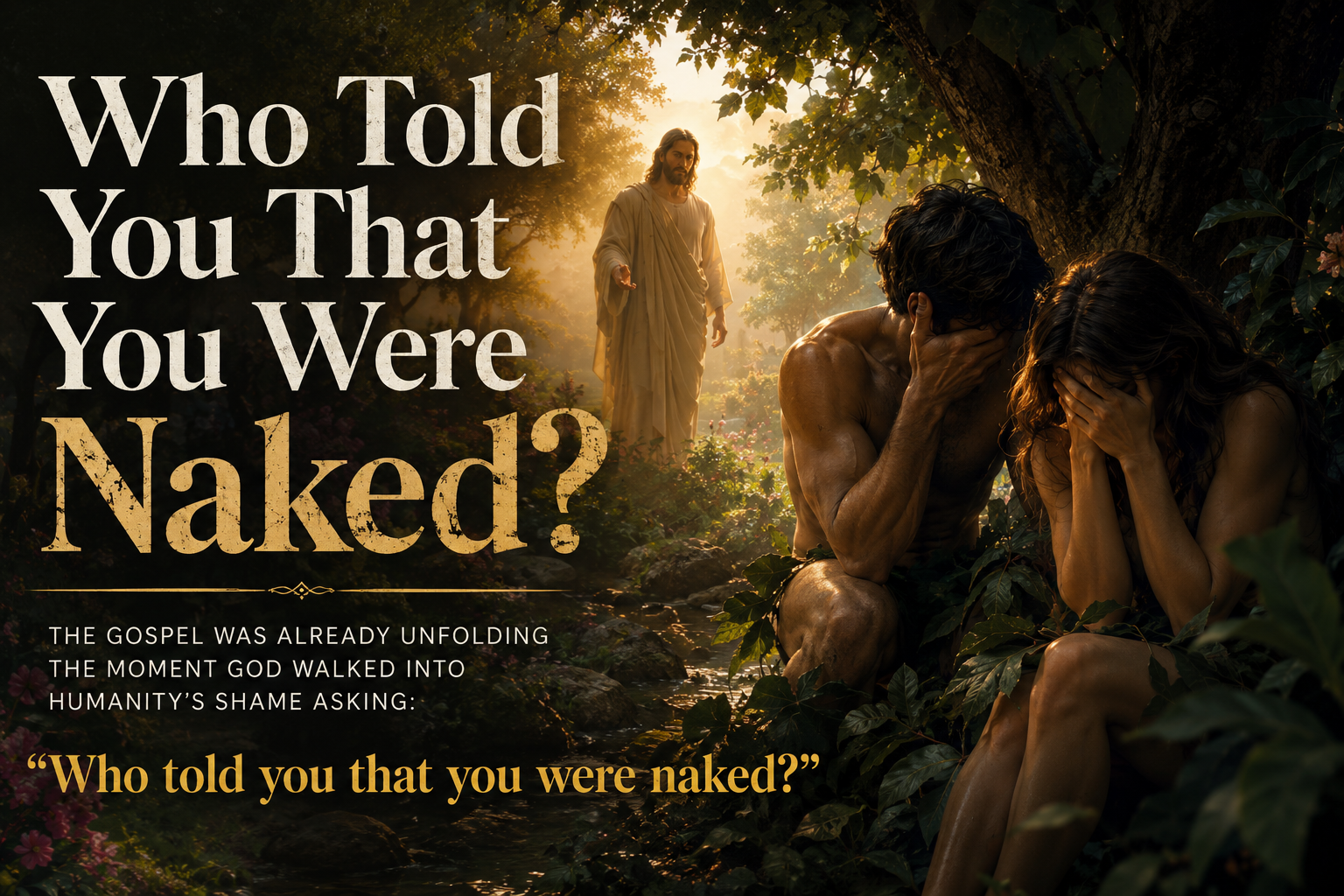
“I heard Your voice in the garden, and I was afraid because I was naked; so I hid myself.”
And He said,
“Who told you that you were naked? Have you eaten from the tree from which I commanded you not to eat?”
Genesis 3:10–11
That question may be one of the most profound questions in all of Scripture.
Not, “What have you done?”
But:
“Who told you that...?”
And perhaps this is where modern western readers often miss the depth of the story. Yes, Adam and Eve were literally naked. The story is real. But ancient Hebrew thought often carried layers of meaning inside physical realities. The nakedness in the garden is clearly more than exposed skin. Suddenly humanity feels exposed, vulnerable, ashamed, unsafe, self-conscious, and afraid.
Something inside humanity has shattered.
Before this moment, they stood fully open before God and one another without fear. Now humanity hides.
And perhaps we have been hiding ever since.
Because the question still echoes through every human heart alive today.
Who told you:
you are not enough?
you are unwanted?
you are ugly?
you are too broken?
you are beyond redemption?
that your failures define you?
that God is disappointed in you?
Shame makes humans cover themselves even from the people who love them most. It teaches us to hide parts of ourselves, protect ourselves, explain ourselves, and fear being truly seen.
Then Adam responds:
“The woman whom YOU gave to be with me, she gave me from the tree, and I ate.”
Genesis 3:12
For years I heard this preached almost entirely as blame toward Eve. Perhaps there is some truth in that. But there may be something even deeper happening here.
Notice the weight of Adam’s words:
“The woman whom YOU gave me…”
Something has fractured inside humanity’s trust toward God Himself.
Adam sounds almost like a terrified human being trying desperately to explain the unbearable condition he now finds himself in. Almost, “God… this happened through what You gave me.”
And honestly, is that not still the human story?
“God, why did You allow this?”
“Why did this happen to me?”
“Why does my life feel broken?”
“Why do I feel so lost?”
The fracture is no longer merely internal.
Humanity has begun suspecting the goodness of God Himself.
That may be the deepest poison the serpent introduced into the human story.
Not merely disobedience.
Distrust.
Because the story in the garden is not merely about sin entering humanity. It is about a lie entering humanity — a lie about God, ourselves, love, shame, and belonging.
The serpent did not merely tempt humanity to disobey.
The serpent taught humanity to distrust.
And suddenly Adam and Eve no longer know how to stand exposed before Love without fear.
That is devastating.
Scripture echoes this story again and again. David cries in Psalm 139:
“Where can I flee from Your presence?”
Yet even there, God is still near.
Isaiah speaks of the coming Messiah who would bind up the brokenhearted. Jesus later opens that scroll and declares those words fulfilled in Himself. And when Jesus says:
“You shall know the truth, and the truth shall make you free,”
perhaps He is speaking into the very lie humanity first believed in the garden.
Because humanity’s deepest wound may not be sinful behavior alone.
It may be the lie now living inside the human heart.
And the heartbreaking thing is that God is still there speaking gently through questions. Humanity is unraveling internally while God is still patiently drawing truth out of them.
He does not abandon humanity in shame.
He pursues humanity through it.
The questions themselves feel like mercy.
Because God is not merely exposing sin.
He is exposing the lie now living inside humanity.
And perhaps this is where the Gospel story has been unfolding from the very beginning.
The Gospel did not begin when Jesus was born in Bethlehem.
The Gospel was already unfolding the moment God walked into humanity’s shame asking:
“Who told you that you were naked?”
The God who walked through the garden is the same God later born in a manger, the same God nailed to a cross, the same God who rose again on the third day.
The Gospel is not merely the forgiveness of sin.
It is the healing of humanity from the lie that made us hide from God.
Healing the fear.
Healing the shame.
Healing the distrust.
Healing the fracture inside the human heart.
As John later writes:
“Perfect love casts out fear.”
1 John 4:18
Fear entered the garden.
Love came walking after us.
The serpent’s voice still whispers lies today:
you are abandoned,
you are unsafe in love,
you must hide,
you are no longer wanted by God.
But another voice still walks through the garden as well.
A voice still calling.
Still pursuing.
Still healing.
Still asking every human heart:
“Who told you that you were naked?”
A Song for This Reflection
My son, Ryan Rush, wrote a song to accompany this week’s reflection, carrying the heart of the story through music.
After sitting with the question, “Who told you that you were naked?” take a few quiet moments to listen.
You can also listen on Spotify:

I love this devotional! A message I have never heard, and the song was beautiful!!!
Thank You. That’s encouraging