Where Are You?

Where Are You?

Where Are You?

There may be no story in Scripture more deeply human than the story unfolding in the garden.

Not because it explains ancient history.

But because it explains us.

Every human being who has ever lived knows what it feels like to hide. To fear exposure. To cover ourselves. To wonder if we could still be loved if we were truly seen.

And perhaps that is why the next movement in Genesis becomes one of the most profound moments in all of Scripture — a moment that quietly sets the stage for the entire gospel story.

“And when the woman saw that the tree was good for food, and that it was pleasant to the eyes… she took of its fruit and ate, and also gave some to her husband who was with her, and he ate.

Then the eyes of both were opened…”

— Genesis 3:6-7

The story changes in a single moment. The fruit is taken. Adam receives it. And suddenly humanity sees differently.

But the text does not say humanity suddenly became evil. It says their eyes were opened. And the very first thing humanity becomes aware of is shame.

“And they knew that they were naked…”

That line is far deeper than it first appears. The first fracture in the human story is not violence, hatred, or murder.

It is shame.

Exposure. Self-consciousness. Fear.

And what is humanity’s first response after shame enters the story?

Hiding.

“They sewed fig leaves together and made coverings for themselves.”

Humanity begins covering itself, and we have been doing it ever since.

Perhaps you know this feeling — the exhausting effort of trying to hold yourself together while quietly fearing that if anyone truly saw you, they might turn away.

Humanity has been hiding among the trees ever since. Some hide behind religion, success, endless good works, wealth, knowledge, addiction, lust, humor, anger, or carefully crafted images of themselves. Some hide so deeply in shame that they begin destroying themselves entirely.

But beneath all of it is often the same ancient fear:

“If I am fully seen… will I still be loved?”

And yet the next movement in the story changes everything.

“And they heard the voice of Yahweh God walking in the garden in the cool of the day…”

— Genesis 3:8

Notice carefully what the story does not say.

It does not say God withdrew from humanity.

It says humanity hid from God.

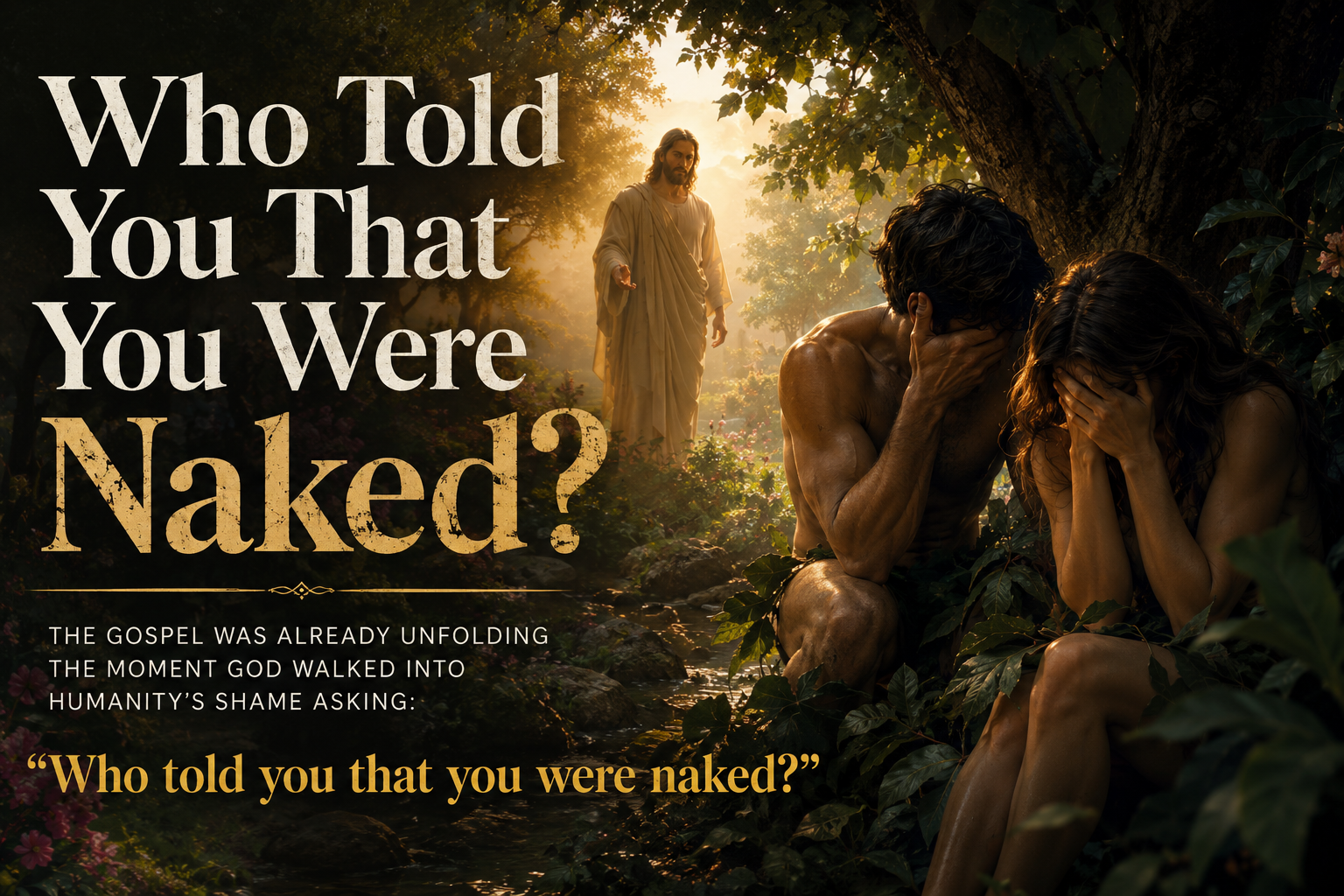
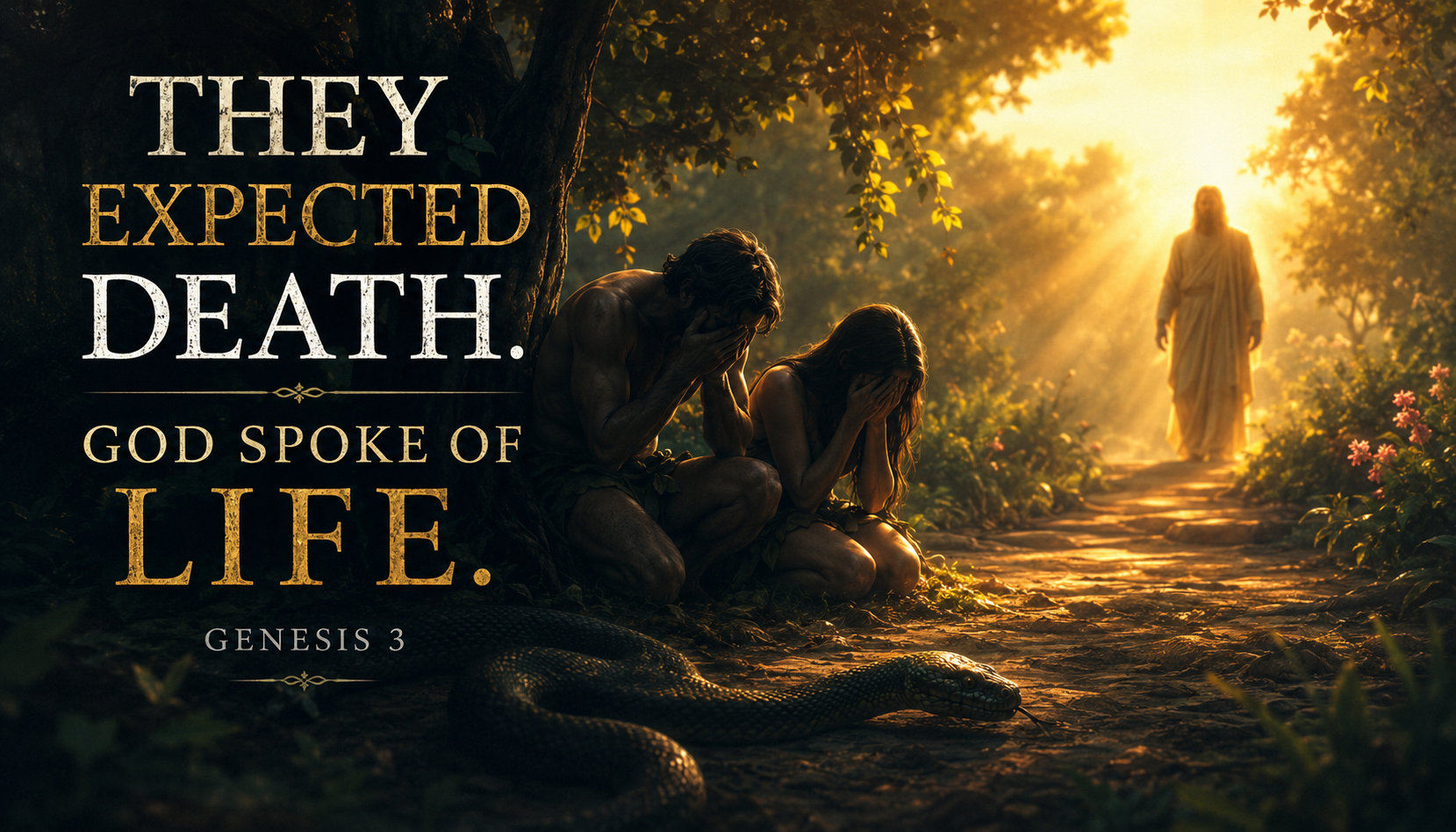
Adam and Eve are hiding among the trees, covering themselves, terrified and ashamed. And God comes walking toward them.

Not away from them.

Toward them.

And yet, something fascinating happens in the story. God had warned:

“In the day you eat of it you shall surely die.”

— Genesis 2:17

And yet after the fruit is taken, God still comes walking through the garden calling for them. The relationship is fractured. Shame has entered. Fear has awakened.

But the voice still comes.

They recognized the voice immediately. This was not the approach of a stranger. This was the voice they had always known.

The voice approaching them is not the source of shame —
it is the answer to it.

And then comes one of the most heartbreaking and beautiful questions in all of Scripture:

“Where are you?”

— Genesis 3:9

Not accusation.

Not condemnation.

Not rejection.

It was the voice of love crying out for the beloved.

The beloved were hiding from Love itself.

“Where are you?”

Not because God lacked information, but because relationship had been fractured. God was not walking through the garden searching for strangers. He was calling for the ones He loved.

And Adam answers with words that still echo through every human soul:

“I was afraid… so I hid.”

— Genesis 3:10

Fear enters the relationship.

Not because God changed.

But because humanity’s perception became fractured through shame.

And perhaps this is still the tragedy of mankind. Not merely that we sin, but that shame drives us away from the very presence that can heal us.

The deepest human problem was never merely sin itself. It was that shame taught humanity to run from the very God who was still calling for them.

That is the fracture.

Not merely that Adam ate the fruit —
but that Adam hid from the One who loved him.

Which means the very presence Adam fears…
is actually the only place healing can be found.

And perhaps that is still the great tragedy of humanity. Not merely that we fail, but that we continue hiding from the One who is still pursuing us.

Religion often unknowingly reinforces this hiding. It tells people to clean themselves first, fix themselves first, become worthy first, stop failing first, and then come to God.

But the garden reveals the opposite movement.

God comes walking into humanity’s failure. God moves toward the hiding humans. God calls before Adam ever speaks a word of repentance.

The voice comes first.

The calling comes first.

The pursuit comes first.

This is not merely Adam’s story.

It is ours.

The serpent’s voice still whispers: hide, cover yourself, withdraw, you are no longer safe in love. And humanity still listens.

Yet through all of history, another voice continues to call. Not the voice of shame. Not the voice of accusation. Not the voice of the serpent.

The voice walking in the garden.

Calling.

Seeking.

Pursuing.

And this is where the story becomes almost too beautiful for words.

Because the God calling through the trees eventually steps directly into the very condition humanity entered in the garden.

“He made Him who knew no sin to be sin for us, that we might become the righteousness of God in Him.”

— 2 Corinthians 5:21

At some point theology gives way to awe.

Because what kind of God does this?

The God walking through the garden eventually allows Himself to be stripped naked before humanity. Mocked. Rejected. Shamed publicly.

Adam hides his nakedness.

Christ bears nakedness publicly.

Adam hides among the trees.

Christ is lifted upon a tree.

Adam runs from God in shame.

God enters shame Himself to bring Adam home again.

The cross was not God finally deciding to love humanity. It was the fullest revelation of the love that had already been pursuing humanity since the garden.

The deepest tragedy in the garden was not merely that humanity sinned.

It was that humanity became afraid of the One who loved them most.

And still He comes.

Still calling.

Still pursuing.

Still loving.

“Looking unto Jesus the author and finisher of our faith; who for the joy that was set before Him endured the cross, despising the shame…”

— Hebrews 12:2

Not merely the pain.

The shame.

Because shame is unbearable to the human soul. It tells us to hide ourselves, cover ourselves, withdraw, and believe we are no longer safe in love.

But Jesus entered directly into humanity’s shame in order to destroy its hold. To open the way home again. To reveal that the voice in the garden was never our enemy.

It was always the voice of the Father calling His children home.

Sin did not cause God to abandon humanity.

Sin caused humanity to hide from God.

Yet even then, the voice still walked through the garden.

Still calling.

Still pursuing.

Still loving.

The question is no longer whether God is willing to come near.

The question is:

will we continue hiding among the trees…

or will we finally answer the voice calling our name?

Because perhaps salvation is, at least in part, the moment a human finally stops hiding long enough to answer the voice calling in the garden.

A Song for This Week’s Reflection

My son wrote a song to go along with this week’s blog, and I believe it beautifully carries the heart of this reflection.

After sitting with the story of the garden, shame, hiding, and the voice of God still calling, this song offers another way to pause and listen.

I invite you to take a few minutes, quiet your heart, and listen.

The Wrong Voice

The Wrong Voice

The Wrong Voice

Until this moment in the story, only one voice has shaped the world.

God speaks, and light appears. God speaks, and the waters divide. God speaks, and the earth brings forth life. Everything in creation responds naturally to His voice. His words bring order, beauty, life, and abundance.

Humanity itself begins this way.

“The LORD God formed man of the dust of the ground, and breathed into his nostrils the breath of life; and man became a living being.”
— Genesis 2:7

The man and the woman live within a world formed by the voice of God. The garden has been prepared for them. Food is abundant. Relationship is whole. They are naked and unashamed, living openly in the presence of the One who made them.

Even the command God gives is surrounded by generosity.

“And the LORD God commanded the man, saying, ‘Of every tree of the garden you may freely eat; but of the tree of the knowledge of good and evil you shall not eat…’”
— Genesis 2:16–17

The command itself begins with abundance.

Of every tree… freely eat.

The voice of God is not restrictive by nature. It is life-giving, generous, and overflowing with provision. The garden is already full before the serpent ever speaks.

And then, another voice enters the story.

“Now the serpent was more cunning than any beast of the field which the LORD God had made. And he said to the woman, ‘Has God indeed said, “You shall not eat of every tree of the garden”?’”
— Genesis 3:1

The story itself warns us immediately about the nature of this voice. The serpent is described as “more cunning” than the other creatures. Crafty. Subtle. Careful. He does not openly attack God at first. He slowly introduces suspicion, reframes the conversation, and invites the human heart to reconsider what God has said.

The question almost feels harmless at first.

But notice what the serpent does. God had spoken about abundance.

Of every tree… freely eat.

The serpent shifts the focus toward restriction.

“Has God indeed said…?”

The conversation itself becomes the temptation. Before any fruit is taken, another voice has already begun reshaping the way humanity sees God.

The woman answers:

“We may eat the fruit of the trees of the garden; but of the fruit of the tree which is in the midst of the garden, God has said, ‘You shall not eat it, nor shall you touch it, lest you die.’”
— Genesis 3:2–3

It is interesting that God never said anything about touching the tree. The command had already begun to shift in the human mind. The story quietly shows how easily the voice of God can become distorted once another voice enters the conversation.

Then the serpent responds:

“You will not surely die. For God knows that in the day you eat of it your eyes will be opened, and you will be like God, knowing good and evil.”
— Genesis 3:4–5

These words are unsettling because they are not entirely false.

Later in the story, their eyes are opened. They do come to know good and evil. And they do not immediately fall lifeless beneath the tree.

That tension has troubled readers for thousands of years.

But perhaps that is exactly the point.

Deception does not always arrive as an obvious lie. Sometimes it comes wrapped in partial truth, spoken by the wrong voice.

The words contained enough truth to sound believable… but the voice behind them was leading away from trust in God.

The serpent’s words slowly reshape the way the woman sees God. The suggestion is subtle, but powerful:

Maybe God is withholding something good.
Maybe His command cannot be fully trusted.
Maybe fullness, wisdom, or life can be found somewhere outside of Him.

And that is where the fracture truly begins.

The issue in the garden is not merely information. It is trust.

Up to this point, humanity has received everything from the voice of God:

- life,
- provision,
- relationship,
- purpose,
- and belonging.

But now another voice enters the relationship and invites humanity to reinterpret reality itself.

That struggle has never really left us.

Most of the destructive voices in our lives do not appear as obvious evil. They often sound reasonable. Sometimes they even contain fragments of truth.

“You are not enough.”
“You must prove yourself.”
“God is disappointed in you.”
“You need something more.”
“You cannot fully trust Him.”
“Life will finally begin when…”

The voices may change, but the question underneath them often remains the same:

Can God really be trusted?

And if His voice no longer defines us, then something else will.

Fear.
Shame.
Performance.
Desire.
Pride.
Insecurity.

Which leaves humanity wrestling with another question:

Who does God say that I am… and who do I believe that I am?

This is why the words of Jesus later in Scripture feel so important:

“Man shall not live by bread alone, but by every word that proceeds from the mouth of God.”
— Matthew 4:4

Humanity was never created to live merely by knowledge, desire, instinct, or even things that sound true. We were created to live by the voice of God.

Jesus Himself faces this same battle in the wilderness. Another voice again offers food, power, and fulfillment apart from trust in the Father. Yet where humanity first listened to another voice, Jesus answers by returning again and again to the words of God.

“My sheep hear My voice, and I know them, and they follow Me.”
— John 10:27
“Every good gift and every perfect gift is from above…”
— James 1:17

The story in the garden is not merely about a forbidden tree long ago. It is about the ongoing struggle of the human heart. Every day we live among competing voices trying to tell us:

- who God is,
- who we are,
- what will satisfy us,
- and where life is truly found.

The question in the garden was never merely about fruit.

It was about whose voice would define reality.

And before hands ever reached for the tree, another voice had already begun to shape the human heart.

It does not have to be a complete lie to lead us away from life. It only has to become the voice we trust more than God’s.

And that raises a difficult question:

What voices have quietly taught us how to see God… and ourselves?

The Man, The Woman, The Union

The Man, The Woman, The Union

The Man, The Woman, The Union

Up to this point, everything in the story has been declared good. The world has been formed, life has been given, and man has been placed within a garden that lacks nothing. There is provision, purpose, and the presence of God.

And then, for the first time, something is not.

“It is not good that man should be alone.”
— Genesis 2:18

This is not a flaw in creation, but a revelation. The man is alive. He is in a perfect environment. He is in relationship with God. And yet, something essential is still missing. This is striking, because it means that even in a perfect world, with every need provided and with God Himself present, something essential was still missing. Humanity was not designed to live alone.

The text does not rush past this. Instead, it allows the man to experience it. The animals are brought before him, and he names them. He observes them, interacts with them, and in doing so, something becomes clear.

“But for Adam there was not found a helper suitable for him.”
— Genesis 2:20

The word used here—helper—has often been misunderstood. It does not suggest something lesser or secondary. In many places throughout Scripture, this same word is used to describe God Himself as the one who comes to the aid of His people.

“Our help is in the name of the LORD…”
— Psalm 124:8

The same word used to describe God’s help is used here. This is not a role of weakness, but one of strength. It speaks of something necessary, something that supplies what is lacking. The idea is not simply assistance, but something deeper—someone who truly fits him. Not the same, but not separate. Someone who meets him as an equal, able to connect with him in a way that nothing else in creation could.

So God does something that has not yet been seen in the story.

“The LORD God caused a deep sleep to fall on Adam… and He took one of his ribs, and closed up the flesh in its place. Then the rib which the LORD God had taken from man He made into a woman, and He brought her to the man.”
— Genesis 2:21–22

The word often translated as “rib” carries a broader meaning. It refers to a side, a part taken from within, not something created separately from the dust as the man was. The woman is not formed independently and then introduced. She is taken from him and then returned to him.

The imagery is deliberate. She is not taken from above him or below him, but from his side—to stand with him, to walk with him, and to share life with him. Not the same, but not separate. Distinct, yet designed to belong together.

When the man sees her, his response is immediate.

“This is now bone of my bones and flesh of my flesh…”
— Genesis 2:23

He does not analyze. He does not question. He recognizes. Something in him responds immediately—this is what had been missing.

The text then gives a statement that reaches beyond this moment.

“Therefore a man shall leave his father and mother and be joined to his wife, and they shall become one flesh.”
— Genesis 2:24

This is often reduced to a physical moment between a man and a woman, but the language points to something far more. The union begins in a moment, but it does not end there. It unfolds over time. Two lives, once separate, begin to share everything—memory, experience, joy, pain, and the quiet rhythms of life together.

Over years, even decades, two lives become deeply intertwined. What begins as two gradually becomes something that cannot be easily separated. This is not the loss of identity, but the formation of a shared life.

The story closes this section with a statement that is easy to read past, but carries enormous weight.

“And they were both naked, the man and his wife, and were not ashamed.”
— Genesis 2:25

This is more than a physical description. It is a picture of complete openness. There is nothing to hide and nothing to protect. They are fully seen, fully known, and completely at ease with one another.

Their physical nakedness is not awkward or exposed. It is natural, unguarded, and without fear.

To be that open, and not feel the need to cover… to be fully known, and feel no shame—this is something most people long for, but rarely experience. It is the kind of openness we were created for, but now rarely know.

This is the foundation of the relationship that has just been established. Trust, unity, openness—nothing between them, and nothing within them that needs to be concealed.

The story has now reached a place of completion. What was “not good” has been resolved. The man is no longer alone. Humanity is now expressed in relationship, not isolation.

And yet, as the narrative continues, this moment becomes even more significant—not only for what it reveals, but for what will soon be tested.

What has been formed here is not fragile… but it is about to be disrupted.

What has been established is not merely companionship. It is a picture of what humanity was meant to be—living in unity, without shame, in the presence of God.

The next chapter will not introduce something entirely new.

It will fracture something that was deeply good.

📜 Pass This Along

What if “not good” was never about failure?

If this story helped you see Genesis differently, consider sharing it with someone who may need to be reminded that humanity was created for relationship, unity, and life without shame.

Facebook X

https://www.gentlemanoutlaw.com/the-man-the-woman-the-union/