Abba – Father!

Abba – Father!

Abba – Father!

The Cry “Abba”

When longing learns a word.

Based on Russell & Maria Moore’s adoption trip and the force of the word Abba (Galatians 4:6).

T he orphanage was quiet — too quiet. Not the stillness of peace, but the silence of children who had stopped believing anyone would come.

Russell and Maria had traveled halfway around the world to meet the two little boys who might soon become their sons. Behind gray walls and iron gates, they were led down echoing halls to a small room filled with metal cribs. The smell of disinfectant lingered in the air. Small faces peered through the bars — not curious, not playful, just waiting.

When they first saw him — a thin little boy with wide eyes — Maria reached down, and he didn’t pull away. She gathered him into her arms and whispered his name. He didn’t speak, didn’t cry. He just leaned into her warmth as if trying to remember what love felt like.

They played on the worn linoleum floor, stacking blocks and tickling tiny toes. For the first time in who knows how long, a faint laugh escaped his lips — quick, uncertain, but real. Russell lifted him high into the air, and the boy smiled. For hours, they held him, fed him, kissed the top of his head. It was as if their hearts had known him forever.

But every visit had to end.

On the final day before returning home, they knew what awaited — that long walk down the corridor, the sound of the door locking behind them, the echo of their own footsteps leaving him behind. They promised they’d return. They said it over and over. But how do you explain paperwork, visas, and government waiting to a child who’s only just discovered love?

When they turned to go, something inside Maria broke. She looked back one more time — just once more — and saw him standing in the crib, his knuckles white around the cold metal bars. His lips trembled, his eyes wide and wet, searching for her face as if memorizing it before it disappeared forever.

Russell’s hand tightened around hers. Neither of them could breathe. The air felt thick — too heavy to swallow. They tried to smile, to wave, to whisper that they’d come back soon. But their words fell flat in the sterile air.

Then it happened. The boy’s mouth opened, and from the hollow silence of that room came a sound no one had ever heard there before — a raw, broken scream that seemed to tear the walls apart. It wasn’t just crying; it was grief, it was fear, it was love that had awakened and didn’t know how to live without them.

His cry filled the hallway, echoing off the tile and chasing them down the corridor. Maria pressed a hand to her chest, wanting to run back — to hold him, to promise he’d never be alone again. But she couldn’t. Not yet.

“Abba!”

The word carried everything — longing, terror, hope, and recognition. It was the sound of a heart that had just learned it was loved… and could not bear to lose it.

Later, Russell wrote, “That was the moment I finally understood what Paul meant — when the Spirit cries out in us, ‘Abba, Father.’”

“Abba” isn’t a gentle nickname like “Daddy.” It’s the cry of a soul that’s been found — the cry that says, Don’t leave me. I’m yours now.

When that little boy screamed “Abba,” he wasn’t performing theology — he was revealing it. And in his cry, we hear our own — the echo of our hearts when we finally believe that Love has come for us, and will never walk away again.

Abba.


📎 Respond:

Take two minutes in quiet. Put a hand over your heart and pray the simplest prayer: “Abba, I’m yours.” If grief rises, let it. That ache is often where love is finally heard.

Share your “Abba” moment

Story adapted from Russell & Maria Moore’s adoption reflections; used here to illuminate the Scriptural “Abba” cry (Gal. 4:6; cf. Rom. 8:15).

When God Looks Angry

When God Looks Angry

When God Looks Angry

When God Looks Angry

🕯️ Sitting with the hard stories until love comes into focus

There are parts of the Bible that stop us cold. Stories that leave a lump in the throat and a question we don’t dare say out loud: How could a loving God do that?

  • A flood that drowns the world 🌊
  • Cities reduced to ash 🧱🔥
  • Entire nations—men, women, children, even animals—wiped from the earth ⚔️

If you’ve ever read those passages and felt sick or confused, you’re not faithless. You’re human.

These are not simple stories. They are stories of horror, grief, and judgment. They tell of a God who seems, at times, terrifyingly severe. And if we’re honest, we don’t know what to do with that.

Don’t rush to fix it. Sit with it. Let the ache ask better questions: What kind of love is this? What could drive a Creator to such desperate measures?

Because faith isn’t born in easy answers. It’s born in the tension—in the ache between what we see and what we still believe about who God truly is.


💠 The Hand Behind the Havoc

When we step back from the horror, a larger story begins to come into view. The Old Testament isn’t the record of an angry God losing control—it’s the story of a Father fighting for the survival of His children.

The world of Noah, Abraham, and Moses was not peaceful or kind. It was soaked in blood—filled with child sacrifice, warlords, cruelty, and corruption so deep it poisoned everything it touched. Generation after generation drifted further from the One who gave them breath, and violence became their native tongue.

So God acted. He separated light from darkness, called out a people for Himself, and set boundaries to protect the fragile hope of redemption. When the waters rose in Noah’s day, it wasn’t blind rage—it was heartbreak. When nations fell under judgment, it wasn’t revenge—it was rescue.

Every command, every act that seems so fierce, was part of a Father’s fierce love—love that protects, love that preserves, love that refuses to let evil consume what is still good.

The same God who later said, “Love your enemies,” was already fighting to make that command possible—to keep alive the lineage through which perfect love would one day enter the world.


💔 The Grief of a Father

“The Lord regretted that He had made man on the earth, and His heart was deeply troubled.” (Genesis 6:6)

Those words aren’t about a God who realized He made a mistake—they reveal a Father whose heart was breaking. He wasn’t sorry that He created humanity; He was sorrowful for what sin had done to His children. He grieved the violence, the cruelty, the corruption that filled the earth—and the terrible cost of what must come next.

When we picture God sending the flood, we often imagine wrath. But maybe the truer image is a Father standing in the rain, heart shattered, knowing that love sometimes demands what it most despises. The flood wasn’t the rage of an angry deity—it was the heartbreak of a loving One.


🛡️ Love That Disciplines

Any parent who has ever had to discipline a child severely understands that ache. You don’t do it because you hate them—you do it because you love them too much to stand by and watch them destroy themselves. You see the danger they can’t yet see. You know the pain they’re walking toward. And something deep inside you says, No, not my child.

So you draw a hard line. You raise your voice. You take away what they cherish most. Sometimes, you even take a belt to the backside—not out of rage, but out of heartbreak. The sting isn’t punishment for punishment’s sake; it’s meant to stop something far worse before it takes root. The pain is intended to prevent destruction—not as an act of anger, but as an act of love.

And you know, as you do it, they’ll see you as cruel. You’ll watch tears spill and hear words you wish you could unhear, and every part of you will want to stop. But you don’t—because love that never corrects isn’t love at all. It’s easier to be liked than to be right, but a father’s love chooses what’s needed over what’s easy.

That’s the pulse behind divine judgment. It’s not the fury of a tyrant—it’s the heartbreak of a Father. Every act of discipline echoes the same cry: “If only you would turn back to Me.”

But love could only discipline for so long. To finish the story, love would have to descend.

Love didn’t change between the flood and the cross — it simply took on flesh. ✝️

🌧️ The God Who Entered the Flood

The story of the Old Testament is the story of a Father doing everything He can to save His children from themselves. But when warnings, prophets, and judgments could no longer reach us—when sin had woven itself too deeply into the fabric of humanity—He did the unthinkable.

He stepped in. He didn’t shout from heaven anymore; He came down into the storm. The Word became flesh and walked among us. The Judge became the judged. The Creator entered His creation to bear the very curse that broke it.

It’s as if God Himself stepped into the floodwaters—not to destroy, but to drown with us, to raise us back to life in His own resurrection. Love that once stood outside the ark now became the ark. The same hands that once shut the door now stretched wide on the cross to say, “Come in.”

The Father who once grieved over a world too far gone was now hanging in its midst, absorbing its violence, its hatred, and its sin. The same heart that wept before the flood now bled for the world it could not stop loving.

What we see in Jesus isn’t a different side of God—it’s the completion of the same love that has always been. The storm of wrath and the flood of mercy meet in Him. And when it’s over, all that remains is grace.


⛓️ The Horror That He Chose

The story of God’s love reaches its climax on a hill called Golgotha. The sky went dark. The earth shook. The Son of God hung between heaven and earth—mocked, bleeding, abandoned. The cross was not a gentle scene. It was horror. Torture. Injustice at its worst.

And yet, in that horror, “God was in Christ, reconciling the world to Himself.” He didn’t send someone else to take the pain. He came Himself.

The God who once grieved over the flood—the One who watched His creation destroy itself—stepped into its ruin. He took the weight of all our violence, all our rebellion, all our heartbreak—and He let it crush Him. Every act of judgment we fear in the Old Testament found its fulfillment there, in the broken body of Love.

Because that’s what God has always done. He enters the mess. He absorbs the pain. He bears the consequence. He doesn’t stand above the suffering of humanity—He steps into it to bring us home.

And that’s what He’s still doing now. Wherever shame, confusion, or doubt live—He’s there, reconciling the world to Himself. Even now, in your story, in mine, in every place that still feels like judgment, His mercy is at work.

The cross was not the end of wrath; it was the beginning of restoration. 🌿

🔭 Looking Back — and Forward

We can’t dismiss the terror of history. The flood, the fire, the wars—they still stand as monuments of pain and warning. But they are also mirrors. Because these stories were never only about them. They’re about us.

Every age has built its towers, drawn its swords, and filled its own earth with violence. Every heart has known rebellion, pride, and selfishness. And every one of us has needed the same mercy that washed over the world in those ancient days.

The story of the Old Testament is our story—humanity trying and failing to live without God, and a Father refusing to give up on His children. And then came the Cross.

There, in one breathtaking act, all the sorrow of history and all the judgment of sin met their end. The wrath, the regret, the grief, the flood—it all converged on that hill. And Love Himself absorbed it.

At the cross, God looked upon the chaos of creation—and made it perfect again. Somehow, somewhere, sometime, in ways we can’t yet see, “It is finished” wasn’t just for that day. It was for all of time.

No one is left out. No one is abandoned. The God who once wept over the flood now reigns from the cross—reconciling, restoring, redeeming—until everything broken is whole again. ✨


📖 The Story of Redemption

The entire Bible, taken as a whole, is a story of redemption — of people just like us who have sinned terribly against God, against others, and against ourselves. It’s the story of a God who loved us before the foundation of the world. Like birth, it’s painful and complicated and bloody — but like birth, it ends with new life. 🕊️

We will be born again. We will see the Father’s face and finally understand love in a way we can’t imagine now. We know through Peter’s words that Jesus slipped back through time and ransomed those who could have been lost. And today, in this moment, He has stepped into my time — rescuing me from myself, from my own sin, from my own chaos. ⛓️❤️

I can’t make God like me. I don’t even want a God I can manage or fully comprehend. He’s outside my world, above my thoughts — yet still, He enters my world, slips into my shoes, takes my hand, and leads me where only love can lead.

That’s my God — amazing, fearsome, and wonderful. ✨
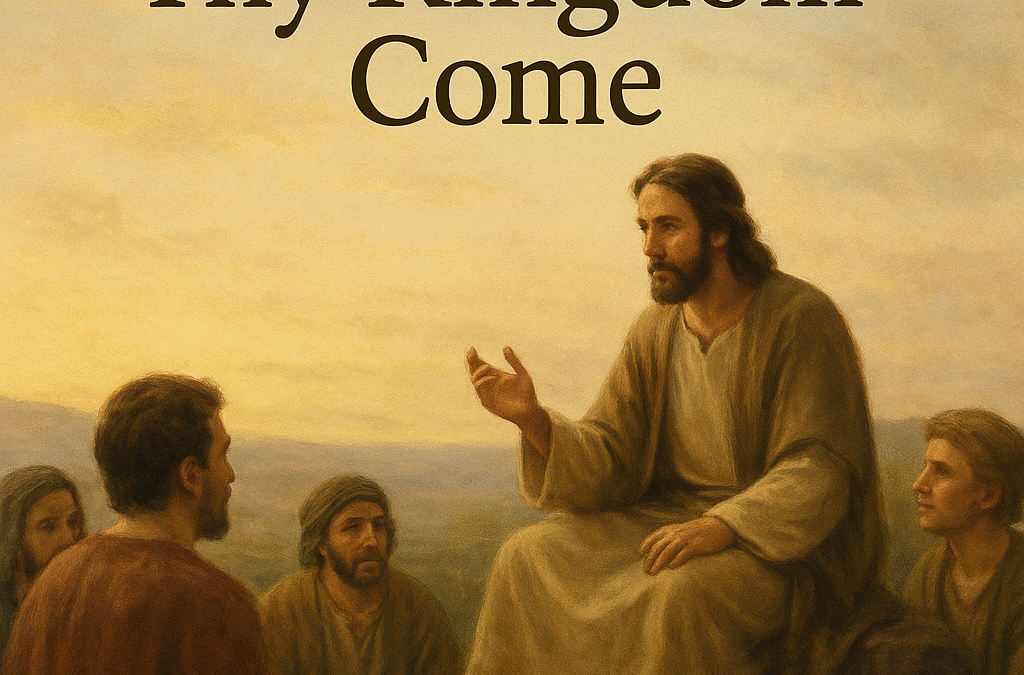
Thy Kingdom Come

Thy Kingdom Come

Thy Kingdom Come

Thy Kingdom Come

💡 Listen to the Devotional
Press play to hear the full devotional, “Thy Kingdom Come.”

On a quiet hillside, a prayer that changed everything

The air was still warm from the afternoon sun.
The hills of Judea lay quiet as Jesus stepped away to pray again.
The disciples watched from a distance — not wanting to interrupt, yet unable to look away.

They’d seen Him heal the blind, calm storms, and lift the brokenhearted.
But this — this was different.
When Jesus prayed, it was as though heaven bent down to listen.
No pretense, no performance, just a Son talking to His Father.
The air itself seemed to hush.

When He finished, one of them finally asked, “Lord… teach us to pray.”

Jesus smiled — not surprised, as if He’d been waiting for that question.
He didn’t give them a chant to memorize, but a way to live.

“When you pray, say… Our Father, who art in heaven, hallowed be Thy name. Thy Kingdom come, Thy will be done, on earth as it is in heaven.”
— Luke 11:2–3

Those words weren’t about a faraway kingdom after death.
They were a declaration for this moment.
A call for heaven’s life to break into earth — right here, right now, through us.

Jesus wasn’t teaching us to escape this world;
He was showing us how to bring God’s world into ours.

Every time you forgive, heaven touches earth.
Every time you choose peace over pride, generosity over greed, compassion over criticism — the Kingdom comes a little closer.
Not someday. Today.
Not somewhere else. Here.

Making It Personal

I’ve whispered those words more times than I can count — sometimes in faith, sometimes out of habit, sometimes not sure I believed they could change anything.
But Jesus meant them as an invitation, not a ritual.

Because if His Kingdom comes… mine has to go.
If His will is done… mine has to yield.
And maybe that’s where real life begins.

Thy Kingdom come in my life means:
Let Your forgiveness flow through me where resentment once ruled.
Let generosity loosen my grip on what’s mine.
Let my words build peace instead of proving I’m right.
Let love decide how I treat the slow cashier, the rude driver, the person who pushes every button I have.

But what about when it’s harder than that?
What about when the Kingdom asks me to forgive someone who isn’t sorry?
To let go of control when everything in me wants to tighten my fists?
To love people who drain me?
That’s where heaven’s rule meets the edges of my heart.

And here’s what I’m learning:
Living in the Kingdom of God doesn’t start with effort — it starts with sight.
When my eyes are opened to the good news that I am already forgiven, everything changes.
Grace has found me.
My sin and failure have been carried away — as far as the east is from the west.
I’m already in the family of God.

When I see that, I turn.
I change direction — not because I’m afraid of punishment, but because I’m captured by love.
I stop chasing self and start chasing this beautiful, wonderful Jesus who loved me enough to die when I should have died.

Salvation isn’t a transaction; it’s a transformation.
It’s not a one-time escape from hell, but a lifelong restoration of relationship — with the One who breathed the stars into the sky and now breathes His Spirit into me.

He’s making me whole.
He’s rescuing me.
He’s restoring the relationship that sin once shattered.

Salvation isn’t merely being saved from something — it’s being saved into something:
into a family, into a kingdom, into love itself.

This is the Gospel — the good news — that opens our eyes, fills our hearts with joy, and turns our steps toward Him.
And when I turn, I find that the Kingdom has already come.
It’s here.
It’s Him.
And I belong in it.

That’s why I can pray with confidence:
Thy will be done, on earth as it is in heaven.
Thy Kingdom come — through me.
Teach me, Lord.
Show me how to live in this Kingdom — how to open my heart and let You truly be my King.

For the Reader

Maybe you’ve always pictured the Kingdom as something you’ll see someday.
But what if it’s already here — hidden in plain sight?
What if it’s in the way you listen to a hurting friend,
or forgive someone who never asked?

The Kingdom isn’t waiting for your deathbed;
it’s waiting for your next breath.

Every time you choose love where it’s hardest,
the King reigns a little more in you.

“The Kingdom of God is within you.” — Luke 17:21

Prayer

Father,
Let Your Kingdom come — not beyond the clouds, but here in the dust where I live.
Let heaven’s mercy rule my words,
heaven’s peace fill my thoughts,
and heaven’s love flow through my hands.
Teach me to live like a citizen of heaven
while my feet still walk this earth —
and let heaven walk with me.
Amen.

Church without the Buildings

Church without the Buildings

Church without the Buildings

If We Didn’t Have Church Buildings

Honest Questions

Is the Church today what Jesus had in mind?
Are we becoming the people He envisioned—or have we quietly settled for something less?

Do our gatherings form disciples—or just fill seats?
Do they lead us deeper into love—or simply into habit?
When we meet each week, are lives being changed—or just schedules being kept?

Didn’t Jesus say, “Follow Me,” not “Attend Me”?

Have we lost the art of teaching people to follow the Spirit of God?
In trying to preserve truth, have we taught people to follow a system, a standard, or a doctrine—yet forgotten how to listen to the living voice of the Shepherd?
Has four songs and a lecture replaced the unpredictable beauty of a Spirit-led community—one that prays, listens, weeps, and rejoices together?

Most of us don’t come to church looking to be entertained. We come hungry for something real—for God, for belonging, for hope.
But the way we’ve structured “church” often turns that hunger into passivity. We sit. We listen. We sing along. Yet few are invited to truly participate.

Somewhere along the way, we learned to consume instead of contribute.
We’ve mistaken inspiration for transformation.
We attempt to draw in crowds instead of touching lives and forming communities.
We’ve stirred emotion, but often lost the filling of the Spirit of God.
And in the process, we’ve taught people to attend instead of abide.

This isn’t about blame—it’s about love.
Because beneath all of our services, songs, and sermons, something in us knows there’s more.
More depth. More life. More Jesus.

And maybe that “more” doesn’t come from trying harder to do church better,
but from learning again how to be the Church together.


What Jesus Intended

Did Jesus ever tell us to build churches—or did He call us to love one another, make disciples, and follow His Spirit?
When He spoke of His Church, was He imagining pews and programs—or a people alive with His presence?

What if His dream wasn’t built around sermons and schedules, but around relationship?
What if He pictured friends breaking bread, families opening their homes, believers sharing life—not just once a week, but as often as the Spirit stirred their hearts?

The gatherings in Acts weren’t polished or predictable. They were living, breathing, Spirit-filled communities.
They met wherever they could—homes, courtyards, under trees, or by the river—because the building didn’t matter. The presence did.

They sang and prayed. They listened for the Spirit’s voice.
They lived the way Jesus had shown them—breaking bread, remembering His words,

“By this everyone will know that you are My disciples, if you love one another.”John 13:35

They wrestled through Scripture, cared for widows, shared what they had, and walked through joy and suffering side by side.
It was messy, but it was real. Ordinary, but sacred. Imperfect, but alive.

Somewhere along the way, we began to trade that simplicity for structure.
Participation became performance.
Family became formality.
And the unpredictable beauty of the Spirit gave way to the safety of routine.

But maybe the same Spirit who breathed life into that first Church still longs to breathe life into us.
Maybe He’s still whispering, still healing, still gathering hearts into family.

Perhaps what Jesus intended was never an institution at all, but an incarnation—His presence alive within His people, His voice guiding them, His love binding them together in a fellowship so deep the world could only call it divine.


The Purpose of the Church

If this is what Jesus intended—a people led by His Spirit, living in love—then why did He create the Church at all?
What did He dream His followers would become together?
Why did He call us His body, His bride, His family?

Maybe it’s simpler than we’ve made it.
Maybe the Church exists to bring His life into every corner of the earth—to embody His love, His truth, and His mercy wherever we go.
To be, quite literally, the visible expression of the invisible Christ.

“Go and make disciples of all nations… teaching them to obey everything I have commanded you.”Matthew 28:19–20

To Manifest Christ on Earth

“Now you are the body of Christ, and individually members of it.”1 Corinthians 12:27

The Church was never meant to just talk about Jesus. We are meant to display Him for the whole world to see—His compassion, His courage, His mercy, His truth.
The world doesn’t need another explanation of Jesus; it needs an encounter with Him through us.

To Worship and Glorify God

“You are a chosen generation… that you may proclaim the praises of Him who called you out of darkness into His marvelous light.”1 Peter 2:9

Our purpose begins and ends in worship—not performance, but presence.
Worship isn’t confined to the songs we sing, but found in the lives we live.
It rises from hearts that know they’ve been rescued and fills both our gatherings and our going with gratitude and awe.

To Equip and Build Up Believers

“He gave apostles, prophets, evangelists, pastors and teachers to equip the saints for the work of ministry.”Ephesians 4:11–12

Notice: He gave them to equip the saints for ministry.
Those servants were never meant to do all the ministry themselves—they were meant to prepare and release others to do it.
In much of today’s church, our “leaders” (who were meant to be servants) have become the ones doing nearly everything, while the rest watch and applaud.

Equipping means helping one another walk with God—learning to hear His voice, discern His leading, and live in faith rather than fear.

“To each one the manifestation of the Spirit is given for the common good.”1 Corinthians 12:7

We were never meant to depend on one person’s teaching to feed us, but to become a people who know how to feed others.

To Carry the Message of Reconciliation

“God… gave us the ministry of reconciliation.”2 Corinthians 5:18

The Church exists to remind a broken world that God has not turned away.
Through Christ, He’s made a way home.
Our calling is not to win arguments but to win hearts—to be living bridges of grace, showing that mercy still triumphs over judgment.

To Reveal God’s Presence to the World

“You also are being built together for a dwelling place of God in the Spirit.”Ephesians 2:22

We are not a monument; we are a temple made of living stones.
Wherever believers gather—homes, fields, cafés, or workshops—the presence of God dwells.
When we love, forgive, and serve in His name, the world catches a glimpse of heaven breaking through earth’s noise.

When the Church lives this way—alive with Christ’s presence and led by His Spirit—everything changes.
The hungry are fed. The lonely find family. The hurting find healing. The lost find home.

This is what He had in mind all along.
Not programs, but people.
Not religion, but relationship.
Not an organization, but an organism—pulsing with the heartbeat of God.


Where We Drifted — and How the Spirit Leads Us Home

If this is what the Church was meant to be—a living body, a Spirit-led family—then what happened?
How did something so alive, so intimate, become so organized, scripted, and restrained?

Maybe it wasn’t rebellion that caused the drift. Maybe it was fear—fear of chaos, of losing control, of what might happen if the Spirit truly led the gathering instead of us.
Because people can get messy. And when people get messy, leaders get nervous.

So we built systems to keep things “safe.”
We created schedules, programs, and traditions—many of them good—but over time they began to replace the living relationship they were meant to protect.
We learned to manage the Church instead of follow the Spirit.

We didn’t mean to lose our way. But somewhere along the line, we started to consume instead of contribute; we began mistaking inspiration for transformation; we tried to draw in crowds instead of touching lives and forming communities; we stirred emotion, but often lost the filling of the Spirit of God; and in the process, we taught people to attend instead of abide.

Most of us are simply doing what we were taught—faithfully and sincerely.
But the result has been a quiet starvation.
People come hungry for God and leave full of words but still empty inside.
They’ve tasted moments of His presence but rarely learned how to walk with Him daily.
They know about Him, but few have been shown how to know Him.

And maybe that’s the deepest wound of all.
We’ve lost the art of teaching people to follow the Spirit of God.
We’ve replaced relationship with routine.
We’ve taught people how to serve, but not how to listen.
We’ve told them what to believe, but not how to hear His voice for themselves.

Yet even here, the Spirit hasn’t stopped calling.
He’s still whispering—not in condemnation, but in invitation.
He reminds us that structure isn’t the enemy; stagnation is.
The goal isn’t to burn it all down, but to breathe new life into what’s grown still.

“Apart from Me you can do nothing.”John 15:5

The Holy Spirit isn’t a guest we invite into our gatherings; He’s the Host who invited us.
He’s not an accessory to our plans—He’s the One who gives them life.
When the Spirit leads, the Church breathes. When He speaks, hearts awaken. When He moves, structure bends to love, and people come alive.

We’ve spent years trying to organize what only He can orchestrate.
But He doesn’t need our choreography—He needs our surrender.
He’s not waiting for better strategies; He’s waiting for yielded hearts.

The same Spirit who led Jesus leads us still.
He gave the disciples words to speak, courage to stand, and power to love beyond their strength.
That same Spirit isn’t distant or diminished. He’s here—ready to fill, to lead, to heal, to restore.

If we truly believed that, what might our gatherings look like?
Would we plan less and pray more?
Would we listen longer before we speak?
Would we leave space for silence, for tears, for prophecy, for healing—for the things only God can do?

The Holy Spirit is not a mystery to be managed; He’s the Presence we were made for.
And when we learn again to depend on Him instead of ourselves, the Church will begin to breathe again.


What We Can Do Differently

If we can see where we’ve drifted, then we can also see where to begin again.
The solution isn’t another program, conference, or committee.
It’s simpler—and far more personal.
It begins with ordinary people rediscovering an extraordinary truth: we are the Church.

We don’t have to wait for permission to start living differently.
We can begin right where we are—
in homes and breakrooms, barns and coffee shops, parks, driveways, and backyards.

We can gather a few friends and share a meal.
We can open the Scriptures and ask honest questions.
We can pray for one another—not just promise to, but actually stop and do it.
We can listen together for the voice of the Spirit.
We can make space for His presence to lead, even when it’s messy or unpredictable.

We can replace spectatorship with participation.
We can open our hands instead of raising our defenses.
We can stop trying to build impressive ministries and start building meaningful relationships.

We can teach each other—again—how to follow the Spirit of God:
to listen for His nudges, to pause before acting, to obey when He whispers, to trust that He knows how to lead His people better than we do.

And maybe, if we do these simple things, the Church will start to breathe again.
Not by trying harder, but by trusting deeper.
Not through control, but through surrender.
Not through innovation, but through invitation—“Come, Holy Spirit.”

Because the Church was never meant to be powered by strategy, but by Presence.
The plan was never ours to perfect; it was His to fulfill through willing hearts.

“For it is God who works in you, both to will and to act according to His good purpose.”Philippians 2:13

What we do differently doesn’t start with policy—it starts with hunger.
If we want to see the Church Jesus intended,
then it begins with hearts that say,
“Here I am, Lord. Lead me.”


It Is Finished — So Why Do We Still Feel Ashamed?

It Is Finished — So Why Do We Still Feel Ashamed?

It Is Finished — So Why Do We Still Feel Ashamed?

It Is Finished — So Why Do We Still Feel Ashamed?

🎧 Listen to the Devotional

Press play to hear the full devotional, “It Is Finished — So Why Do We Still Feel Ashamed?”

Download audio (MP3)

The Story

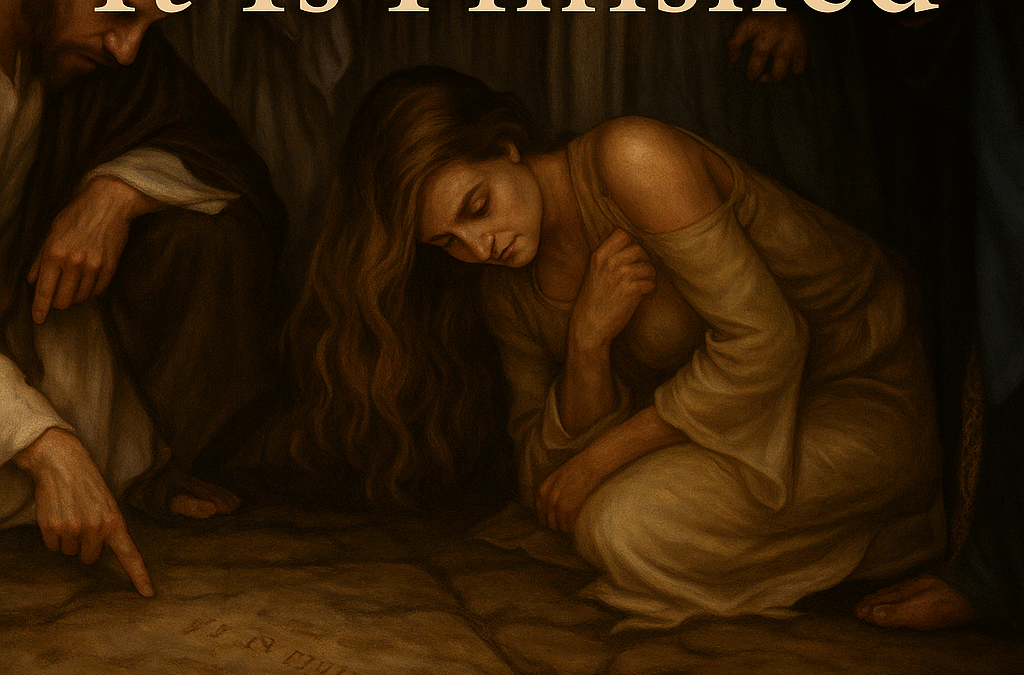
The crowd dragged her through the dust, fists clenched around stones, eyes blazing with accusation.
A woman—caught in the sexual sin of adultery. A sin punishable by death.

She stood trembling in the open square, her failure made public, her shame on display. Every whisper, every glare, every heartbeat told her the same thing: shame on you — you are guilty.

The teachers of the Law confronted Jesus.
“Teacher, this woman was caught in the very act. Moses commanded us to stone such a woman. What do You say?”

It was a trap. They cared little for her sin, and even less for her soul. But Jesus didn’t answer. He stooped down and began to write in the dust with His finger—the same finger that had once written the Law on tablets of stone.

And as He wrote, the air thickened with silence. When He finally spoke, His words cut through centuries of guilt: “Let the one who is without sin cast the first stone.”

Jesus Himself was the only one there without sin—and yet He never reached for a stone. Instead, He reached for her dignity.

One by one, the stones fell from trembling hands as the religious turned away, until only the Creator of the universe—clothed in grace—remained.

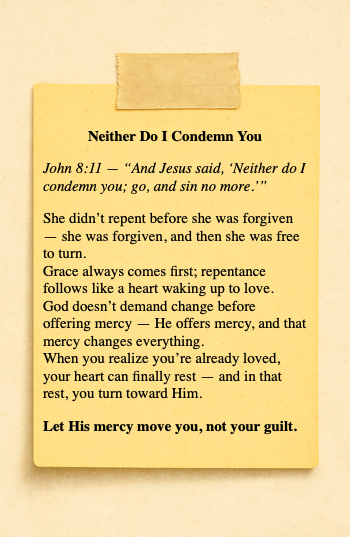
Then Jesus stood, His shadow covering her shame. “Woman, where are they? Has no one condemned you?” She whispered, “No one, Lord.” And He said, “Neither do I condemn you. Go now, and leave your life of sin.”


The Word

“Therefore, there is now no condemnation for those who are in Christ Jesus.”
Romans 8:1

“For I resolved to know nothing while I was with you except Jesus Christ and Him crucified.”
1 Corinthians 2:2

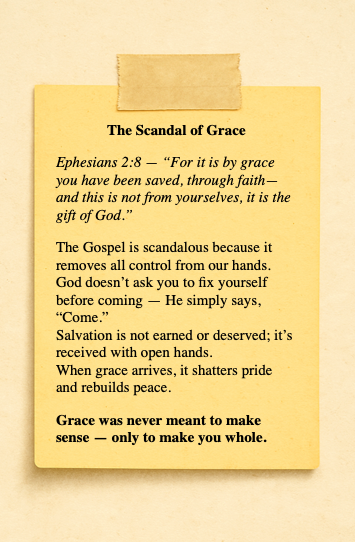
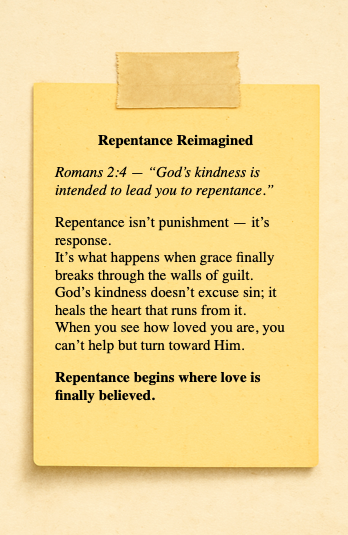
This is the scandal of the Gospel — that God doesn’t wait for repentance before He saves. He brings salvation first, and repentance follows as the natural, Spirit-led response to grace.

The woman didn’t repent before she was forgiven. She was forgiven — and then she was free to turn. Love opened her eyes before obedience ever moved her feet.

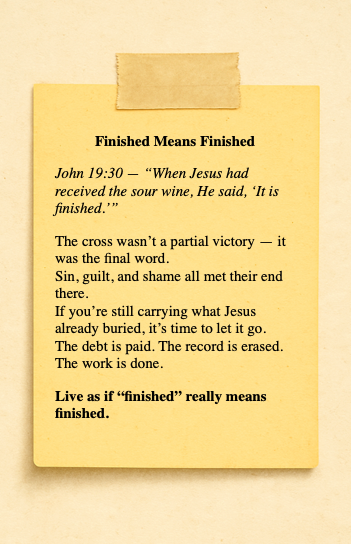
We often forget what Jesus really meant when enduring the cross, despising the shame—shame that He carried for us. And then, through blood and agony, He loudly proclaimed, “It is finished!” He wasn’t announcing defeat; He was declaring victory — the end of sin’s reign, the breaking of guilt’s chains, the death of condemnation.

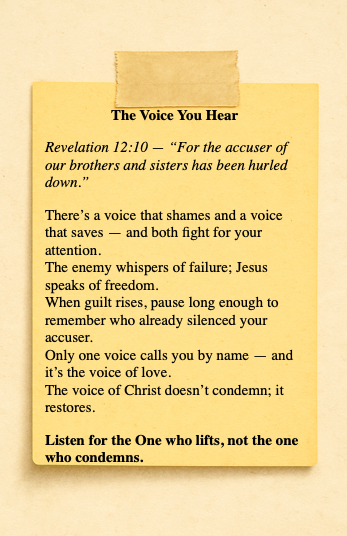
He has put shame to death. Yet too often, we listen to the accuser and pick it back up again.

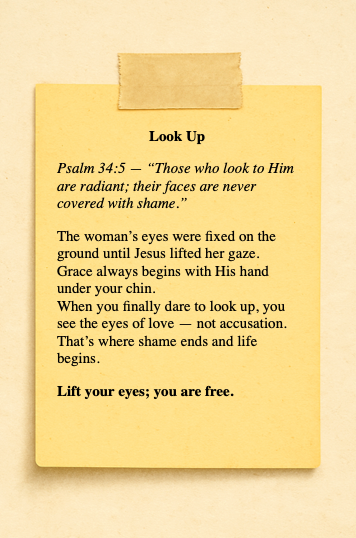
Grace, however, keeps whispering: “Look up.” Salvation has already been given. The work is already done. God doesn’t demand repentance — He reveals His love, and repentance becomes the awakened heart’s response. When grace opens your eyes to the One standing before you — in your sin, in your weakness, yet full of love — you turn toward Him. That turning isn’t duty. It’s delight. It’s not fear. It’s freedom.

Like the woman that day, we find ourselves caught and exposed — and then lifted by hands that bear scars. He gently raises our chin, and we dare to meet His gaze. In His eyes, there is no trace of accusation. Only compassion. Only love. Only the reflection of the one He came to redeem.

He has already taken care of every sin and every shame. The verdict is done. The cross has spoken. Now, go — live in the shadow of that cross. Free to live. Alive to praise.


The Call

Stop hiding from the One who came to save you. Listen for His voice above the noise of accusation. When He says, “Neither do I condemn you,” believe Him.

Walk today as one who has seen the scandalous grace of God — and live amazed by the cross.


The Prayer

Jesus,
Open my eyes to see what You’ve already done.
Remind me that salvation isn’t something I earn — it’s something You’ve finished.
Thank You that grace comes first, and repentance follows like a heartbeat awakened by love.
Silence the accuser’s voice when shame tries to return.
Lift my head to see Your eyes of mercy.
Let me live every day unafraid, unashamed, and fully alive in the freedom You’ve already given.

Amen.

Quick Additional Thought: What Is Shame?

Shame is the voice that tells you your failure is your identity. It’s the whisper that says, “You’re not just someone who sinned — you are the sin.”

Guilt says, “I did something wrong.”
Shame says, “I am something wrong.”

And that’s the lie Jesus came to destroy. On the cross, He didn’t just carry our guilt — He carried our shame. He endured the humiliation, the nakedness, the rejection — all the things that make us hide — and He despised that shame. Why? Because it had no right to define us.

When He said, “It is finished,” He wasn’t just ending sin’s power; He was ending shame’s story. So now, in Christ, your past doesn’t name you. Your failure doesn’t brand you.

You are no longer “the one caught” — you are the one set free.

Another Thought: What Does It Mean That Jesus Bore Our Shame?

Shame was the very first result of sin. When Adam and Eve disobeyed, their eyes were opened — and they felt exposed. Their first reaction wasn’t rebellion; it was to hide.

They covered themselves and hid from the presence of God, believing their failure had changed how He saw them. But it hadn’t changed Him at all. He came looking for them. “Where are you?” He asked — not because He didn’t know, but because He refused to let shame have the final word.

That’s what Jesus came to do — to bear our shame and end the separation it causes. On the cross, He stepped into our hiding place. He endured the mocking, the nakedness, the rejection — everything shame used to convince us that God could never want us again. He bore it all so we would never have to hide again.

To bear our shame means Jesus carried not just our sin, but the distance it created. He stepped into the isolation and humiliation that shame produces. He took it all upon Himself — and in doing so, He broke its power forever.

When He endured the cross and despised the shame, He wasn’t ignoring it — He was defeating it. He faced what we fear most: being fully seen and still unloved. But instead of turning away, He loved us through it.

He stood exposed so we could stand unashamed. He faced rejection so we could walk in acceptance.

When He cried out, “It is finished,” shame’s story was over. Now, when we’re tempted to hide, He still calls softly, “Where are you?” Not to accuse — but to restore.

He bore our shame so that nothing — not even our own fear — could ever separate us from His love again.