
Church without the Buildings
If We Didn’t Have Church Buildings
Honest Questions
Is the Church today what Jesus had in mind?
Are we becoming the people He envisioned—or have we quietly settled for something less?
Do our gatherings form disciples—or just fill seats?
Do they lead us deeper into love—or simply into habit?
When we meet each week, are lives being changed—or just schedules being kept?
Didn’t Jesus say, “Follow Me,” not “Attend Me”?
Have we lost the art of teaching people to follow the Spirit of God?
In trying to preserve truth, have we taught people to follow a system, a standard, or a doctrine—yet forgotten how to listen to the living voice of the Shepherd?
Has four songs and a lecture replaced the unpredictable beauty of a Spirit-led community—one that prays, listens, weeps, and rejoices together?
Most of us don’t come to church looking to be entertained. We come hungry for something real—for God, for belonging, for hope.
But the way we’ve structured “church” often turns that hunger into passivity. We sit. We listen. We sing along. Yet few are invited to truly participate.
Somewhere along the way, we learned to consume instead of contribute.
We’ve mistaken inspiration for transformation.
We attempt to draw in crowds instead of touching lives and forming communities.
We’ve stirred emotion, but often lost the filling of the Spirit of God.
And in the process, we’ve taught people to attend instead of abide.
This isn’t about blame—it’s about love.
Because beneath all of our services, songs, and sermons, something in us knows there’s more.
More depth. More life. More Jesus.
And maybe that “more” doesn’t come from trying harder to do church better,
but from learning again how to be the Church together.
What Jesus Intended
Did Jesus ever tell us to build churches—or did He call us to love one another, make disciples, and follow His Spirit?
When He spoke of His Church, was He imagining pews and programs—or a people alive with His presence?
What if His dream wasn’t built around sermons and schedules, but around relationship?
What if He pictured friends breaking bread, families opening their homes, believers sharing life—not just once a week, but as often as the Spirit stirred their hearts?
The gatherings in Acts weren’t polished or predictable. They were living, breathing, Spirit-filled communities.
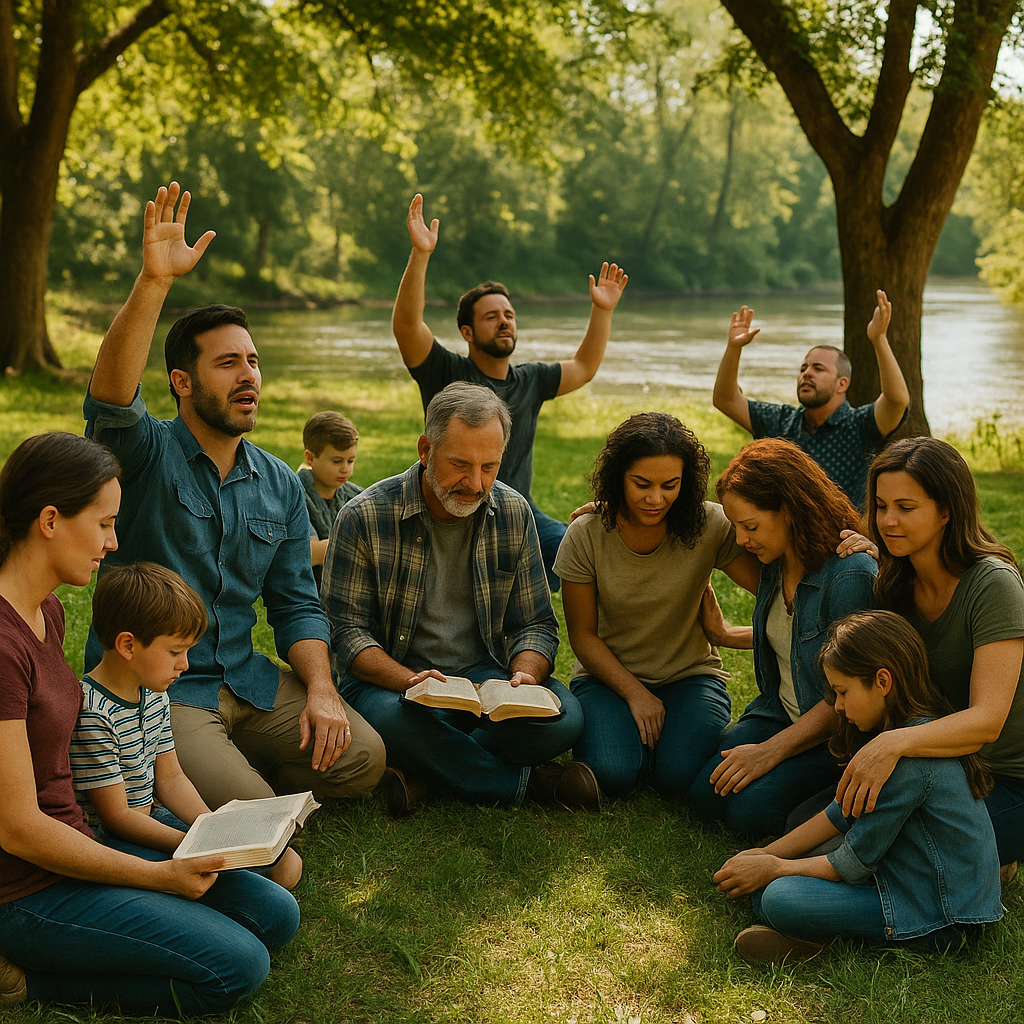
They met wherever they could—homes, courtyards, under trees, or by the river—because the building didn’t matter. The presence did.
They sang and prayed. They listened for the Spirit’s voice.
They lived the way Jesus had shown them—breaking bread, remembering His words,
They wrestled through Scripture, cared for widows, shared what they had, and walked through joy and suffering side by side.
It was messy, but it was real. Ordinary, but sacred. Imperfect, but alive.
Somewhere along the way, we began to trade that simplicity for structure.
Participation became performance.
Family became formality.
And the unpredictable beauty of the Spirit gave way to the safety of routine.
But maybe the same Spirit who breathed life into that first Church still longs to breathe life into us.
Maybe He’s still whispering, still healing, still gathering hearts into family.
Perhaps what Jesus intended was never an institution at all, but an incarnation—His presence alive within His people, His voice guiding them, His love binding them together in a fellowship so deep the world could only call it divine.
The Purpose of the Church
If this is what Jesus intended—a people led by His Spirit, living in love—then why did He create the Church at all?
What did He dream His followers would become together?
Why did He call us His body, His bride, His family?
Maybe it’s simpler than we’ve made it.
Maybe the Church exists to bring His life into every corner of the earth—to embody His love, His truth, and His mercy wherever we go.
To be, quite literally, the visible expression of the invisible Christ.
To Manifest Christ on Earth
The Church was never meant to just talk about Jesus. We are meant to display Him for the whole world to see—His compassion, His courage, His mercy, His truth.
The world doesn’t need another explanation of Jesus; it needs an encounter with Him through us.
To Worship and Glorify God
Our purpose begins and ends in worship—not performance, but presence.
Worship isn’t confined to the songs we sing, but found in the lives we live.
It rises from hearts that know they’ve been rescued and fills both our gatherings and our going with gratitude and awe.
To Equip and Build Up Believers
Notice: He gave them to equip the saints for ministry.
Those servants were never meant to do all the ministry themselves—they were meant to prepare and release others to do it.
In much of today’s church, our “leaders” (who were meant to be servants) have become the ones doing nearly everything, while the rest watch and applaud.
Equipping means helping one another walk with God—learning to hear His voice, discern His leading, and live in faith rather than fear.
We were never meant to depend on one person’s teaching to feed us, but to become a people who know how to feed others.
To Carry the Message of Reconciliation
The Church exists to remind a broken world that God has not turned away.
Through Christ, He’s made a way home.
Our calling is not to win arguments but to win hearts—to be living bridges of grace, showing that mercy still triumphs over judgment.
To Reveal God’s Presence to the World
We are not a monument; we are a temple made of living stones.
Wherever believers gather—homes, fields, cafés, or workshops—the presence of God dwells.
When we love, forgive, and serve in His name, the world catches a glimpse of heaven breaking through earth’s noise.
When the Church lives this way—alive with Christ’s presence and led by His Spirit—everything changes.
The hungry are fed. The lonely find family. The hurting find healing. The lost find home.
This is what He had in mind all along.
Not programs, but people.
Not religion, but relationship.
Not an organization, but an organism—pulsing with the heartbeat of God.
Where We Drifted — and How the Spirit Leads Us Home
If this is what the Church was meant to be—a living body, a Spirit-led family—then what happened?
How did something so alive, so intimate, become so organized, scripted, and restrained?
Maybe it wasn’t rebellion that caused the drift. Maybe it was fear—fear of chaos, of losing control, of what might happen if the Spirit truly led the gathering instead of us.
Because people can get messy. And when people get messy, leaders get nervous.
So we built systems to keep things “safe.”
We created schedules, programs, and traditions—many of them good—but over time they began to replace the living relationship they were meant to protect.
We learned to manage the Church instead of follow the Spirit.
We didn’t mean to lose our way. But somewhere along the line, we started to consume instead of contribute; we began mistaking inspiration for transformation; we tried to draw in crowds instead of touching lives and forming communities; we stirred emotion, but often lost the filling of the Spirit of God; and in the process, we taught people to attend instead of abide.
Most of us are simply doing what we were taught—faithfully and sincerely.
But the result has been a quiet starvation.
People come hungry for God and leave full of words but still empty inside.
They’ve tasted moments of His presence but rarely learned how to walk with Him daily.
They know about Him, but few have been shown how to know Him.
And maybe that’s the deepest wound of all.
We’ve lost the art of teaching people to follow the Spirit of God.
We’ve replaced relationship with routine.
We’ve taught people how to serve, but not how to listen.
We’ve told them what to believe, but not how to hear His voice for themselves.
Yet even here, the Spirit hasn’t stopped calling.
He’s still whispering—not in condemnation, but in invitation.
He reminds us that structure isn’t the enemy; stagnation is.
The goal isn’t to burn it all down, but to breathe new life into what’s grown still.
The Holy Spirit isn’t a guest we invite into our gatherings; He’s the Host who invited us.
He’s not an accessory to our plans—He’s the One who gives them life.
When the Spirit leads, the Church breathes. When He speaks, hearts awaken. When He moves, structure bends to love, and people come alive.
We’ve spent years trying to organize what only He can orchestrate.
But He doesn’t need our choreography—He needs our surrender.
He’s not waiting for better strategies; He’s waiting for yielded hearts.
The same Spirit who led Jesus leads us still.
He gave the disciples words to speak, courage to stand, and power to love beyond their strength.
That same Spirit isn’t distant or diminished. He’s here—ready to fill, to lead, to heal, to restore.
If we truly believed that, what might our gatherings look like?
Would we plan less and pray more?
Would we listen longer before we speak?
Would we leave space for silence, for tears, for prophecy, for healing—for the things only God can do?
The Holy Spirit is not a mystery to be managed; He’s the Presence we were made for.
And when we learn again to depend on Him instead of ourselves, the Church will begin to breathe again.
What We Can Do Differently
If we can see where we’ve drifted, then we can also see where to begin again.
The solution isn’t another program, conference, or committee.
It’s simpler—and far more personal.
It begins with ordinary people rediscovering an extraordinary truth: we are the Church.
We don’t have to wait for permission to start living differently.
We can begin right where we are—
in homes and breakrooms, barns and coffee shops, parks, driveways, and backyards.
We can gather a few friends and share a meal.
We can open the Scriptures and ask honest questions.
We can pray for one another—not just promise to, but actually stop and do it.
We can listen together for the voice of the Spirit.
We can make space for His presence to lead, even when it’s messy or unpredictable.
We can replace spectatorship with participation.
We can open our hands instead of raising our defenses.
We can stop trying to build impressive ministries and start building meaningful relationships.
We can teach each other—again—how to follow the Spirit of God:
to listen for His nudges, to pause before acting, to obey when He whispers, to trust that He knows how to lead His people better than we do.
And maybe, if we do these simple things, the Church will start to breathe again.
Not by trying harder, but by trusting deeper.
Not through control, but through surrender.
Not through innovation, but through invitation—“Come, Holy Spirit.”
Because the Church was never meant to be powered by strategy, but by Presence.
The plan was never ours to perfect; it was His to fulfill through willing hearts.
What we do differently doesn’t start with policy—it starts with hunger.
If we want to see the Church Jesus intended,
then it begins with hearts that say,
“Here I am, Lord. Lead me.”
0 Comments