They Expected Death
Before reading this reflection…
Before reading this reflection, I would encourage you to pause for a few moments and read Genesis chapter 3 for yourself.
Read it slowly.
Try, if only for a moment, to set aside everything you have been taught about the story and simply listen to the words.
Then come back and continue reading.
Adam and Eve are standing before God.
They have already hidden among the trees. They have already covered themselves with fig leaves. They have already heard the voice walking through the garden and calling, “Where are you?” And now there is nowhere left to hide.
They know what God said.
“In the day that you eat of it, you shall surely die.”
Then they ate.
Now that day has come.
I do not think we should rush past the terror of that moment. Adam and Eve are not standing there calmly waiting for a theological explanation. They are ashamed, exposed, afraid, and trembling before the One whose voice once meant life to them. The tragedy is that they are now hearing that voice through fear.
And fear has a way of distorting everything.
Fear hears judgment where mercy is speaking. Fear hears rejection where reconciliation is being offered.
Fear hears death
even when Life itself
is standing right in front of it.
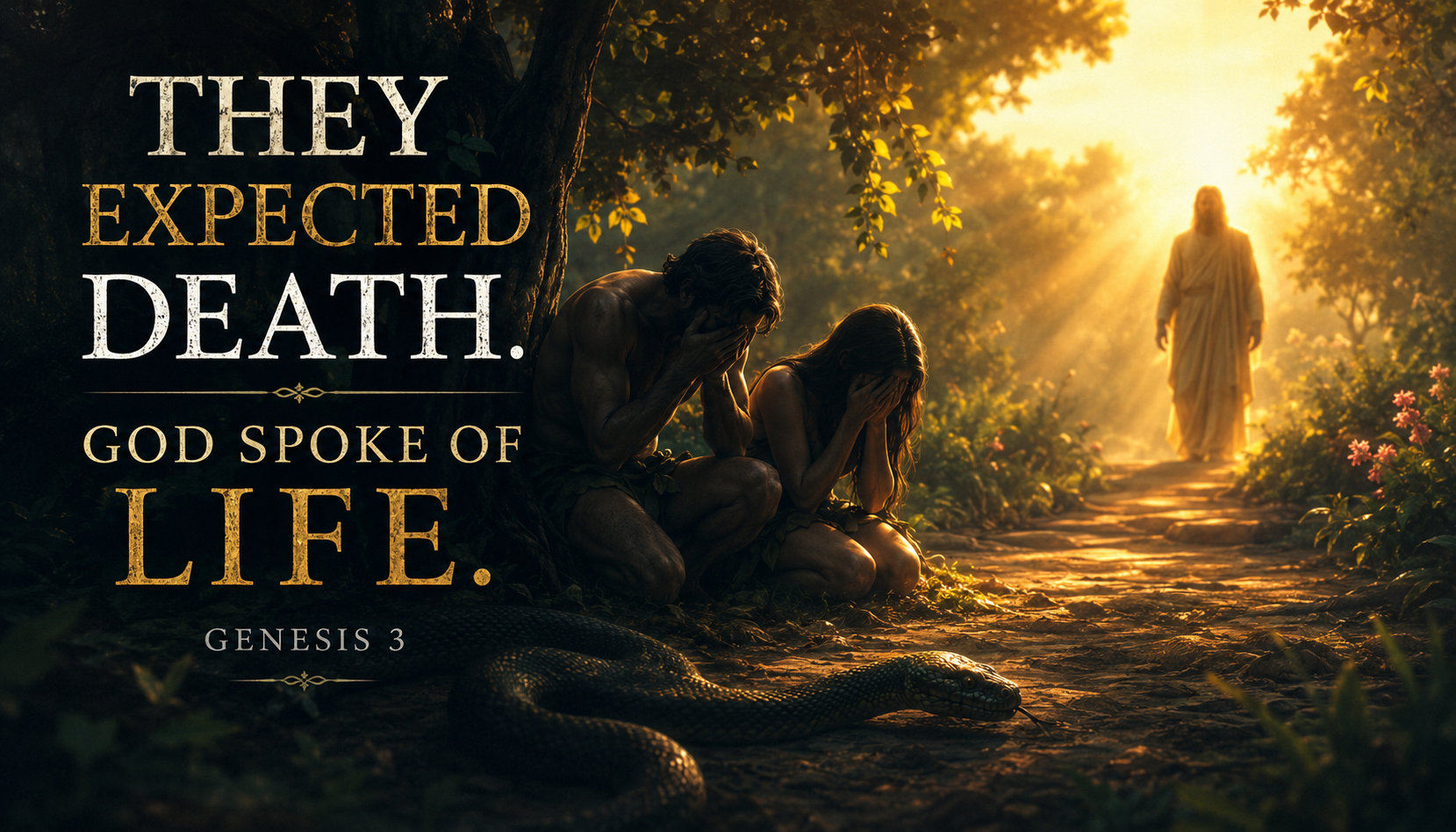
Adam and Eve are expecting death.
The reader is expecting death.
Then God begins to speak.
And the first curse falls.
Not upon Adam.
Not upon Eve.
Upon the serpent.
“Because you have done this,
cursed are you…”
The deceiver is cursed. The liar is cursed. The voice that first taught humanity to distrust God is cursed.
And that alone should make us pause.
For generations many people have spoken as though Adam and Eve were cursed in the garden. Yet the text never says that.
The serpent is cursed.
Later, the ground is cursed.
But Adam and Eve are not directly called cursed.
That may not answer every question, but it is certainly worth noticing.
Then God turns toward Eve.
And if there is a moment in Scripture where we should hold our breath, perhaps this is it.
What comes next?
Condemnation?
Destruction?
Death?
Instead, God begins speaking about children.
Children.
I cannot get past that word.
Adam and Eve are standing before the God they believe is about to pronounce death, and instead He begins speaking of children.
Children mean tomorrow. Children mean family. Children mean future generations. Children mean the story continues. Children mean humanity has not been abandoned.
Whatever else these words contain — and they do contain pain, sorrow, struggle, and consequences — they also contain something almost too beautiful to rush past.
Life.
Adam and Eve are expecting death.
God is speaking of life.
That contrast takes my breath away.
And if we slow down long enough, it should take yours too.
God does not ignore what has happened. The consequences are real. The sorrow is real. The fracture is real. The world they knew is gone. But neither does God speak as though the story is over.
Humanity will continue.
Children will be born.
A future is still coming.
And even more than that, God speaks of an offspring who will one day crush the serpent’s head.
Adam and Eve cannot possibly understand the fullness of those words. They cannot see Bethlehem. They cannot see Calvary. They cannot see the empty tomb.
But they can know this:
The serpent does not get the final word.
The deceiver loses.
And somewhere inside those words, the first notes of the Gospel begin to sing.
Still, the tension remains.
God had said:
“In the day that you eat of it, you shall surely die.”
So what exactly died that day?
Adam is still standing.
Eve is still standing.
Children are coming.
History is continuing.
Life fills the passage.
And yet something undeniably died.
Trust died. Innocence died. Peace died. The ability to stand naked before Love without fear died. Humanity lost the ability to see God clearly.
They were standing in front of Love
and seeing death.
That is astonishing.
And deeply human.
Because if we are honest, most of us have lived inside this story too. We have failed. We have hidden. We have expected condemnation. We have stood before God convinced He was disappointed, angry, or finished with us. And like Adam and Eve, we often struggle to hear what He is actually saying.
Perhaps death is far deeper than a body ceasing to breathe.
Scripture seems to say this again and again.
Jesus later says:
“I have come that they may have life.”
Yet He says this to people who are already breathing.
So perhaps life is more than biological existence. And perhaps death is more than biological ending.
The garden is teaching us how to hear those words.
To be dead is not merely to stop breathing. It is to be cut off from the life we were created to share with God. It is to hide from Love. To distrust the voice of the Father. To live in fear, shame, exile, and separation from the One who is Life itself.
That is the death humanity entered.
And that is the life Jesus came to restore.
This also brings us back to the theme that has been echoing through the garden from the beginning.
Voices.
God asks, “Where are you?”
God asks, “Who told you that you were naked?”
And when He speaks to Adam, He says:
“Because you have listened to the voice of your wife and have eaten of the tree…”
Once again, the question is not merely what was eaten, but whose voice was trusted.
Eve listened to the voice of the serpent.
Adam listened to the voice of another human.
Both stopped listening to the voice of God.
And the result was death.
Not merely because fruit was eaten, but because trust was broken. Humanity listened to the wrong voice and began walking away from life.
Then God says something else that deserves at least a brief pause:
“Cursed is the ground because of you…”
Adam was formed from the dust of the ground. In Hebrew, the connection is woven right into the words: Adam and adamah — man and ground. The human creature, the earth from which he came, and the dust to which he will return are bound together in a way modern readers may not immediately feel.
So when the ground is cursed because of Adam, something mysterious is being revealed about humanity’s relationship with creation itself. The fracture in Eden is larger than one man and one woman. It reaches into the soil beneath their feet.
Centuries later, Paul would write that creation itself groans, waiting to be delivered from corruption. Creation is not the villain in the story. The ground did not deceive humanity. Yet creation suffers under the weight of humanity’s fracture.
Still, even here, notice the mercy.
The serpent is cursed.
The ground is cursed.
But Adam himself is not directly called cursed.
That silence matters.
And perhaps it leaves a question hanging in the air:
If we expected the curse to fall directly on Adam,
why does the text place it on the ground instead?
That question may take us far beyond this moment. It may take us to covenant. To sacrifice. To blood. To a cross. To the One who eventually enters death Himself in order to destroy it.
But even here, in the garden, the Gospel is already beginning to breathe.
The humans expect death.
God speaks life.
The humans expect condemnation.
God speaks of children.
The humans expect the end.
God speaks of a future.
The humans expect the serpent to win.
God speaks of the serpent being crushed.
This is not a small detail.
This is the sound of mercy.
This is the sound of life in the shadow of death.
This is the first whisper that death will not have the final word.
And perhaps this is why the words of Jesus carry so much weight when we finally hear them:
“I have come that they may have life.”
The Gospel is not merely the forgiveness of sin.
It is the restoration of life.
The healing of what was fractured.
The awakening of what died.
The reconciliation of humanity back to the God from whom we hid.
Adam and Eve stood in the presence of Life itself and still believed death was all that remained.
They expected death. God spoke of life.
They expected condemnation. God spoke of children.
They expected the end. God spoke of a future.
They listened to the wrong voice and lost the life they had been created to share with God.
The rest of Scripture is the story of God calling humanity back to His voice.
And perhaps that is the Gospel.
Not merely that sin can be forgiven.
Not merely that guilt can be removed.
But that humanity can learn to hear the voice of Life again.

0 Comments