The Man Who Walked With God
The Man Who Walked With God
Before you begin, I encourage you to pause for just a few moments and read Genesis 5. It won't take long.
Then come back and continue.
🎧 Audio Version
Press play below to listen to this week's His-Story.
The Man Who Walked With God
Over the years, I've learned that some of the greatest treasures in Scripture are hidden in the places most of us are tempted to skip.
Genesis 5 is one of those places.
At first glance it appears to be little more than a genealogy—a long list of unfamiliar names connected by the repeated words, "...and he died... and he died... and he died." Most of us read it quickly, if we read it at all.
But hidden in the middle of that chapter is a single sentence that has quietly changed the way I read not only Genesis, but the entire story of God.
"And Enoch walked with God." (Genesis 5:24)
Because I no longer think this chapter is about genealogy.
I think it's about remembering.
As I studied this week, I found myself thinking less about the names themselves and more about the people behind them. Adam was still alive through much of Enoch's lifetime. The Garden of Eden wasn't an ancient story handed down through countless generations. The man who had actually walked with God was still alive to tell it himself.
I cannot help but imagine those evenings.
Children gathered around.
Grandchildren listening.
Great-grandchildren sitting quietly at the feet of the oldest man who had ever lived.
Not because he had studied the Garden.
Because he had lived there.
Can you imagine Adam telling the story?
Not as a sermon.
Not as a lesson.
As memory.
Perhaps his voice became quiet as he remembered hearing the footsteps of God in the cool of the day. Perhaps tears filled his eyes as he described hiding among the trees, convinced everything had been lost forever. Perhaps he recalled expecting death, only to find that God spoke of life still to come. Maybe, as his hands rested on the garments God Himself had made, he remembered the moment those rough fig leaves were replaced by the soft covering of God's own provision.
Those weren't simply facts.
They were encounters.
They revealed what God is like.
Stories do more than preserve history; they preserve the character of God.
I wonder if we've forgotten that.
Today we often pass along information. We teach verses, doctrines, creeds, and theological truths. Those things matter. They are precious gifts.
But information alone rarely builds trust.
Stories do something different.
They allow us to borrow someone else's encounter until we have one of our own.
That is discipleship.
Long before there were synagogues, sermons, or even written Scriptures, there were families gathered together telling the stories of what God had done. They weren't merely preserving history. They were introducing the next generation to the heart of the God they had come to know.
Some listened.
Others did not.
Genesis quietly traces both paths. One generation after another chose whether to believe the stories they had heard. Some continued calling upon the name of the Lord. Others drifted farther and farther away until the thoughts of their hearts became consumed with evil.
The family line did not guarantee faith.
The choice remained.
Then, almost without warning, Genesis pauses.
"And Enoch walked with God."
Twice the chapter says it.
Out of all those names, God stops long enough to make sure we notice one man.
Ancient Jewish tradition remembers Enoch as a man who often withdrew from the noise of the world to spend seasons alone with God, and whose wisdom became known throughout the earth. Those traditions reflect the lasting impression Enoch left on those who remembered him.
Scripture simply tells us that he walked with God.
As I sat with that thought this week, another question settled into my heart.
How many evenings had Enoch sat around a fire listening to Adam?
How many times had he heard about the Garden?
About God's voice?
About the terror of hiding...
...and the overwhelming mercy that followed?
I cannot help wondering if, somewhere in Enoch's heart, a quiet thought began to grow.
If Adam walked with God... why shouldn't I?
Perhaps that is what makes Enoch's story so remarkable.
The Garden had been closed.
But the invitation had not.
As I reflected on that this week, I realized something about myself.
I don't think I can learn to walk like Enoch while I'm still thinking like Adam.
The moment I ask, "What must I do to become like Enoch?" my eyes immediately turn inward.
What do I need to fix?
What do I need to accomplish?
How much more faithful must I become before someone like me could ever walk with God?
Before long, my eyes are on the ground again.
Measuring.
Trying.
Hiding.
But perhaps that is Adam's story, not Enoch's.
Then Genesis quietly asks me a different question.
Do I believe God still desires to walk with me?
The more I read Scripture, the more I realize that this has been the story all along.
God walked with Adam.
Enoch walked with God.
Noah walked with God.
Abraham was called the friend of God.
Then Jesus stepped into history and simply said,
"Follow me." (Matthew 4:19)
Later He would say,
"Abide in me." (John 15:4)
He prayed that we would know the Father just as He knew the Father. (John 17:3)
Paul wrote that we have received "the Spirit of adoption, whereby we cry, Abba, Father." (Romans 8:15)
John declared, "Truly our fellowship is with the Father, and with his Son Jesus Christ." (1 John 1:3)
Those are not invitations to religion.
They are invitations to relationship.
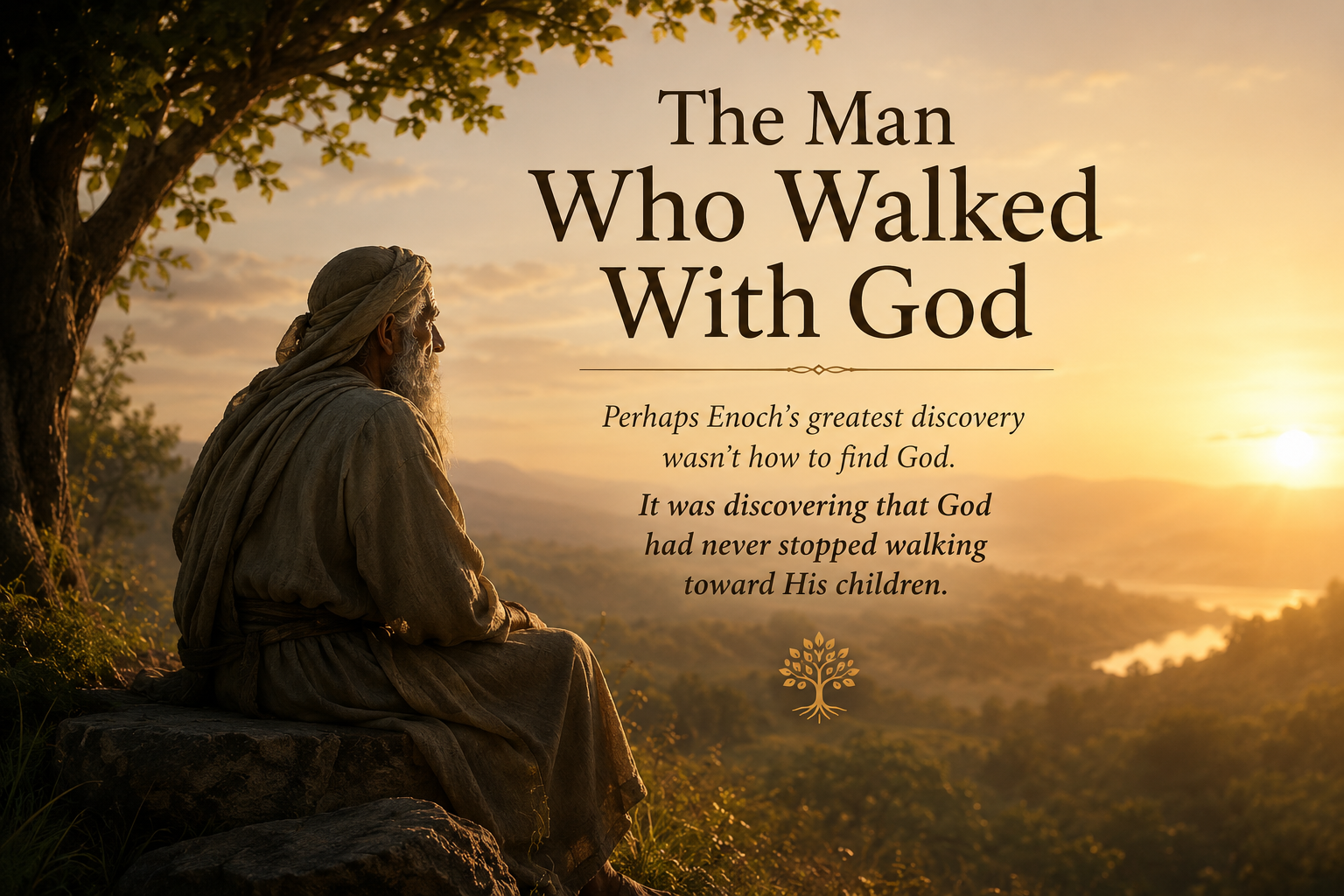
Perhaps Enoch's greatest discovery wasn't how to find God.
Perhaps it was discovering that God had never stopped walking toward His children.
Perhaps the greatest miracle in Genesis 5 is not that Enoch was taken by God.
Perhaps it is that centuries after Eden, one man still believed the God Adam described was the same God who still desired to walk with His children.
And perhaps that has been His story all along.
Not a story about mankind struggling to reach God...
But the story of a Father who has never stopped walking toward His children.