Outside the Garden
Over the years I have returned to these opening chapters of Genesis again and again. Yet every time I return, another layer seems to emerge.
This week was another one of those moments.
Before reading this week's blog, I would encourage you to pause for a few moments and read Genesis 4. It is a familiar chapter, and because it is familiar, it is easy to assume we already know what it says.
Slow down.
Read it carefully.
Then come back and continue.
🎧 Audio Version
Press play below to listen to this week's His-Story.
Outside the Garden
Most people know Genesis 4 as the story of the first murder.
Yet murder is not where the chapter begins.
The previous chapter ended with humanity leaving Eden. The Tree of Life is guarded. The ground is cursed. The world has changed forever.
Yet life continues.
A child is born.
Hope enters the story.
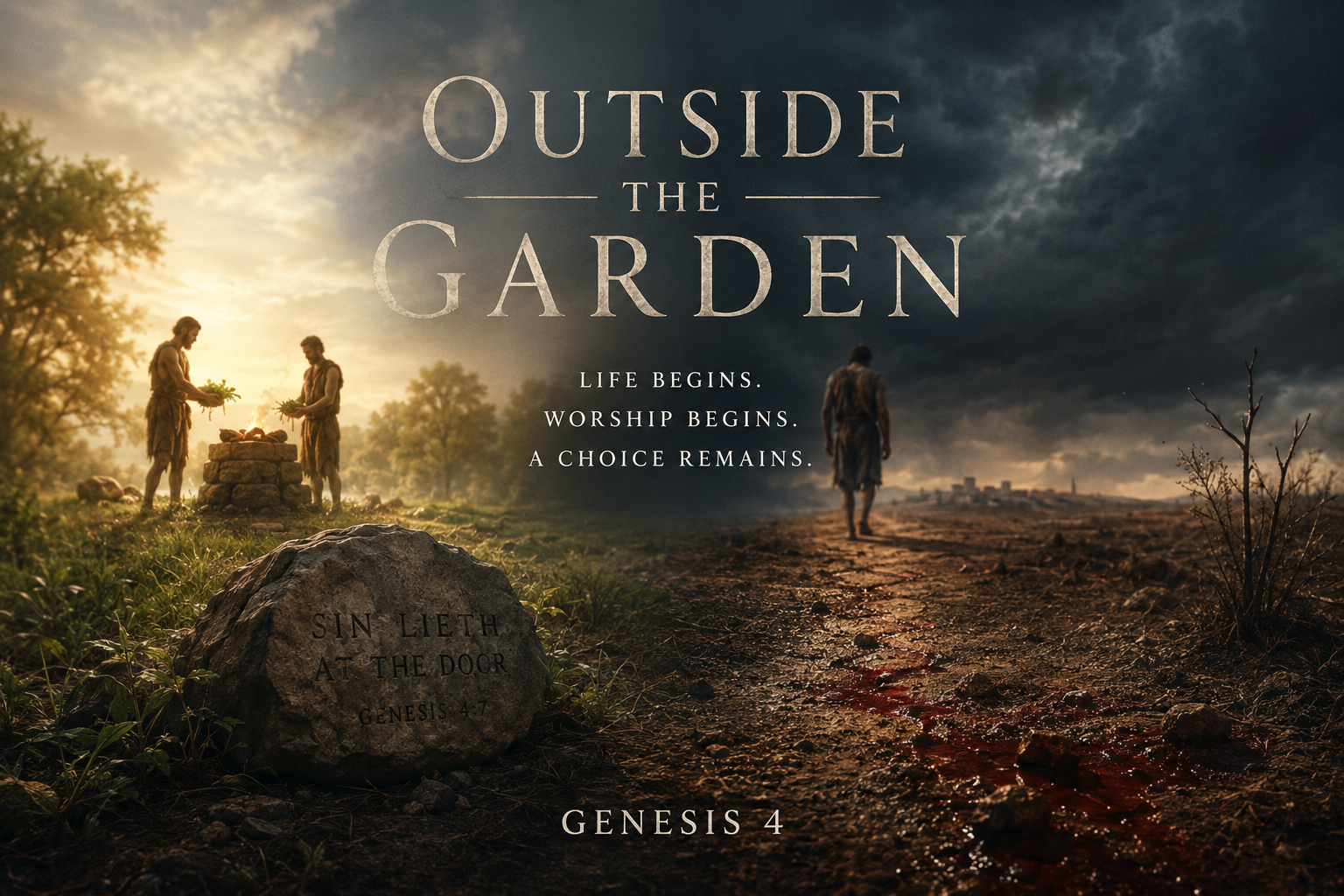
Then something remarkable happens. The first major event recorded outside the garden is worship.
Cain brings an offering.
Abel brings an offering.
Both brothers come before God.
The first family outside Eden begins with life and worship.
Yet before the chapter closes, blood will cry from the ground.
It is a sobering picture of how quickly a wounded heart can transform worship into tragedy.
For generations people have debated why Abel's offering was accepted and Cain's was not. The text, however, quickly turns our attention away from the altar and toward Cain himself.
Something is happening inside him.
His countenance falls.
Anger begins to grow.
Was it jealousy? Wounded pride? A hurt he had carried for years?
We are never told.
Perhaps that is why the story remains so powerful.
Cain becomes every one of us.
Most of us know what it feels like to be disappointed. Most of us know what it feels like to compare ourselves to someone else and wonder why they seem accepted while we feel overlooked.
And then God speaks.
Again.
"Why are you angry? And why has your countenance fallen?" (Genesis 4:6)
What strikes me is the tenderness of the moment. God sees where Cain's heart is heading before Cain does. He sees the danger before the violence and moves toward him rather than away from him.
Then comes one of the most striking images in Genesis:
"Sin lieth at the door." (Genesis 4:7)
Sin is pictured as something crouching. Waiting. Watching. Desiring.
And suddenly the chapter becomes about far more than two brothers.
It becomes about two voices.
One voice is calling Cain toward trust, humility, and life.
The other is feeding the anger and nurturing the wound.
The garden is gone, but the choice remains.
Which voice will he follow?
Sadly, we know the answer.
The murder was not the beginning of the tragedy. It was the result of a voice Cain chose to follow.
When God confronts Cain, He says:
"The voice of thy brother's blood crieth unto me from the ground." (Genesis 4:10)
Interestingly, the Hebrew word is plural—bloods.
Ancient Jewish interpreters often understood this to mean that Cain had done more than kill a man. He had extinguished generations that would never be born.
Cain did not simply end a life.
He shattered a future.
Yet even death does not silence Abel's voice.
Hebrews tells us:
"He being dead yet speaketh." (Hebrews 11:4)
Then it points us to Christ and His blood:
"That speaketh better things than that of Abel." (Hebrews 12:24)
Abel's blood cried from the ground.
Christ's blood speaks a better word.
The story is already reaching beyond Genesis.
Yet what amazes me most is not what Cain did.
It is what God did next.
God speaks again.
Cain receives consequences, but he also receives protection.
The same God who covered Adam and Eve now protects a murderer.
The same God who guarded the Tree of Life now guards Cain's life.
Again and again Genesis reveals a God who is far more merciful than we expect.
The chapter then widens its view. Generations pass. Violence spreads. What began as a wound in one man's heart begins shaping entire generations.
Yet Genesis refuses to end there.
Another son is born.
Seth.
Then we read these remarkable words:
"Then began men to call upon the name of the LORD." (Genesis 4:26)
What a beautiful ending.
The chapter begins with life.
It begins with worship.
It passes through anger, violence, and death.
Yet it ends with people calling upon the name of the Lord.
"For whosoever shall call upon the name of the Lord shall be saved." (Romans 10:13)
The story continued.
The serpent did not silence God's voice.
Cain did not silence God's voice.
Death did not silence God's voice.
"My sheep hear my voice, and I know them, and they follow me." (John 10:27)
And thousands of years later, it still has not been silenced.
Soon we will meet Enoch, a man who walked with God. Later we will meet Noah, who also walked with God. The story will continue through Abraham, Moses, David, the prophets, the cross, the resurrection, and ultimately into our own lives.
Different generations.
The same question.
Which voice will we follow?
One voice crouches at the door.
The other continues to call our name.
The garden may be gone.
But God's voice remains.
And perhaps that has been the story all along.

0 Comments