
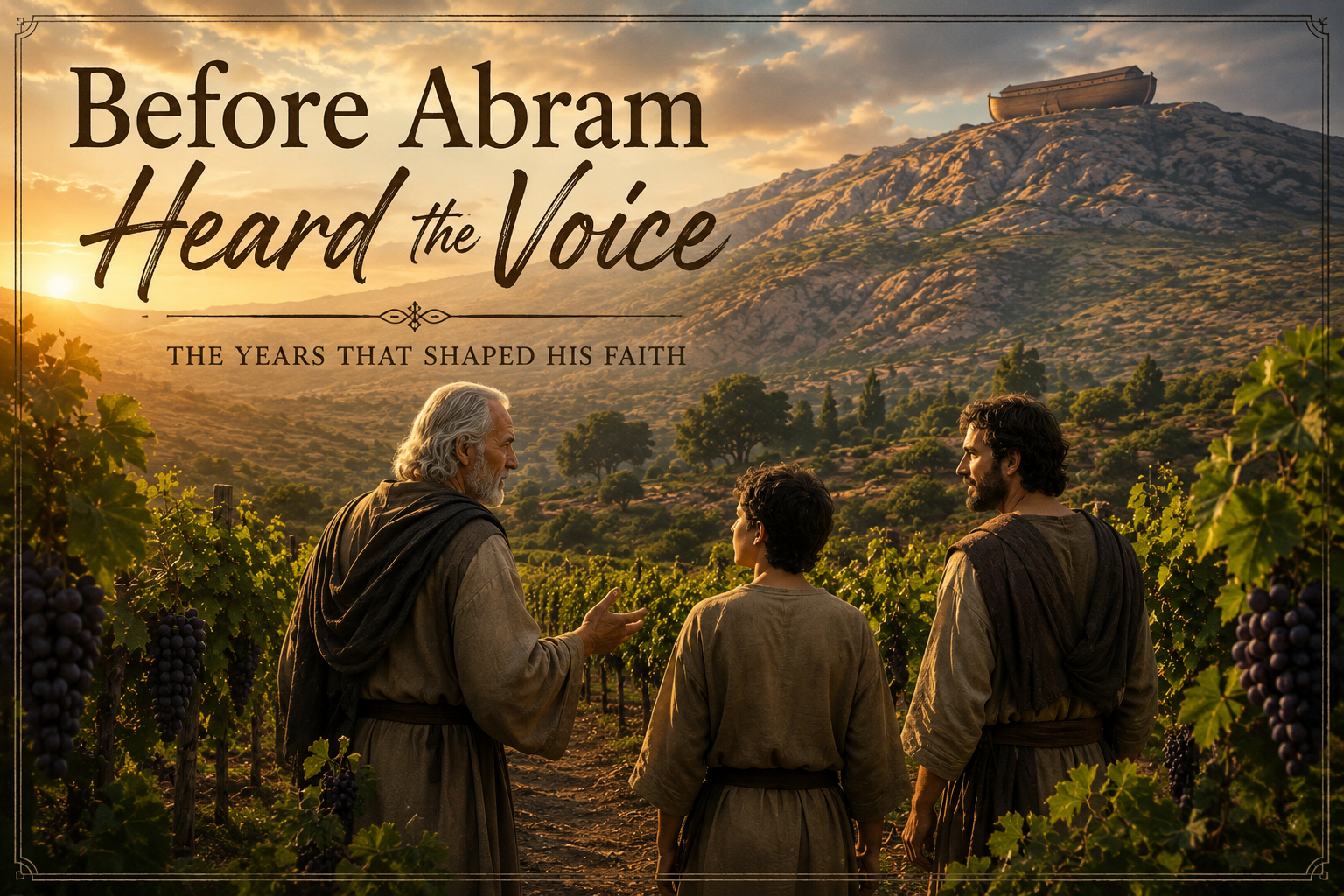
When you reach the end of this week's story, linger for a moment. An original song written especially for this reflection is waiting there.
Before Abram Heard the Voice
This week’s His-Story reflection is a little different.
Imagine a young boy, born into an pagan household, welcomed into the home of Noah and his son, Shem. Imagine forty years of shared meals, quiet walks, honest questions, and stories told beside the fire. Whether every detail happened exactly this way, no one can say. But the picture invites us to consider something timeless:
Faith is often formed long before God speaks.
Listen to this week's audio version:
Before Abram Heard the Voice
Before reading this week’s reflection, I invite you to do something a little different.
Rather than opening our Bibles immediately, I invite you to step into the quiet years that Genesis passes over so quickly.
Scripture introduces Abram as a man already prepared to hear the Father’s voice. It tells us where he came from, but says very little about the years that shaped his heart. Ancient Jewish manuscripts preserve a remarkable history that helps fill in those silent years. They tell of a young boy, born into an ungodly household that neither knew nor worshiped the Father, who was welcomed into the home of distant relatives—Noah and his son, Shem.
Whether every detail has been preserved perfectly, I cannot say. But the picture it paints echoes something we have already discovered throughout Genesis.
The Father is always moving toward people.
He sought Adam in the garden.
He protected Cain when no one else would.
He preserved Noah through the flood.
He scattered Babel rather than allowing humanity to destroy itself.
Perhaps it should not surprise us, then, that the next chapter begins with a child finding a place in the home of those who knew the Father well.
Not simply to save his life.
But to share one.
...
For nearly forty years Abram lived among them.
He rose with them in the morning, worked beside them through the day, shared meals around their table, laughed with their family, mourned their losses, and listened as ordinary moments became reminders of an extraordinary Father.
Noah carried the memories of a world that was gone.
Shem carefully preserved the history his father had lived.
Together, they gave Abram something his own household never had.
A place where questions were welcomed.
A table where he belonged.
A home where the Father was more than the subject of ancient stories.
It was not the stories that shaped him.
It was the people who lived them before his eyes.
They gave him a home where the character of the Father was lived before his eyes.
There were hundreds of conversations like these.
These are simply a few that I imagine Abram never forgot.
The Garments
The afternoon sun had begun its slow descent when the day’s work finally gave way to rest. Outside the tents, the women gathered together, laughing quietly as they stitched garments from softened animal hides. Children played nearby, chasing one another through the grass while the smell of fresh bread drifted from the cooking fire.
Abram had always enjoyed sitting near Noah.
The old man rarely hurried. Even in silence there was a gentleness about him that made people want to draw close.
That afternoon, Noah sat with a strip of leather resting across his knees, carefully trimming its edges with a small knife. Abram watched for several minutes before finally asking the question that had been turning in his mind.
“Grandfather... why do we still make garments from skins? Wouldn’t woven cloth be easier?”
Noah smiled but did not answer immediately.
Instead, he ran his weathered fingers across the leather as though remembering something far older than the hide itself.
“The first garments the Father ever made looked much like these.”
Abram looked up.
“For Adam and Eve?”
Noah nodded.
“They had already tried to cover themselves.”
“They sewed leaves together.”
“They hid among the trees.”
He paused.
“But leaves do not hide shame for very long.”
For several moments neither of them spoke.
The laughter of the women continued in the background.
A child squealed with delight somewhere beyond the tents.
Life quietly carried on around them.
Finally Noah spoke again.
“Do you know what I remember most about that story?”
Abram shook his head.
“It was not Adam’s failure.”
“It was not Eve’s deception.”
“It was not even leaving the garden.”
His eyes settled on the unfinished garment lying across his lap.
“It was that the Father went looking for them.”
“They were hiding from Him.”
“But He was not hiding from them.”
Noah lifted the garment into the afternoon light.
“And before they stepped into a world filled with thorns, sorrow, and death... the Father covered them with something made by His own hands.”
A short distance away, Shem had been listening while repairing a leather strap.
“The stories say Adam and Eve had already made coverings for themselves,” he added quietly. “But the Father knew their own covering would not be enough.”
Noah glanced toward his son and smiled.
Then he turned back to Abram.
“The Father did not leave them to carry their shame alone.”
Abram sat silently, watching the old man’s hands.
He had grown up in a household where men shaped gods with their own hands.
Here, he was hearing of a Father whose hands had shaped a covering for His frightened children.
Long afterward, Jesus would tell of another father who answered the shame of a returning son by calling for the finest robe.
But on that afternoon, Abram knew only that the Father had gone looking for those who were hiding from Him.
After a long while Noah rested one gentle hand upon the boy’s shoulder.
“Watch carefully, son.”
“The Father is always like this.”
The Door
Years passed.
The questions changed as Abram grew, but the conversations never seemed to end.
One cool morning, Noah, Shem, and Abram were repairing a section of fencing along the edge of the pasture. Beyond the fields, the weathered timbers of the ark could still be seen resting far above them against the mountainside. Time had darkened the wood, but nothing could erase the memories it carried.
Abram had looked at the great vessel a thousand times.
That morning, he finally asked.
“Grandfather... what was the hardest day?”
Noah kept working.
He drove the wooden mallet against the fence post once...
then again.
Only after the third strike did he answer.
“It was not building the ark.”
Another strike.
“It was not gathering the animals.”
He stopped.
Resting both hands on the handle of the mallet, he looked toward the massive hull in the distance.
“It was the day the Father shut the door.”
The words hung between them.
Abram waited.
He had learned that Noah never hurried a story.
“There were people outside that door whom I knew.”
A long silence.
“Friends.”
Another silence.
“Neighbors... even members of my own family.”
His voice became quieter.
“Children.”
Abram had never heard Noah speak this way.
The old man’s eyes never left the ark.
“I wanted to open that door.”
The confession came almost as a whisper.
“But I could not.”
Noah drew a slow breath.
“The Father had spoken.”
“And after all the years I had walked with Him...”
He paused.
“...I had learned to trust His heart, even when I could not understand His ways.”
Shem had stopped working.
For a moment he simply watched his father, as though he had seen that same grief return many times before.
“My father carried that day for the rest of his life,” Shem said softly.
Noah looked toward him.
Their eyes met, and nothing more needed to be said.
Then Noah turned back to Abram. His eyes were moist, but peaceful.
“Never mistake trust for the absence of sorrow.”
“The Father grieves more deeply than we ever will.”
Many generations later, the Father’s Son would stand outside the tomb of a friend and weep, even though resurrection was only moments away.
Knowing how the story ends does not make sorrow unreal.
Trust does not silence grief.
Sometimes it simply gives us someone to trust while we grieve.
Noah rested a hand on the young man’s shoulder.
“Watch carefully, son.”
“The Father is always like this.”
The Walk
There were mornings when no stories were told at all.
The work itself became the conversation.
One cool morning, Noah, Shem, and Abram walked the edge of the pasture together while the sheep grazed quietly nearby. Dew still clung to the grass, and the rising sun cast long shadows across the hills. The only sounds were birds greeting the morning and the occasional bleat of a lamb wandering too far from its mother.
Abram had learned to enjoy these quiet walks.
Neither Noah nor Shem seemed uncomfortable with silence.
In fact, some of the greatest lessons they shared were never spoken until long after the silence had done its work.
After a while Abram asked, “Grandfather... did the Father always speak to Adam?”
Noah smiled.
“I do not know.”
Abram looked surprised.
“You don’t?”
The old man chuckled.
“No.”
“Those stories passed through many generations before they reached me. Some things were remembered clearly. Other things belonged only to Adam and the Father.”
They continued walking for a few moments before Noah spoke again.
“But I remember what my grandfather used to tell us.”
“Enoch?” Abram asked.
“Yes.”
A smile crossed Noah’s face at the sound of his grandfather’s name.
“He often said that walking with the Father was not about keeping pace.”
Abram waited.
Noah laughed softly.
“When I was a boy, I thought he was talking about his feet.”
He shook his head with a smile.
“It took me many years to realize...”
“...he was talking about his heart.”
Shem smiled.
“Father told me that story when I was young too.”
“And did you understand it?” Abram asked.
“Not at first,” Shem answered. “Some truths have to be walked before they can be understood.”
The three continued along the edge of the pasture.
Finally Noah spoke again.
“The Father did not create mankind simply to give them work to do.”
“He created them because He simply wanted to be with them.”
Abram looked across the fields before asking quietly, “Is that why He came looking for Adam?”
Noah nodded.
“Yes.”
“He was not merely looking for a man.”
“He was looking for His friend.”
The words lingered in the cool morning air.
Centuries later, the Father’s Son would walk dusty roads with His disciples and call them His friends.
He would eat with them.
Rest beside them.
Listen to their questions.
Correct them when they misunderstood.
And remain near even when they failed Him.
After a long silence Abram asked one more question.
“Do you think the Father still walks with us?”
Noah stopped and looked at the young man beside him.
His eyes twinkled.
“Who do you think has been walking with us all morning?”
Abram instinctively glanced around the pasture.
Noah could not help but laugh.
Shem smiled and placed a hand on Abram’s shoulder.
“You will spend much of your life discovering this,” he said.
Noah nodded.
“The Father is often closest when we become quiet enough to notice.”
Abram smiled with them, but something inside him quietly shifted.
In the house where he had been born, gods were shaped by human hands and kept upon shelves.
Here, the Father could not be contained.
He walked through pastures.
He shared ordinary mornings.
And somehow, Abram was being welcomed into that walk.
They continued along the pasture.
Nothing remarkable happened that morning.
The sheep continued grazing.
The birds continued singing.
The wind whispered through the trees just as it always had.
It was, by every outward measure, an ordinary day.
Yet Abram would remember it for the rest of his life.
For the first time, he began to understand that the Father’s greatest desire was not merely to be obeyed...
It was to walk with His children.
Noah rested a gentle hand upon Abram’s shoulder.
“Watch carefully, son.”
“The Father is always like this.”
The Vineyard
The vineyards had become one of Noah’s favorite places.
Perhaps it was because vines required patience.
You could not hurry them.
Some branches reached eagerly toward the sun. Others sagged beneath their own weight and trailed along the ground.
Noah never discarded a branch merely because it had fallen low.
He would bend carefully, lift it from the earth, and secure it where it could receive the light again.
“A vine cannot bear fruit while it lies buried in the dust,” he once told Abram. “Sometimes it does not need to be cut away. Sometimes it simply needs someone to lift it.”
Years later, Jesus would describe His Father as a gardener who tended every branch so that it might bear fruit.
Abram often joined Noah and Shem among the vines.
The work was simple enough that conversation came easily. They walked the rows together, tying new growth to the stakes, lifting fallen branches from the soil, trimming away what hindered healthy growth, and quietly enjoying one another’s company.
On one such morning, Noah stopped beside a vine heavy with clusters of deep purple grapes.
A smile crossed his face.
Abram noticed.
“You always smile when we come here.”
Noah chuckled.
“I suppose I do.”
“Were vineyards always your favorite?”
The old man laughed softly.
“No.”
“They used to remind me of one of my greatest failures.”
Abram looked surprised.
“I have never heard that story.”
“No,” Noah answered. “Most people would rather remember the ark.”
A few rows away, Shem looked up from the vine he was tending.
“I remember both.”
Noah turned toward him.
“And I am thankful for both,” Shem continued.
“The ark reminds me of what the Father can preserve.”
He looked down at the vine in his hands.
“The vineyard reminds me of what the Father can restore.”
Noah held his son’s gaze for a moment, then nodded.
He reached out and gently turned a cluster of grapes in the morning light.
“After the flood, I planted my first vineyard.”
“It seemed like the beginning of a new world.”
His smile faded just a little.
“But one evening, I drank far more of its fruit than wisdom would have allowed.”
Abram remained quiet.
He knew enough to let Noah finish in his own time.
“I dishonored myself.”
“My family witnessed a shame I wish they had never seen.”
The old man sighed.
“I had survived the flood.”
“I had walked with the Father for centuries.”
“And yet...”
He looked down at his hands.
“...I discovered that the flood had washed the earth.”
“It had not washed away every weakness inside of Noah.”
The three resumed walking.
Only the sound of their sandals brushing the grass broke the silence.
Finally Abram asked, “Did the Father turn away from you?”
Noah stopped.
“Never!”
His answer came without hesitation.
“No more than He turned away from Adam.”
“No more than He turned away from Cain.”
“No more than He turned away from me when I stood inside the ark wondering if I could ever bear the weight of what had happened.”
His eyes met Abram’s.
“The Father has never loved perfect people.”
“If He had...”
A gentle smile returned.
“...He would have had no one to love.”
Abram could not help but smile.
Neither could Noah.
Shem shook his head, but he was smiling too.
Abram looked down at the branch Noah had lifted from the dirt only moments earlier.
He had seen gods discarded when they cracked.
He had seen idols thrown away when they no longer pleased their owners.
But the Father Noah described did not discard His children when they fell.
He bent low.
He lifted them from the dust.
He placed them where they could stand in the light again.
Then Noah rested a hand against one of the vines.
“The Father does not abandon His children when they stumble.”
“He teaches them to stand again.”
He looked toward Abram.
“Watch carefully, son.”
“The Father is always like this.”
The Stars
The years passed more quickly than any of them expected.
The boy had become a young man.
His questions had grown fewer—not because he had stopped wondering, but because he had learned that many answers were found simply by walking beside those who knew the Father well.
One evening, after the day’s work had ended, Noah, Shem, and Abram climbed a gentle rise overlooking the valley. They often came there when the weather was fair. No one needed to suggest it anymore. It had become one of those quiet traditions that families share without ever speaking about it.
They sat together as the last colors of sunset faded beyond the western hills.
One by one, the stars began to appear.
Then hundreds.
Then thousands.
Soon the heavens stretched from horizon to horizon with more light than Abram could ever hope to count.
Noah looked upward and smiled.
“Your forefather Adam looked upon these same stars.”
Abram followed his gaze.
After a long silence, Noah spoke again.
“So did Eve.”
“And Abel.”
His voice grew softer.
“And Enoch.”
“And many years later... so did we.”
“I remember standing upon the ark after the rain had ended.”
“The air had never seemed so clear.”
“The sky had never seemed so full.”
He paused.
“I remember thinking...”
Another pause.
“...the Father never stopped being faithful.”
None of them spoke for a long while.
There was no need.
The heavens were saying enough.
Finally Shem broke the silence.
“Your children will look upon these same stars someday.”
Abram turned toward him.
Shem continued looking upward.
“The generations change.”
“The Father does not.”
Noah lifted one weathered hand toward the heavens.
“Whenever you find yourself wondering...”
“...look up.”
“The heavens have a way of reminding us who the Father is.”
Abram said nothing.
He simply looked.
He did not know it then, but years later the Father Himself would lead him outside and say,
“Look now toward heaven, and count the stars if you are able to number them.”
When that day came, Abram would not be looking into an unfamiliar sky.
He would remember a lifetime spent beside two faithful men who had shown him the Father’s heart.
He would remember quiet walks.
A place at their table.
Hands that lifted fallen branches.
Stories told without hurry.
A father and a grandfather who had welcomed his questions and shared their lives with him.
Because it was never simply about the stars.
It was about the Father who made them.
And it was not the stories that shaped Abram’s faith.
It was the people who lived them before his eyes.
Conclusion
As I imagine those quiet years, I find myself asking a different question than I once would have.
Not...
“What did Noah and Shem teach Abram?”
But...
“What kind of home did they give him?”
It was a home where the stories of the Father were spoken naturally over meals, during work, while walking through vineyards, and beneath the stars.
It was a home where questions were welcomed.
Where silence was not awkward.
Where failure was confessed honestly.
Where mercy was remembered often.
It was a home where the character of the Father was lived before a young man’s eyes.
Perhaps Abram remembered more than their stories.
Perhaps he remembered what it felt like to be given a place among them.
To be called “son.”
To discover that failure did not mean abandonment.
To learn that the Father did not remain distant upon a shelf, waiting to be served.
He walked with His children.
He covered their shame.
He grieved with them.
He lifted them when they fell.
He led them outside and taught them to look toward heaven.
Perhaps that is how faith has always grown.
Not merely through sermons.
Not merely through books.
But around tables.
Along dusty paths.
Through ordinary conversations.
Beside people whose lives quietly whisper,
“Watch carefully, son.”
“The Father is always like this.”
A Song for This Story
Ryan wrote this song to accompany Before Abram Heard the Voice.

0 Comments