
Before reading this week's His-Story, please take a few minutes to read Genesis chapters 33, 34, and 35.
I know that's more reading than usual, but understanding the whole story is especially important this week. These chapters take us from a beautiful reconciliation between brothers into a deeply disturbing account of deception and violence, and finally to an extraordinary invitation from God.
Please don't skip the difficult chapter in the middle. Without it, we may miss something remarkable about what the Father does next. Read the story as a whole, and keep asking the question that has guided us throughout His-Story: What does this reveal about the Father?
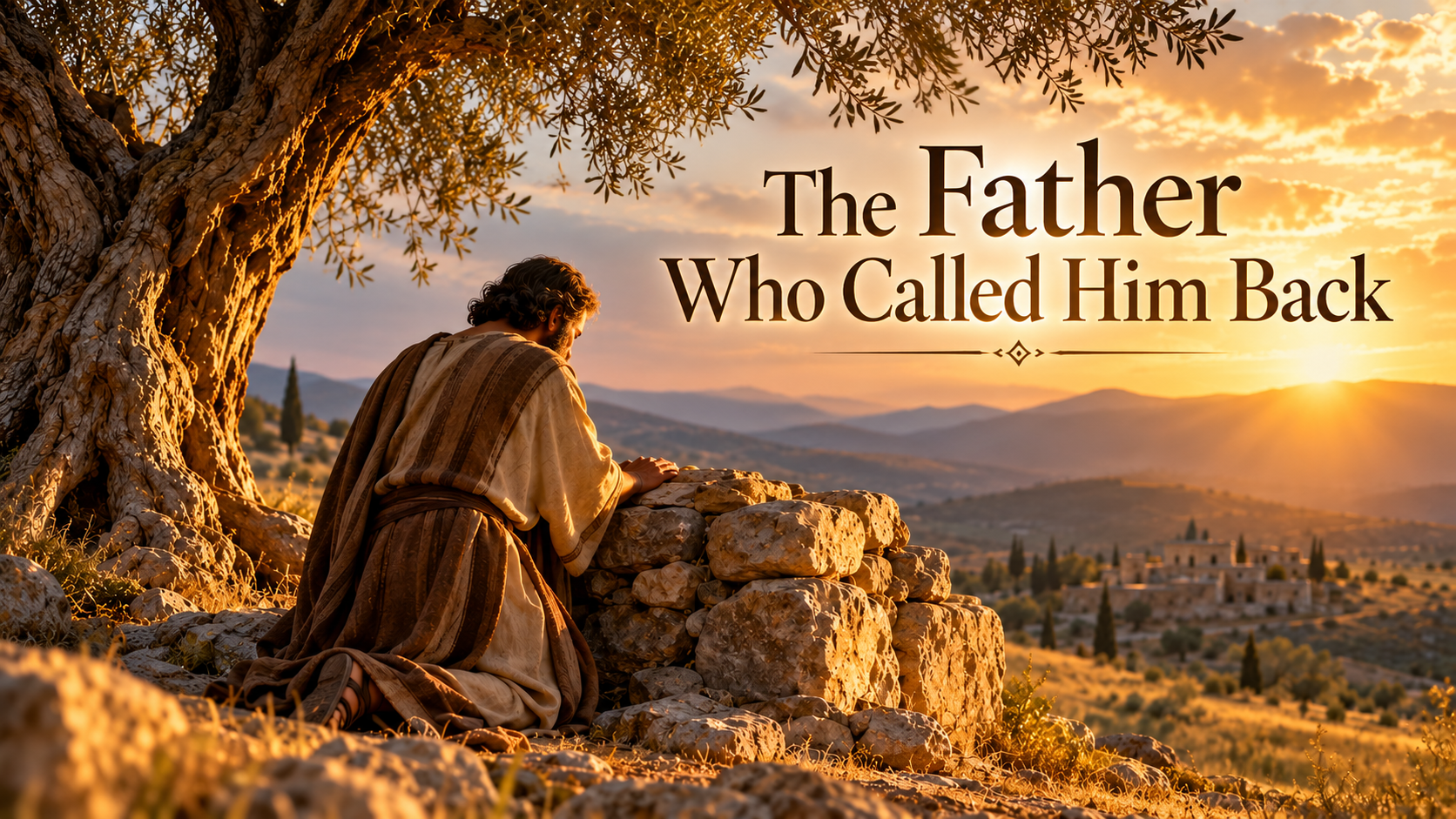
The Father Who Called Him Back
Perhaps one of the most troubling things we discover in Scripture is what happens when people who carry God's name act without reflecting His character.
And sometimes, those people look uncomfortably familiar.
Jacob had encountered God at Bethel, witnessed His faithfulness through twenty difficult years, wrestled with Him beside the Jabbok River, and received a new name: Israel. Yet receiving that name hadn't suddenly transformed every part of his life. And it certainly hadn't made his household a family that consistently reflected the Father's heart.
What happens next is heartbreaking.
When we left Jacob last week, he had experienced an extraordinary reconciliation with Esau. The brother he had feared for twenty years had embraced him and wept with him. It was a beautiful moment, especially considering everything that had happened between them.
Jacob told Esau that he would follow him toward Seir, traveling slowly because of the children and livestock. But Scripture next follows Jacob to Succoth and eventually to Shechem. We don't know whether he intended to visit Esau later, yet it's difficult not to notice how much this resembles the Jacob we've known throughout his life. He had been renamed Israel, but there were still traces of the old Jacob.
Near Shechem, he purchased land and built an altar to God. He hadn't abandoned Yahweh. He was still worshiping the One who had brought him home. But he hadn't returned to Bethel, where God first met him when he was fleeing his brother.
And then something terrible happened.
The story continues with the disturbing account of Dinah, Jacob's daughter, and Shechem, the son of a local ruler. The biblical account describes Shechem's treatment of Dinah as a violation. Yet afterward, we're told that he loved her, spoke tenderly to her, and wanted to marry her. There are things about this encounter we simply don't know, and Dinah herself is never given a voice in the account.
Her brothers, however, were furious. In their culture, what had happened was a serious offense against Dinah and her family. Their anger was understandable, but what followed was not.
Jacob's sons told the men of Shechem that their families could join together through marriage, but only if the men agreed to be circumcised. Think about that. Circumcision was the sign of God's covenant with Abraham, representing a family set apart by God and entrusted with His promises. And Jacob's sons used that sacred sign as an instrument of deception.
While the men of the city were recovering, Simeon and Levi attacked and killed them. The other brothers then plundered the city, taking possessions, livestock, women, and children.
They may have believed they were defending their sister and their family's honor, but their actions went far beyond justice. Nowhere does Scripture tell us that God commanded or approved of what they did. In fact, years later, Jacob would condemn Simeon and Levi's violence and anger.
It's a terrible chapter, and perhaps the most disturbing thing is how little these people seem to resemble the God whose promises they carry. They know the covenant, the traditions, and the stories of Abraham and Isaac.
Jacob is frightened. He knows the surrounding peoples may retaliate, and he fears his household could be destroyed. The chapter ends with his sons defending their actions, but there is no resolution, no comforting explanation, and no recorded word from God.
Just a family surrounded by the consequences of terrible choices.
Perhaps you've known something of that feeling. Maybe you've made decisions you wish you could undo, allowed things into your life that never belonged there, or wandered further from the Father's heart than you ever imagined. Sometimes the consequences remain long after the moment has passed, and you wonder what the Father must think of you now.
But the story doesn't end at Shechem.
The next chapter begins with words I find extraordinarily moving.
After everything that had happened, after the deception and violence, after the fear and uncertainty, the Father spoke.
"Arise, go up to Bethel and dwell there. Make an altar there to the God who appeared to you when you fled from your brother Esau."
Genesis 35:1
Notice what God said. He didn't simply tell Jacob to move to another town. He reminded him of a moment in their history together.
Twenty years earlier, Jacob had been alone, frightened, and uncertain of his future. He had deceived his father, angered his brother, and fled from everything familiar. He lay down with a stone beneath his head, and there, in the darkness, the Father came to him.
God made an extraordinary promise that night:
"Behold, I am with you and will keep you wherever you go, and will bring you back to this land. For I will not leave you until I have done what I have promised you."
Genesis 28:15
And He had kept His promise. Jacob had returned to Canaan with a large household, substantial possessions, and the unexpected blessing of reconciliation with his brother.
But Jacob had not yet returned to Bethel.
There's an interesting contrast with Abraham. After his difficult experience in Egypt, Abraham returned to the place where he had previously built an altar, between Bethel and Ai, and there he called upon the name of the LORD.
Abraham returned to the altar. Jacob's story was different.
And there's something profoundly tender in that distinction. The Father didn't wait for Jacob to remember the way. He didn't wait until Jacob's household had everything straightened out. He reminded Jacob of the place where they had first met, when Jacob was frightened and running from the consequences of his own choices.
Now, after another terrible chapter in his family's history, the Father was calling him back again.
Not because the things that had happened no longer mattered, or because God had overlooked the violence and deception. But because His relationship with Jacob was not finished.
Jacob may have lost his way, but the Father had never lost sight of Jacob.
What happens next reveals just how far Jacob's household had drifted. Jacob tells his family:
"Put away the foreign gods that are among you and purify yourselves and change your garments."
Genesis 35:2
Foreign gods, in the household of Abraham's grandson.
This was the family that carried the promises of Yahweh. They had witnessed His protection, provision, and faithfulness, yet somehow other gods had found a place among them. Years earlier, Rachel had stolen her father's household gods. We don't know whether those particular idols were still present, but clearly the household had not remained free of them.
And yet, notice the order of events.
And Jacob responded.
There's a beautiful principle here that we also find in Paul's words to the Romans: God's kindness is meant to lead us toward repentance. The Father's gracious initiative doesn't make change unnecessary. It gives us a reason to respond.
The family surrendered its foreign gods and earrings, and Jacob buried them beneath a tree near Shechem. Scripture doesn't explain why he buried them rather than destroying them, but in that moment the household was leaving them behind.
Then Jacob said something beautiful:
"Let us arise and go up to Bethel, so that I may make there an altar to the God who answers me in the day of my distress and has been with me wherever I have gone."
Genesis 35:3
After everything, Jacob could still look back and recognize the Father's faithfulness. He remembered the God who had answered him in distress, the God who had accompanied him through twenty difficult years, the God who had never abandoned him.
Jacob had not always been faithful, but the Father had.
As Jacob and his household traveled toward Bethel, a terror from God fell upon the surrounding cities, and no one pursued them. Jacob had feared retaliation for his sons' violence, yet the Father protected them on their journey.
That protection did not mean God approved of what happened at Shechem. But the family's failures had not brought an end to His faithfulness.
At Bethel, Jacob built an altar, and God appeared to him again. Once more, the Father spoke the name Israel over him and renewed the promises made to Abraham and Isaac. Nations and kings would come from his descendants, and the land promised to his fathers would belong to those who came after him.
The Father wasn't merely reminding Jacob of something that happened twenty years earlier. He was reminding him that their story wasn't finished. His purposes extended beyond Jacob's lifetime, beyond his failures, and beyond the failures of his household.
Centuries later, Paul would write:
"If we are faithless, he remains faithful—for he cannot deny himself."
2 Timothy 2:13
Those words were written in a different setting, and they are not a promise that our choices have no consequences. But they remind us of something we've been discovering throughout Genesis: the Father's faithfulness is rooted in who He is, not in our ability to live without failure.
The promise to Jacob was still alive because the One who made it was still faithful.
I wonder whether some of us have a Bethel somewhere in our memories.
Not necessarily a physical place, but a time when we first began to recognize the Father's presence. Perhaps it was a season when trust seemed simpler, when we were discovering His love and beginning to understand that He was far more gracious than we had ever imagined.
But life happened. We made mistakes, experienced disappointments, and sometimes failed in ways we never expected. Perhaps we became distracted or allowed other things to occupy places in our hearts that once belonged to Him. And somewhere along the way, the closeness we once knew seemed to fade.
Maybe you've looked back on those earlier days and wondered whether you could ever know the Father that way again.
I don't want to suggest that our failures don't matter. They do. Sometimes they leave wounds that take years to heal, and sometimes they affect people who never deserved the pain we caused. The Father doesn't ask us to pretend otherwise, and His faithfulness doesn't excuse our wrongdoing.
But neither does He abandon us to the worst chapters of our lives.
Think about Jacob. The Father knew the entire story. He knew about the deception, the violence, the fear, and the idols. He knew how far this family had wandered from the character of the God whose promises they carried.
Not simply to a place on a map, but to the place where Jacob could remember the One who had been with him all along.
I think that's what makes this story so moving. Jacob didn't have to convince the Father to remember their relationship. He didn't have to remind God of the promises made beneath the stars twenty years earlier.
Perhaps your Bethel feels like a distant memory. Perhaps too much has happened, and you wonder whether the relationship you once knew can ever be restored. Or perhaps you've spent years knowing about God, while quietly longing to know Him more deeply.
The invitation to Jacob reminds us that the Father's faithfulness does not end where our faithfulness fails. His call is not an invitation to pretend the past never happened, but to come toward Him with all the unfinished places in our lives.
Abraham found his way back to the altar. Jacob needed the Father to call him.
And perhaps that's the most beautiful thing we've discovered this week.
Even when Jacob had not returned to the place where he first met God, the Father had not forgotten where to find him.
And perhaps the Father who called Jacob back is calling you, even now, to know Him more deeply.