The God Who Sees Me
Before reading this week’s reflection, I encourage you to slowly read Genesis 16.
🎧 Listen to this week’s reflection
The God Who Sees Me
The story of Abram has been filled with extraordinary moments.
The Father called him from his homeland. He spoke to him beneath the stars. He promised descendants beyond number. He walked the blood path and placed Himself behind His promise.
Then Genesis does something unexpected.
It turns our attention away from Abram.
And follows a servant woman into the wilderness.
Her name is Hagar.
Sarai has waited years for the child the Father promised. She is growing older, and still there is no son. So she gives her Egyptian servant Hagar to Abram as a wife.
Modern readers are often quick to stop here and declare that Abram and Sarai have lost faith and decided to accomplish God’s promise themselves.
Perhaps.
But Genesis doesn’t actually say that.
In their world, a barren wife giving her servant to her husband as a wife in order to produce an heir was culturally recognizable. And although the Father had promised Abram that his heir would come from his own body, He had not yet explicitly said that Sarai would be the mother.
So perhaps we should be slower to judge and simply allow Genesis to tell the story.
Hagar conceives.
And almost immediately, things begin to unravel.
Genesis tells us that when Hagar realizes she is pregnant, Sarai becomes despised in her eyes. The servant can suddenly do the one thing her mistress has desperately wanted to do for years.
Sarai responds harshly.
The Hebrew is uncomfortable. The word carries the idea of affliction, oppression, or harsh treatment.
Whatever happened inside those tents, it became unbearable enough that Hagar ran.
Genesis doesn’t give us a hero in this conflict.
Hagar is flawed.
Sarai is flawed.
Abram is flawed.
Sometimes people who genuinely know the Father still hurt one another.
And sometimes we are the ones who get hurt.
Hagar is living inside decisions largely made by people with more power than she has. She didn’t choose Sarai’s barrenness. She didn’t make the promises that had shaped Abram’s household. She didn’t create the longing and tension surrounding an heir.
Yet somehow she finds herself carrying the consequences.
Millions of people know what that feels like.
Sometimes the wounds we carry were caused by decisions we never made. A parent. A spouse. An employer. A church. Someone with authority. Someone we trusted.
Sometimes we contributed to the mess ourselves.
Sometimes we didn’t.
And sometimes the pain becomes so great that all we know to do is run.
Hagar runs into the wilderness.
And then comes one of the most beautiful little sentences in Genesis:
“Now the Angel of the LORD found her by a spring of water in the wilderness...”
— Genesis 16:7
The great story of Abraham and the covenant suddenly leaves the patriarch behind and follows an Egyptian servant woman into the desert.
And the Father goes looking for her.
This shouldn’t surprise us.
When Adam hid among the trees, the Father came asking, “Where are you?”
When Cain stood alone with the blood of his brother crying from the ground, the Father came and spoke to him.
And centuries later, Jesus would describe the same heart:
“For the Son of Man has come to seek and to save that which was lost.”
— Luke 19:10
The Father has always been a seeker.
And now He seeks Hagar.
Then He does something remarkably tender.
He calls her by name.
“Hagar, Sarai’s maid, where have you come from, and where are you going?”
— Genesis 16:8
The Father knows exactly where she has come from.
He knows exactly where she is going.
The questions are not for Him.
They are for her.
Hagar can answer the first.
“I am fleeing from the presence of my mistress Sarai.”
But she never answers the second.
She doesn’t know where she is running to.
Maybe you’ve been there.
You know what hurt you.
You know what you’re trying to escape.
You just don’t know what comes next.
But the Father does.
He tells Hagar to return, and then He speaks an extraordinary promise over her:
“I will multiply your descendants exceedingly, so that they shall not be counted for multitude.”
— Genesis 16:10
Listen to that language.
It sounds remarkably similar to the blessing spoken over Abram.
The Father does not merely keep Hagar alive and send her back to Abram’s household.
He blesses her.
Then He tells her about the child she carries:
“You shall call his name Ishmael, because the LORD has heard your affliction.”
— Genesis 16:11
The cries Hagar may have believed disappeared into the wilderness had reached the Father.
He heard what happened.
He heard her pain.
He heard her affliction.
And Hagar suddenly realizes something even greater.
The One who found her was not merely a messenger passing along information from a distant God. Genesis tells us plainly:
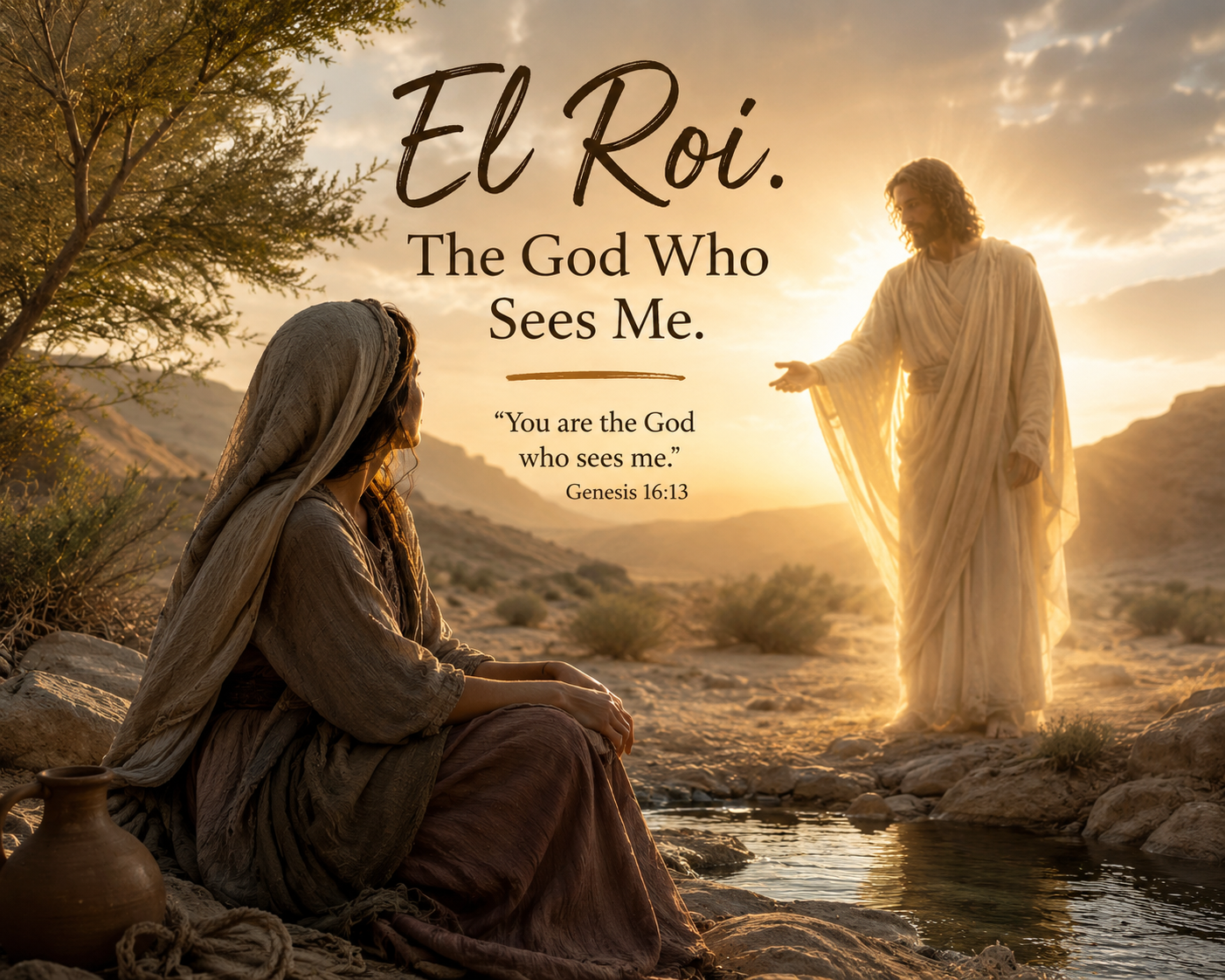
“Then she called the name of the LORD who spoke to her, You-Are-the-God-Who-Sees...”
— Genesis 16:13
The LORD who spoke to her.
Yahweh.
And Hagar gives Him a name born from her own encounter:
Ishmael’s name declares:
The Father hears.
Hagar’s name for God declares:
The Father sees.
And suddenly this little wilderness encounter reveals something enormous about the Father.
We expect Him to pursue Abram.
Abram is the patriarch.
Abram carries the promise.
Abram is the man who stood beneath the stars and watched the Father walk the blood path.
But Hagar?
She’s an Egyptian servant woman running through the wilderness.
The world could easily overlook her.
And centuries later, Scripture gives us a strangely familiar scene.
Another complicated story.
Another well.
This time she is a Samaritan, and Jesus meets her beside the water. He knows the parts of her story a stranger could not possibly know. And after encountering Him, she leaves her waterpot behind and runs into the city saying:
“Come, see a Man who told me all things that I ever did.”
— John 4:29
Hagar had discovered it centuries before.
He sees me.
Different well.
Same God.
We shouldn’t miss who these women are.
Neither is a patriarch. Neither possesses great social standing. Neither appears to be someone around whom we would expect God to build an extraordinary encounter.
Yet both walk away as witnesses to something they discovered about Him.
And perhaps that is what someone needs to hear today.
You may have been hurt by someone who should have loved you better.
You may be living with consequences from decisions you never made.
You may even have contributed to the mess and wonder whether that disqualifies you from being pursued by the Father.
Hagar’s story says otherwise.
The Father did not have to choose between loving Abram and seeing the woman Abram’s household had wounded.
He loved Abram.
Maybe you cannot see what the Father is doing right now.
Maybe you don’t know where you’re going.
Maybe all you know is where you’ve come from.
But you have not disappeared from His sight.
The Father hears.
The Father sees.
And sometimes, in the wilderness, we discover something about Him that we could never have learned inside the safety of the tent.

I love this !! I so want to share it with my son tonite! He does not believe that God answers his prayers but does mine.
Thank you, Jessica. I hope you do share it with him. It can be so difficult when we pray and don’t see the answer we hoped for. That’s one of the things I love about Hagar’s story—the Father heard her even before she could see what He was doing. An unanswered prayer is not necessarily an unheard prayer. I hope your son comes to know that the Father sees him, hears him, and has not forgotten him.
Thank you, Jessica. I hope you do share it with him. It can be so difficult when we pray and don’t see the answer we hoped for. That’s one of the things I love about Hagar’s story—the Father heard her even before she could see what He was doing. An unanswered prayer is not necessarily an unheard prayer. I hope your son comes to know that the Father sees him, hears him, and has not forgotten him.