
Before reading this week's reflection, I encourage you to read Genesis 36 and 37.
As you read, try to forget what you already know about Joseph's future. Don't rush ahead to the palace, the famine, or the reunion with his brothers.
For now, Joseph is seventeen years old, and his story is about to fall apart.
And as we have done throughout this journey, ask yourself one question:
What does this reveal about the Father?
The God Who Seemed Silent
What happens to our faith when the God we've been taught to trust doesn't seem to be doing what we've been taught He does?
That's a question I wish I had never needed to ask.
From the beginning of His-Story, we've been listening for the voice of God. We heard Him speak into the darkness of creation. We heard Him call to Adam in the garden, give Noah instructions for the ark, and invite Abraham to leave everything familiar for a land he had never seen.
Abraham heard His voice. Isaac encountered Him. Jacob met Him at Bethel, wrestled with Him beside the Jabbok, and heard Him call him home when he had wandered.
Again and again, we've discovered a Father who speaks, promises, intervenes, and reassures His children of His faithfulness.
These were the stories Joseph inherited. Stories of a faithful Father who watched over His children, kept His promises, and never forgot those He loved.
And now, everything was about to change.
But first, Genesis pauses to tell us about Esau.
Chapter 36 records his descendants, their territories, their chiefs, and even their kings. Esau's family was becoming an established nation, while Jacob's family, the very family entrusted with God's covenant promises, was struggling to hold itself together.
There's something worth remembering here.
Esau's descendants were flourishing. Jacob's household was about to experience betrayal, grief, and division. And the Father had not forgotten either family.
Then Genesis introduces Joseph.
He was seventeen years old, the son of Rachel, the woman Jacob had loved so deeply. And Jacob loved Joseph more than his other sons.
Think about that for a moment.
Jacob had grown up in a family divided by favoritism. Isaac favored Esau. Rebekah favored Jacob. That division had nearly destroyed their household. Yet here was Jacob, repeating the very pattern that had caused so much pain in his own life.
He gave Joseph a special garment, publicly distinguishing him from his brothers.
And they hated him for it.
Then came the dreams.
Joseph dreamed of his brothers' sheaves bowing before his own. Later, he dreamed of the sun, moon, and eleven stars bowing before him.
Were these dreams from God? The story will eventually give us reason to understand them that way, although Genesis 37 doesn't explicitly identify their source.
Was Joseph arrogant in sharing them? Perhaps he was an immature teenager who didn't understand how deeply his brothers resented him. But Scripture doesn't tell us that either.
What it does tell us is that his brothers hated him even more.
And although Jacob rebuked Joseph, he kept the matter in mind.
I wonder what Joseph imagined those dreams meant. Did he envision a future of honor and blessing? Did he believe something extraordinary was waiting for him?
We don't know.
But whatever Joseph imagined, I doubt it looked anything like what happened next.
One day, Jacob sent Joseph to check on his brothers, who were tending their flocks some distance from home. When they saw him approaching, they began plotting his death.
Their own brother. The son of their father. The young man who had grown up alongside them.
They called him “this dreamer,” and decided to see what would become of his dreams.
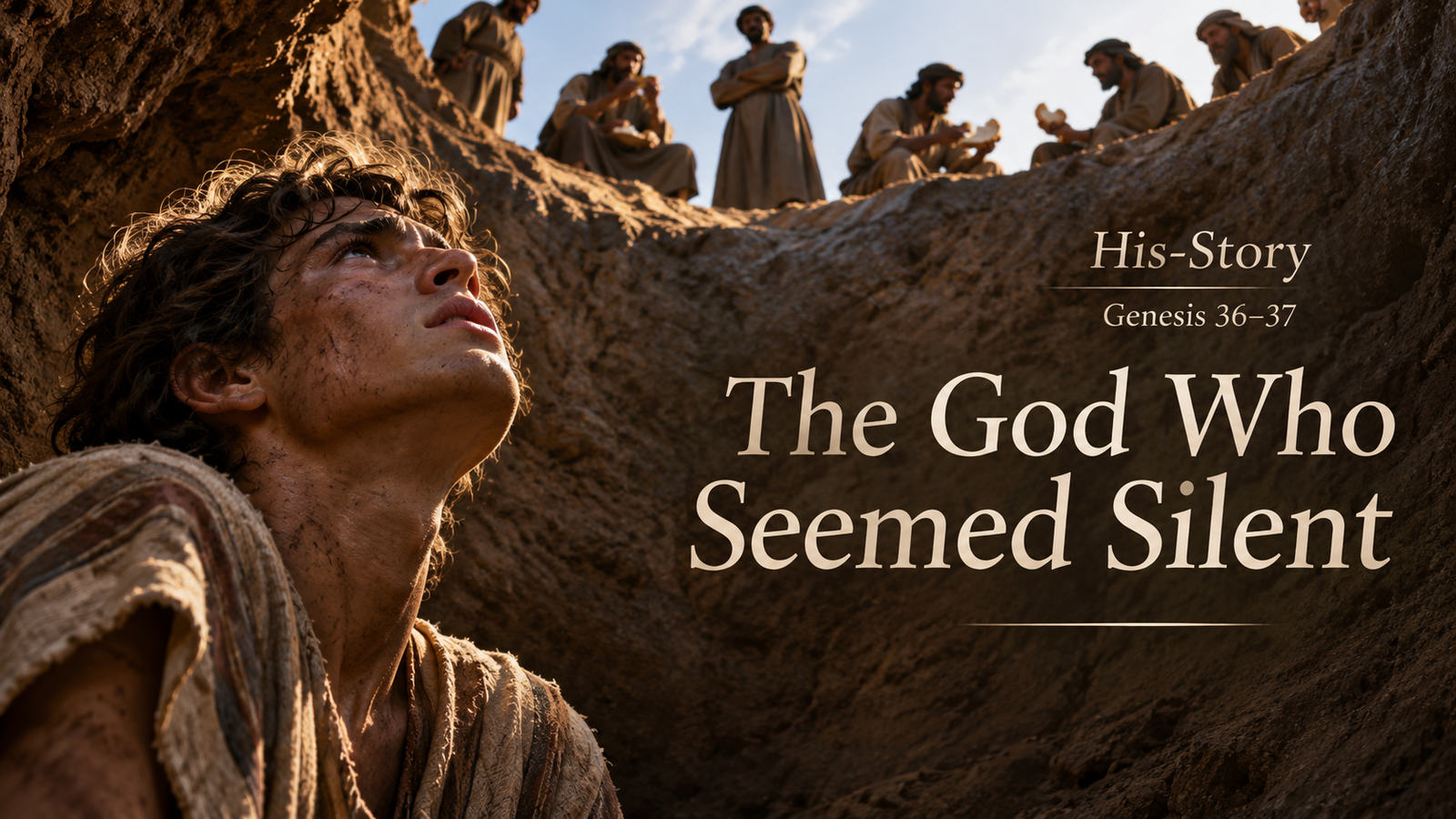
Reuben persuaded them not to kill him outright. Instead, they stripped Joseph of his special garment and threw him into an empty pit.
And suddenly, the dreams and the reality could hardly have been more different.
In Joseph's dreams, his brothers bowed before him. But now those same brothers stood above him while he lay helpless at the bottom of a pit. Whatever those dreams meant, the circumstances before him seemed to tell an entirely different story.
Then his brothers sat down to eat.
I find that detail almost unbearable.
Their seventeen-year-old brother was trapped at the bottom of a pit, and they sat down to have a meal.
Genesis 37 doesn't tell us much about Joseph's reaction. But years later, his brothers would remember something that reveals the terrible reality of that moment.
“We saw the distress of his soul, when he begged us and we did not listen.”
Genesis 42:21Joseph was begging his own brothers for mercy, and they wouldn't listen.
I wonder whether he called each of them by name. Whether he reminded them of their father. Whether he believed someone would eventually come to his rescue.
We aren't told.
But there's another silence in this story that troubles me even more.
No angel appeared at the edge of the pit. No voice spoke from heaven. No miraculous intervention stopped what was happening.
The God who had spoken to Abraham, Isaac, and Jacob seemed silent when Joseph desperately needed Him.
And I wonder what that silence felt like.
Joseph had inherited generations of stories about God's faithfulness. He knew about the promises, the blessings, the remarkable encounters, and the God who had never abandoned his family.
But now he was sitting in a pit. His brothers hated him, his father wasn't coming, and the Father he had heard so much about seemed nowhere to be found.
Did Joseph feel abandoned? Did he wonder whether God had rejected him? Did he question the dreams?
Scripture doesn't tell us, and we shouldn't pretend to know.
But I know something about what it feels like when the God you've spent your life believing in doesn't seem to be doing what you were certain He would do.
When everything you've been taught about His faithfulness collides with circumstances you cannot explain. When the promises you thought you understood suddenly seem painfully distant, and the silence feels like abandonment.
Sometimes the most painful part isn't what has happened to us.
It's that the Father we thought we knew has become a Father we can no longer understand.
Joseph would not be the last of God's people to encounter this terrible tension.
Generations later, David would cry,
“My God, my God, why have you forsaken me?”
Psalm 22:1Another psalmist would ask,
“O LORD, why do you cast my soul away? Why do you hide your face from me?”
Psalm 88:14And the prophet Habakkuk would plead,
“O LORD, how long shall I cry for help, and you will not hear?”
Habakkuk 1:2These weren't the words of people who had rejected God. They were the cries of people who knew His promises but couldn't reconcile those promises with what they were experiencing.
And notice something remarkable.
Psalm 88 is especially striking because it doesn't end with deliverance or an explanation. It ends in darkness. The writer continues crying out to God, but the circumstances remain unresolved.
Apparently, the Father is not afraid of our unanswered questions.
And perhaps we shouldn't be afraid of them either.
Throughout His-Story, we've spoken often about the importance of hearing the Father's voice. We've encouraged one another to listen, to recognize His voice, and to discover the extraordinary intimacy of knowing Him rather than simply knowing about Him.
But Joseph's story confronts us with a question we cannot simply ignore.
Most of us will live our entire lives without hearing an audible voice from heaven. We read about extraordinary encounters in Scripture, and sometimes we long desperately for something similar.
We want to hear Him. We want to know that He's near. We want some reassurance that He hasn't forgotten us.
And sometimes we receive none of those things.
We've become remarkably skilled at explaining God's silence to people who are desperately longing to hear Him. But explanations can sound terribly hollow from the bottom of a pit.
Sometimes we're told to pray harder, listen more carefully, or simply trust that God is working behind the scenes. Perhaps there's wisdom in some of those words, but they don't necessarily answer the question that troubles us most.
There's something I've had to learn, sometimes painfully.
I can know Him, love Him, and trust Him without pretending that I understand everything He does or allows. But I also know there are moments when even trusting Him feels terribly difficult.
And I don't believe we need to disguise that struggle with religious explanations.
Meanwhile, Joseph's brothers sold him to traders traveling toward Egypt. Then they took his special garment, dipped it in the blood of a goat, and brought it to Jacob.
There's a painful irony here.
Years earlier, Jacob had used a goat and his brother's clothing to deceive his father Isaac. Now his own sons used a goat and Joseph's garment to deceive him.
The man who had once deceived his father was now devastated by the deception of his sons.
And Jacob mourned.
He believed Joseph had been torn apart by a wild animal. His children tried to comfort him, but he refused to be comforted.
The family carrying God's promises was being torn apart by its own failures.
And Joseph was being carried away toward Egypt, away from his father, his home, and everything familiar.
We know nothing of his thoughts as that caravan traveled south. Perhaps he prayed, wept, or struggled to understand why the God of his fathers had allowed this to happen.
We simply don't know.
But perhaps that's what makes his story so painfully familiar.
There are seasons when we cannot reconcile the Father we've come to know with the circumstances we're living through. When His silence feels like abandonment, and every explanation we've ever trusted seems painfully inadequate.
We cannot see what the Father is doing. We cannot understand why He hasn't intervened, and we have no assurance that tomorrow will look any better than today.
I wish I could tell you why the Father sometimes remains silent.
I can't.
I wish I could promise that every pit leads to something wonderful, that every unanswered prayer will eventually make sense, and that every painful experience will someday be explained.
But I can't promise those things either.
And I don't believe that's what Joseph's story is asking us to believe.
Perhaps the invitation is something deeper, and much more difficult.
To discover that the Father is still God, even when He doesn't behave according to our expectations. That His faithfulness is not measured by how clearly we can recognize His activity, and that His character doesn't change simply because our understanding of Him has been shaken.
That's difficult to understand, and perhaps we aren't meant to explain it away.
Joseph was being carried toward Egypt. His father believed he was dead. His brothers had betrayed him, and the God of his fathers had offered no explanation.
We don't know what Joseph believed about God in that moment. We don't know whether he could still recognize the Father in any of it.
And perhaps, for now, we have to leave those questions unanswered.
I've come to believe that my inability to understand the Father doesn't mean He has ceased to be who He is.
But believing that doesn't always make the silence easier.

His silence should not be taken as a form of correction or punishment. Sometimes we simply need to learn to wait on God.