The Father Was Still There
Before reading this week’s reflection, I encourage you to slowly read Genesis 25 and 26.
Abraham’s story is coming to an end.
The man who left everything familiar because God called his name has spent a lifetime walking with the Father. He trusted. He doubted. He failed. He waited. Sometimes he tried to make the promises happen himself. But through all of it, the Father remained faithful.
Now Abraham will die, and the story will pass to another generation.
As you read, keep asking the question we have been asking throughout His-Story:
What does this teach us about the Father?
The Father Was Still There
Abraham was an old man.
Sarah was already gone. She had died without seeing the nation God promised, without seeing her grandchildren, and without seeing Abraham possess the land except for the field he purchased so he could bury her.
Yet just before telling us of Sarah’s death, Genesis had said something remarkable:
“The LORD had blessed Abraham in all things.” (Genesis 24:1)
There stood a blessed man beside his wife’s grave.
That image may challenge some of the ways we have learned to think about blessing.
Before his own death, Abraham put his household in order. He gave gifts to the sons of his concubines and established them away from Isaac while he was still living. But Genesis makes clear where the inheritance would remain:
“Abraham gave all he had to Isaac.” (Genesis 25:5)
Then Abraham died.
He was 175 years old. The man who had left his country without knowing where he was going had finally reached the end of his journey. He had crossed deserts and built altars. He had known fear and failure, laughter and grief. He had waited decades for a promised son, held that son in his arms, and years later placed him on an altar.
Abraham had not merely learned things about God along the way. Through all those years of walking, stumbling, questioning, trusting, and beginning again, Abraham had come to know the Father.
Now he was gone.
Then Genesis gives us a small detail that deserves more than a passing glance:
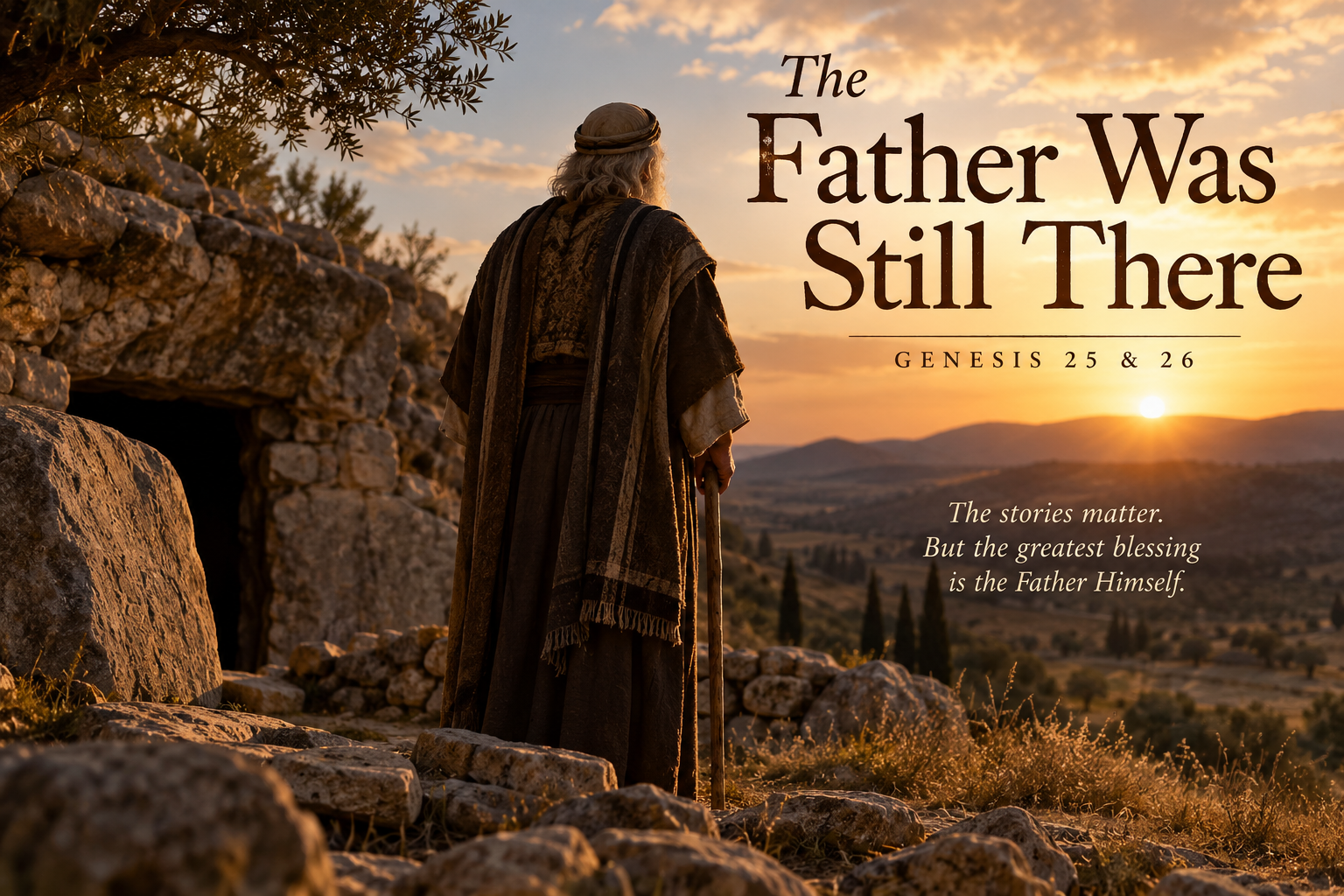
“Isaac and Ishmael his sons buried him in the cave of Machpelah.” (Genesis 25:9)
The last time Genesis showed us Isaac and Ishmael as children, their family was being torn apart. Sarah demanded that Hagar and Ishmael be sent away, and Abraham was deeply distressed because Ishmael was his son. Now Sarah was gone, Hagar had disappeared from the story, and the two sons stood together at their father’s grave.
Genesis does not tell us what happened between Isaac and Ishmael during all the years between those scenes. It does not tell us what they said at Machpelah, or whether they said anything at all. We do not need to invent a reconciliation story Genesis does not give us.
It simply tells us that they came.
Together, they buried their father.
Ishmael had been sent away from Abraham’s household, but he had never been sent beyond the Father’s care. God had heard him crying in the wilderness. God had promised that he too would become a great nation. And after Abraham’s burial, Genesis pauses long enough to name Ishmael’s twelve sons, just as God had promised. (Genesis 17:20; 25:12–16)
The Father had not forgotten him.
But the promise given to Abraham would continue through Isaac, and then comes one of the most important sentences in these chapters:
“After the death of Abraham, God blessed Isaac his son.” (Genesis 25:11)
Abraham was gone.
The Father was still there.
Isaac inherited almost everything Abraham could leave him: livestock and servants, wealth and possessions, the field at Machpelah, wells his father had dug throughout the land.
And stories.
Isaac knew about the God who had called his father away from everything familiar. He knew about the promises and the waiting, and the years when Sarah could not have a child. He knew that his own existence was part of the story of God’s faithfulness.
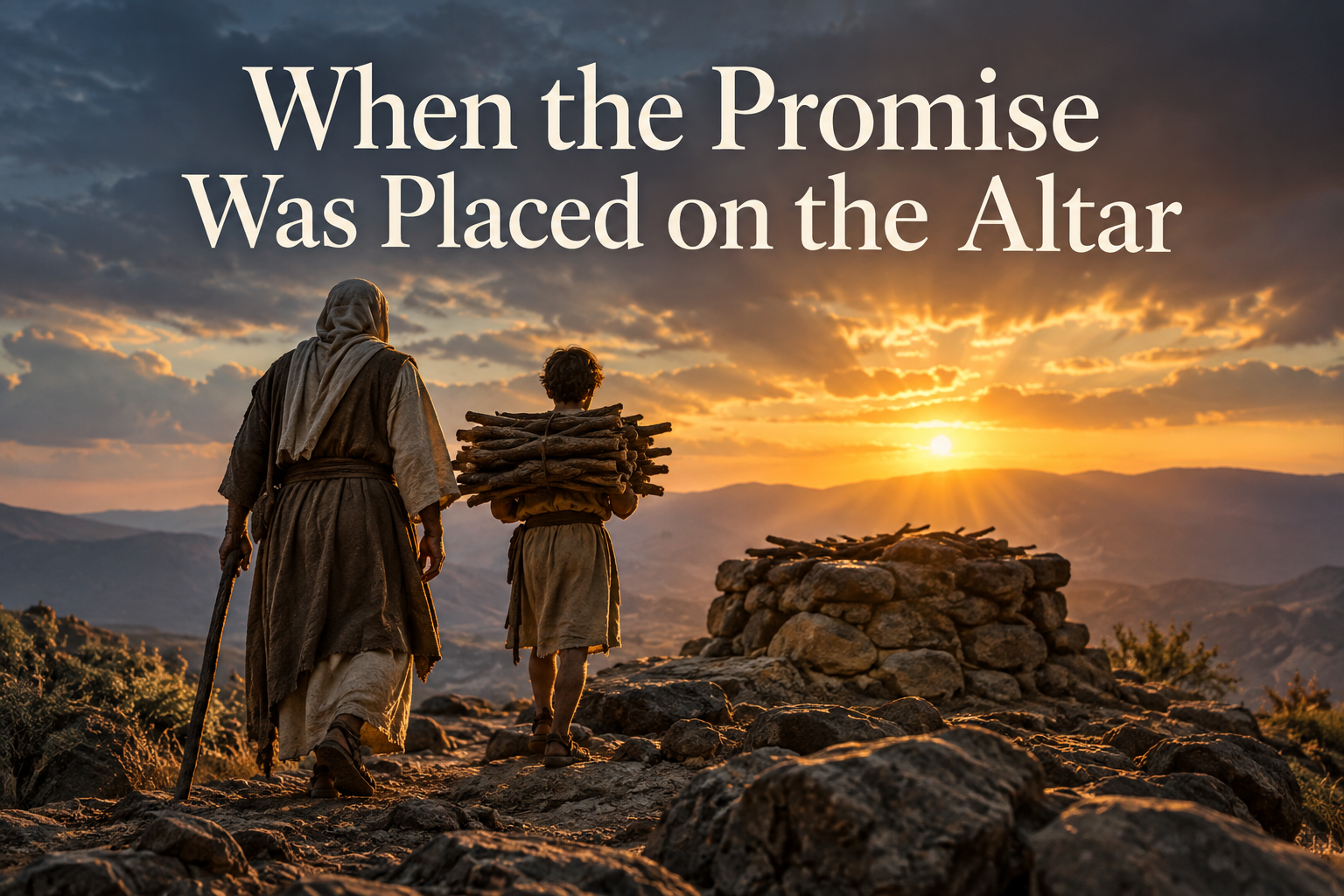
And Isaac knew the story of the altar better than anyone. He remembered walking up the mountain beside his father, carrying the wood on his own back. He remembered asking, “Where is the lamb?” He remembered being bound and placed upon the altar. And he remembered the voice that stopped Abraham and the ram the Father had already provided. (Genesis 22:6–13)
That was not merely one of his father’s stories.
Isaac had been there.
Abraham had given his son an extraordinary foundation of faith. But there was something Abraham could never give him.
Abraham could leave Isaac livestock. He could leave him servants. He could leave him the field at Machpelah. He could leave him wells and stories and memories of the mountain where Isaac himself had lain upon the altar.
But Abraham could not leave Isaac his relationship with God.
Abraham could tell Isaac what the Father had said and what the Father had done. He could tell him about the times he trusted and the times he was afraid, about promises he had tried to fulfill himself and the years in which he discovered that the Father remained faithful anyway.
But Abraham had something deeper than information.
Abraham knew Him.
That kind of knowing had taken a lifetime. Abraham had walked with God long enough that eventually, when he could no longer understand what God was doing, he could still trust the One who was doing it. He did not merely know what he believed about God.
He knew the Father.
Faith has a history, and the stories matter. Again and again throughout Scripture, God tells His people to remember and to tell the next generation what He has done:
“We will not hide them from their children, but tell to the coming generation the glorious deeds of the LORD.” (Psalm 78:4)
The stories give the next generation a foundation. They teach them the Father’s name and show them where He has been faithful before.
But knowing the stories is not the same as knowing Him, and that kind of knowing cannot simply be inherited.
Thankfully, Isaac did not have to somehow find his way to the God his father knew.
The Father came to Isaac.
When Rebekah could not have children, Isaac prayed for his wife, and the LORD heard him. Rebekah conceived. When the children struggled within her, Rebekah herself went to inquire of the LORD, and He answered her. (Genesis 25:21–23)
Two sons were growing inside her, two very different men who would eventually become two nations. Esau was born first, red and hairy. Jacob followed with his hand wrapped around his brother’s heel. Even his entrance into the world gives us an image that will follow Jacob for years.
He was grasping.
The boys grew into very different men. Esau became a skillful hunter and a man of the field, while Jacob remained among the tents. Then Genesis gives us one painful sentence that will matter later:
“Isaac loved Esau… but Rebekah loved Jacob.” (Genesis 25:28)
Dad had his favorite. Mom had hers.
One day Esau returned from the field exhausted and found Jacob cooking stew. Esau wanted what Jacob had, while Jacob wanted something much greater.
“Sell me your birthright now.”
Esau agreed. He ate, drank, got up, and walked away.
Genesis says simply:
“Thus Esau despised his birthright.” (Genesis 25:31–34)
We will come back to these brothers. For now, Genesis turns our attention again to Isaac.
A famine came to the land. Abraham had once gone toward Egypt during a famine, but this time the LORD appeared to Isaac and told him to remain where he was. Then God repeated promises Isaac must have heard since childhood—land, descendants, blessing, and the promise that through Abraham’s offspring all the nations of the earth would be blessed.
But now those promises were no longer merely part of a story his father had told him.
The Father was speaking to Isaac.
“I will be with you.” (Genesis 26:3)
It is tempting to imagine that an encounter like that would remove all of Isaac’s fear, but it did not. When the men of Gerar asked about Rebekah, Isaac was afraid they might kill him because she was beautiful, so he told them she was his sister.
It was almost painfully familiar. Abraham had done the same thing.
Apparently our children can inherit more than our stories of faith. Sometimes they inherit our fears as well.
Still, the Father remained faithful to Isaac. Isaac planted crops and prospered. His flocks and herds increased until the Philistines envied him and Abimelech finally told him to leave.
So Isaac moved.
After Abraham died, the Philistines had filled the wells Abraham dug with earth. Isaac reopened them and called them by the names his father had given them. There is something beautiful about that. Isaac did not have to erase his father’s story in order to have one of his own. He began by reopening his father’s wells.
But eventually Isaac dug new wells too. Some brought conflict, so Isaac moved and dug again. Finally his servants dug a well no one fought over, and Isaac called it Rehoboth—room.
“For now the LORD has made room for us, and we shall be fruitful in the land.” (Genesis 26:22)
Isaac reopened his father’s wells.
But he also dug his own.
Then Isaac went to Beersheba, and that night the LORD appeared to him:
“I am the God of Abraham your father. Fear not, for I am with you and will bless you.” (Genesis 26:24)
Perhaps those words held both sides of Isaac’s life together.
“I am the God of Abraham your father.”
Isaac knew that God. He knew the stories. He knew what his father had told him. He had grown up hearing about the voice that called Abraham, the promises God had made, the years of waiting, and the ways the Father had remained faithful.
But then came the other half:
“Fear not, for I am with you.”
The God Isaac knew about through his father was making Himself known to Isaac.
The stories were becoming his story.
Isaac responded by building an altar and calling upon the name of the LORD. He pitched his tent there, and his servants dug another well. (Genesis 26:25)
It all sounds familiar. Abraham had built altars and called upon the name of the LORD. He had pitched his tent in this land and dug wells. Long before Isaac was born, Abraham had lived among people who worshiped other gods and had proclaimed the name of YHWH among them.
Now Isaac was living in that same story—not because he had become another Abraham, but because the Father who had walked with Abraham was now walking with his son.
Then Abimelech came looking for him.
These were the people who had pushed Isaac away, so Isaac asked why they had come. Their answer is remarkable:
“We see plainly that the LORD has been with you.” (Genesis 26:28)
They had noticed.
They had watched Isaac prosper, but prosperity alone was not all they had seen. They had watched people oppose him. They had watched wells become disputed. They had watched him move rather than fight, dig again, and continue living among them. Somewhere along the way, the presence of the Father in Isaac’s life had become visible to the people around him.
“We see plainly that the LORD has been with you.”
Abraham had proclaimed the name of the LORD.
Now people could see that same LORD in the life of his son.
There is a dangerous assumption we humans make that the person whose life is easiest must be the person God has blessed most.
We see someone whose family is healthy, whose home is comfortable, whose work is successful and whose future seems secure, and we call that person blessed. Then we look at our own lives when things break, people leave, plans fail, or prayers seem unanswered, and somewhere quietly inside us we begin to wonder whether perhaps God is disappointed with us. Maybe we have done something wrong. Maybe someone else received a blessing we were not worthy to receive.
But Abraham could stand beside Sarah’s grave and still be blessed.
Isaac could lose a well and still be blessed.
Much later, a psalmist would struggle with this same question. He looked at people around him who seemed to prosper while his own life hurt, and for a while he could not understand it. Eventually he discovered something deeper:
“Whom have I in heaven but you? And there is nothing on earth that I desire besides you.”
And then:
“My flesh and my heart may fail, but God is the strength of my heart and my portion forever.” (Psalm 73:25–26)
God was his portion.
Jesus would eventually ask the question even more sharply:
“For what does it profit a man to gain the whole world and forfeit his soul?” (Mark 8:36)
You could have the whole world and still miss the greatest treasure.
Perhaps we have spent so much time looking at the gifts that we have mistaken them for the greatest blessing.
The land was a gift. Isaac was a gift. The wells were gifts. The livestock was a gift. The promises themselves were gifts. Every one of them was a blessing.
But greater than every gift was the Giver Himself.
Long before Isaac was born, when Abraham was still trying to understand how God’s promises could possibly come true, the LORD had said:
“Do not be afraid, Abram. I am your shield, your very great reward.” (Genesis 15:1)
Maybe Abraham spent the rest of his life discovering what those words meant.
The land could be promised and still not be possessed. The promised son could be placed on an altar. Sarah could die. Abraham could stand beside her grave.
And still, Abraham was blessed.
Because ultimately the blessing was never merely something the Father placed into Abraham’s hands.
The Father Himself was the blessing.
To know Him—not merely to know about Him. To have walked with Him long enough to recognize His faithfulness even when nothing made sense. To know His patience because you had tested it, His mercy because you had needed it, and His provision because there had been moments when you had nothing else.
Abraham knew the Father.
And that blessing could not be buried at Machpelah.
Abraham died. Isaac and Ishmael laid their father beside Sarah and eventually walked away from the grave. But the Father Abraham had come to know through a lifetime of walking, stumbling, questioning, trusting, and beginning again was not buried in that cave.
The Father was still there.
Abraham had given Isaac everything he could. He had given him an inheritance, stories, memories, wells, and a foundation of faith. He could tell Isaac about the Father he had come to know.
But he could not give Isaac the Father.
Only the Father could do that.
And He did.
“I am the God of Abraham your father.”
Yes, Isaac. The stories were true.
“Fear not, for I am with you.”
Your father knew Me.
Now I am here with you.