
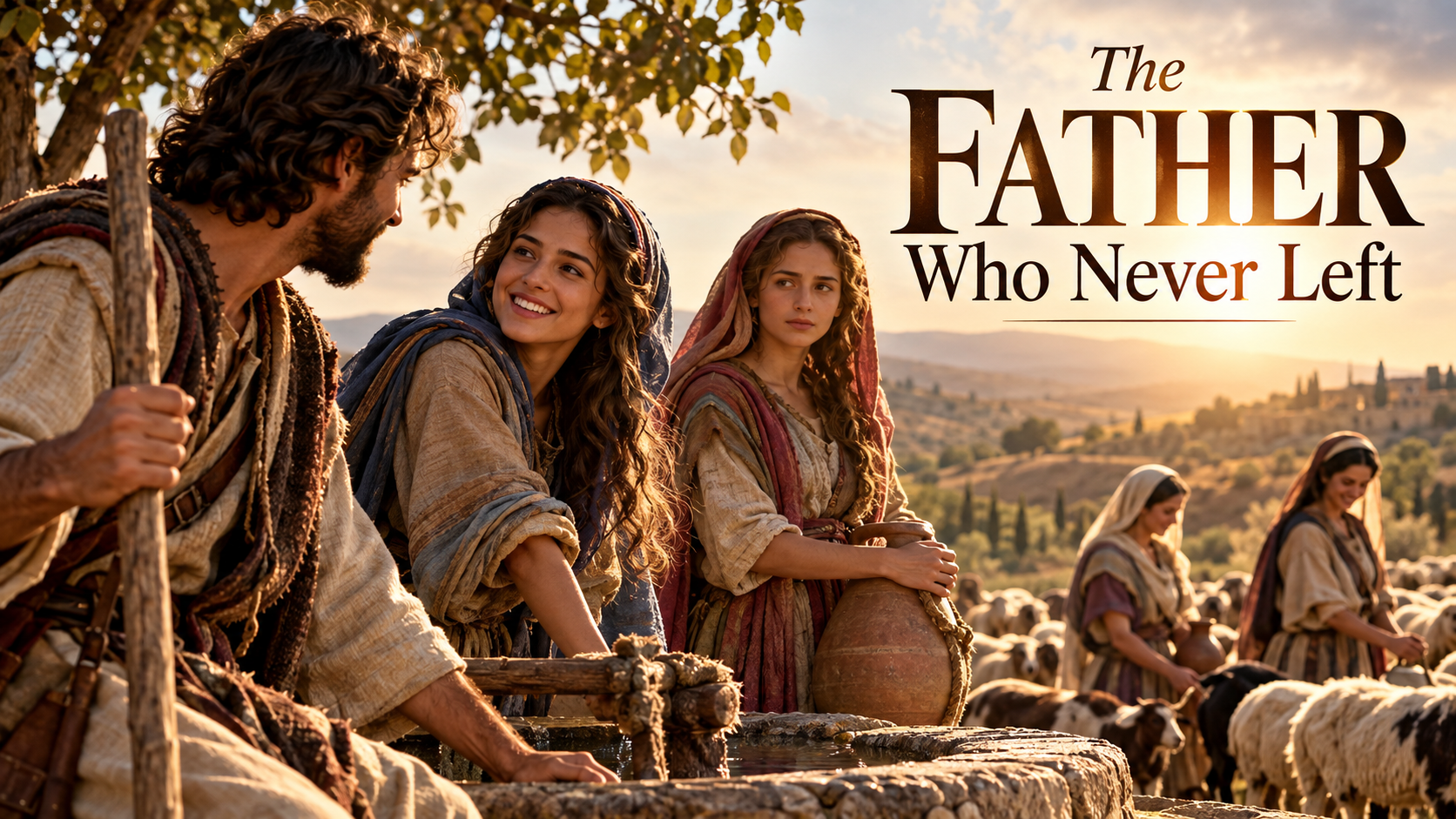
Before reading this week's reflection, I encourage you to read Genesis chapters 29 through 31. These chapters take us through twenty years of Jacob's life, years filled with love, disappointment, deception, family struggles, and unexpected blessings. There's far more here than we can explore together, but woven through it all is something beautiful about the Father.
The Father Who Never Left
When we last saw Jacob, he was sleeping beneath the stars at Bethel. He had fled his father's household, carrying little more than his staff and the consequences of his deception. Yet there, alone in the wilderness, the Father appeared and promised, “I am with you and will watch over you wherever you go.”
Jacob responded with a promise of his own. If God would accompany him, provide for his needs, and bring him safely home, then the LORD would be his God.
Now Jacob continues his journey, and the next twenty years will give him plenty of opportunities to discover what those promises mean.
He arrives at a well, meets a beautiful young woman named Rachel, and falls deeply in love. He agrees to work seven years for her father, Laban, in exchange for her hand in marriage. Scripture tells us those seven years seemed like only a few days because of his love for her.
Imagine the anticipation as the wedding finally arrives. Seven years of waiting, seven years of working, and at last Rachel would be his wife.
But when morning comes, the woman beside him is not Rachel. It's her older sister, Leah.
Laban has deceived him.
And there's an irony here that's difficult to overlook. Jacob, the younger son who deceived his father to receive the blessing intended for the firstborn, has now been deceived by a man who insists that the firstborn daughter must come before the younger.
Laban offers a solution. Jacob must complete Leah's seven-day wedding celebration, and then he can marry Rachel, provided he agrees to work another seven years. Jacob doesn't wait fourteen years to marry the woman he loves. He marries Rachel just one week after Leah, then spends another seven years working for her.
And so begins one of the most complicated family stories in Scripture.
Imagine being Leah.
She enters a marriage knowing that her husband loves her younger sister. The morning after her wedding, her husband confronts her father because he has been deceived. A week later, her sister becomes his wife too.
And Leah is left longing for something that cannot be purchased or demanded.
Her husband's love.
There are women reading these words who may understand Leah's loneliness more deeply than anyone realizes. Sharing a home, raising children, and sleeping beside someone doesn't necessarily mean feeling loved. Sometimes the deepest loneliness is experienced in a marriage where affection seems to belong somewhere else.
And then we read something remarkable.
“When the LORD saw that Leah was unloved, he enabled her to have children.”
Genesis 29:31
The Father saw her.
Leah named her first son Reuben, hoping that now her husband would love her. When Simeon was born, she acknowledged that the LORD had heard she was unloved. With Levi, she hoped her husband would finally become attached to her.
But when her fourth son was born, something changed in her words.
“This time I will praise the LORD.”
We aren't told that Jacob suddenly began loving Leah as she desired. And we shouldn't pretend that having children erased her loneliness. But for a moment, her attention seems to move from the affection she longed to receive toward the Father who had never overlooked her.
And the Father wasn't overlooking Rachel, either.
Rachel desperately wanted children. The sisters competed, even bargaining over mandrakes, plants believed to encourage fertility. But eventually Scripture tells us that God remembered Rachel, listened to her, and opened her womb.
The Father saw both women, even though their struggles were very different.
Over the years, Jacob's family grew through four women: Leah, Rachel, Bilhah, and Zilpah. Bilhah and Zilpah had originally been servants given to Rachel and Leah, but they too became Jacob's wives and bore his sons. Together, these four women would become the mothers of the twelve tribes of Israel.
We sometimes become so uncomfortable with the circumstances of this household that we overlook what the Father was doing through it. The nation of Israel, through which He would reveal so much of Himself to the world, was established through Jacob and these four women.
Centuries later, the book of Ruth would remember Rachel and Leah together as the women who built the house of Israel. (Bilhah and Zilpah, whose sons were also counted among the tribes, were no less part of that remarkable beginning.)
Meanwhile, Jacob continued working for Laban, and life was far from easy.
Laban repeatedly changed his wages. Jacob developed unusual methods of increasing his flocks, including placing peeled branches before the animals while they bred, reflecting an ancient belief about reproduction. Yet the story eventually reveals that Jacob's prosperity was not simply the result of his cleverness.
The Father had been watching.
Twenty years passed. Children were born, flocks multiplied, and Jacob became wealthy. The sisters who had once competed so fiercely now appear together, agreeing that their father had treated them unjustly and that it was time to leave.
We aren't told whether every wound in that family healed, or whether Leah ever received the affection she longed for. But twenty years is a long time, and the story allows us to see these women as more than the rivals they once were.
Then the Father spoke to Jacob again.
“Return to the land of your fathers and to your family, and I will be with you.”
Genesis 31:3
There it is again.
I will be with you.
The same promise Jacob heard at Bethel.
Jacob gathers his family and possessions and quietly leaves. But Laban discovers their departure and pursues them. For seven days he follows, finally overtaking the family in the hill country.
Jacob has wives, children, servants, and livestock. Everything he has spent twenty years building is traveling with him, vulnerable on the open road.
But before Laban can confront him, God appears to Laban in a dream and warns him to be careful how he speaks to Jacob.
The Father was already protecting Jacob before Jacob even knew the danger approaching.
When they finally confront one another, Jacob recounts the exhausting years of labor, the heat of the days, the cold of the nights, and the wages repeatedly changed. Then he says something extraordinary:
“If the God of my father... had not been with me, you would have sent me away empty-handed.”
Genesis 31:42
Think back to Bethel.
Jacob had asked whether God would provide for him. Whether He would protect him. Whether He would remain with him.
Now Jacob stands surrounded by a family, flocks, servants, and possessions he never imagined having when he left home with only his staff.
But the greatest discovery isn't how much he has accumulated.
It's that the Father has been faithful.
He saw Leah's loneliness. He heard Rachel's longing. He witnessed Jacob's mistreatment. And when danger approached, He intervened.
For twenty years, through all the confusion and struggles of this complicated household, the Father had never stopped paying attention.
Jacob was learning that God's presence was more than a promise spoken beneath the stars. It was a reality that had accompanied him through every season of his life.
And now, at last, he is going home.
But the journey isn't finished.
Somewhere ahead lies the brother he deceived, the brother who once threatened to kill him. Jacob is returning with everything the Father has provided, but he has no assurance of how Esau will receive him.
Twenty years have passed since the brothers last stood together.
And Jacob is about to discover just how much he still needs the Father who promised never to leave him.