Before reading this week's reflection, I encourage you to slowly read Genesis 10 and 11.
If you notice that Genesis 10 already speaks of different languages before chapter 11 says, "the whole earth had one language," don't be discouraged. Genesis often arranges its stories by theme rather than strict chronology. Chapter 10 describes the nations as they eventually became. Chapter 11 then steps back to show one of the defining moments that shaped them.
As you read, don't focus first on the tower.
Instead, continue asking the question we've been asking since Genesis 1:
What does this teach us about the Father?
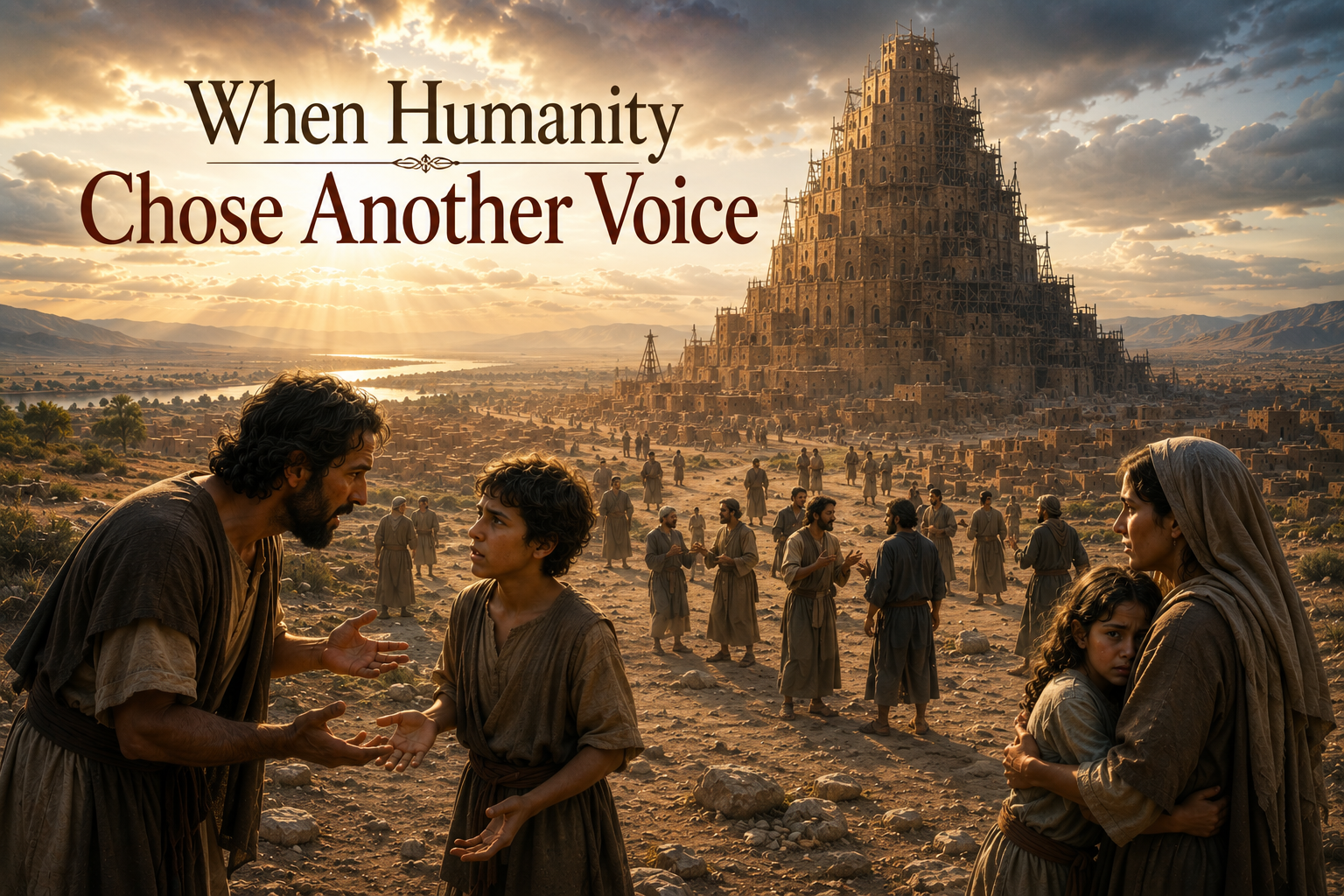
When Humanity Chose Another Voice
The waters had long since receded. Children who had never seen the ark were now grown, and around evening fires they could still hear Noah tell the story. He spoke of the day God shut the door, the months upon the waters, and the rainbow that appeared when the storm had finally passed.
The memory of God's faithfulness was still fresh.
The Father had not been silent.
Yet humanity listened to another voice.
"Come, let us build ourselves a city, with a tower that reaches to the heavens, so that we may make a name for ourselves..." — Genesis 11:4
Those words echo another conversation.
Long ago, a different voice whispered,
"Did God really say...?" — Genesis 3:1
Now humanity speaks with one voice of its own.
"Come, let us..."
The words have changed, but the invitation has not. Both promise life apart from the Father. Both invite us to believe that what He has already spoken is somehow not enough.
At first glance, God's response can seem surprising. Is He opposed to cities? To technology? To people working together?
The rest of Scripture answers that question with a resounding no.
On the night before His crucifixion, Jesus prayed,
"...that they may all be one, just as You, Father, are in Me, and I in You..." — John 17:21
Jesus was not praying for another Babel.
He was praying for a unity that Babel could never produce—a people whose oneness would not grow from shared ambition, shared language, or shared achievement, but from sharing the very life of the Father.
That kind of unity cannot be manufactured.
It can only be received.
Paul later described the Church as one body with many members. Every member is different, yet every member belongs. The eye does not become the hand, nor the hand the foot. Unity is not found by making everyone the same; it is found when every person discovers the place the Father has prepared for them.
"But in fact God has placed the parts in the body, every one of them, just as He wanted them to be." — 1 Corinthians 12:18
That is the opposite of Babel.
The people of Babel were not merely building a city.
They were building an identity.
"Let us make a name for ourselves."
There is no mention of seeking God.
No gratitude for the One who had preserved humanity through the flood.
No desire to know the Father more deeply.
Ancient Jewish writers remembered Babel as humanity's attempt to secure its future apart from God. Whether every detail of those traditions is historically accurate matters less than the truth they recognized.
The Father had spoken.
Humanity chose another voice.
Then Moses quietly adds a detail that is easy to overlook.
"Come, let us make bricks..."
There is nothing wrong with bricks. Yet throughout Scripture, God's dwelling places tell a different story. His altars were built with uncut stone. The temple was built of stone. Centuries later Peter reaches back into that same imagery and writes,
"...you also, like living stones, are being built into a spiritual house..." — 1 Peter 2:5
Bricks are manufactured.
Uniform.
Interchangeable.
Living stones are different. They are shaped over time. Each bears its own marks. Each is placed by the Builder exactly where it belongs.
Human kingdoms create unity by making everyone alike.
The Father's kingdom creates unity by fitting uniquely shaped people together until they become one living house.
The tower itself was almost certainly a ziggurat—a great temple meant to connect earth and heaven.
Then Moses records one of the most quietly delightful lines in Genesis.
"The LORD came down to see the city and the tower..." — Genesis 11:5
Humanity believed it had reached heaven.
The Father still had to come down.
No tower has ever bridged the distance between God and man.
Throughout Scripture, the story is never about humanity climbing high enough to reach God. It is always about God graciously coming down to meet His children.
The city became known as Babel. Genesis connects the name with the Hebrew word balal—"to confuse." Ironically, Babylon celebrated itself as "the Gate of God." Humanity believed it had built a doorway into heaven.
The Father simply called it confusion.
Then came the heartbreak.
Imagine a father speaking to his son, only to see confusion in his eyes. A mother reaches for her frightened child, yet the words that once brought comfort now sound foreign. Friends who worked side by side the day before stand in bewildered silence. Families slowly gather with those they can still understand, and communities begin to drift apart.
The tower stopped rising, not because there were no more bricks, but because something far more precious had been broken.
Relationship.
Communication.
Community.
The scattering of Babel was never merely geographical.
It was deeply personal.
Why would the Father allow such pain?
Because sometimes love interrupts what pride refuses to stop.
The Father did not interrupt Babel because He feared what humanity might accomplish. He interrupted Babel because He loved humanity too much to let it continue down a path that could only lead to deeper brokenness.
History has repeated Babel countless times. Empires rise. Nations boast. Civilizations become convinced they no longer need the One who gave them life.
The names change.
The temptation never does.
The greatest danger has never been our ability to build remarkable things.
The greatest danger is believing we no longer need the Father while we build them.
The story of Babel is not the last time Scripture speaks of many languages.
But...
that is a story for another day.
Perhaps this is what Babel teaches us about the Father.
He does not answer human pride with greater power.
He answers it with relationship.
Humanity says,
"Come, let us..."
The very next chapter begins,
"Now the LORD said to Abram..." — Genesis 12:1
The Father has not stopped speaking.
And once again...
Not with cheap optimism.
Not by pretending humanity's rebellion didn't matter.
But with the quiet, steady hope that has marked His-story from the very beginning—a hope built upon His own faithfulness.
Before reading this week’s reflection, I encourage you to slowly read Genesis 9:18–10:32.
Do not become discouraged by the unfamiliar names or rush past the uncomfortable details. Some passages of Scripture require us to slow down and look beneath the surface before their place within the larger story becomes clear.
As we have done from the beginning of Genesis, read these chapters while asking one simple question:
What does this teach us about the Father?
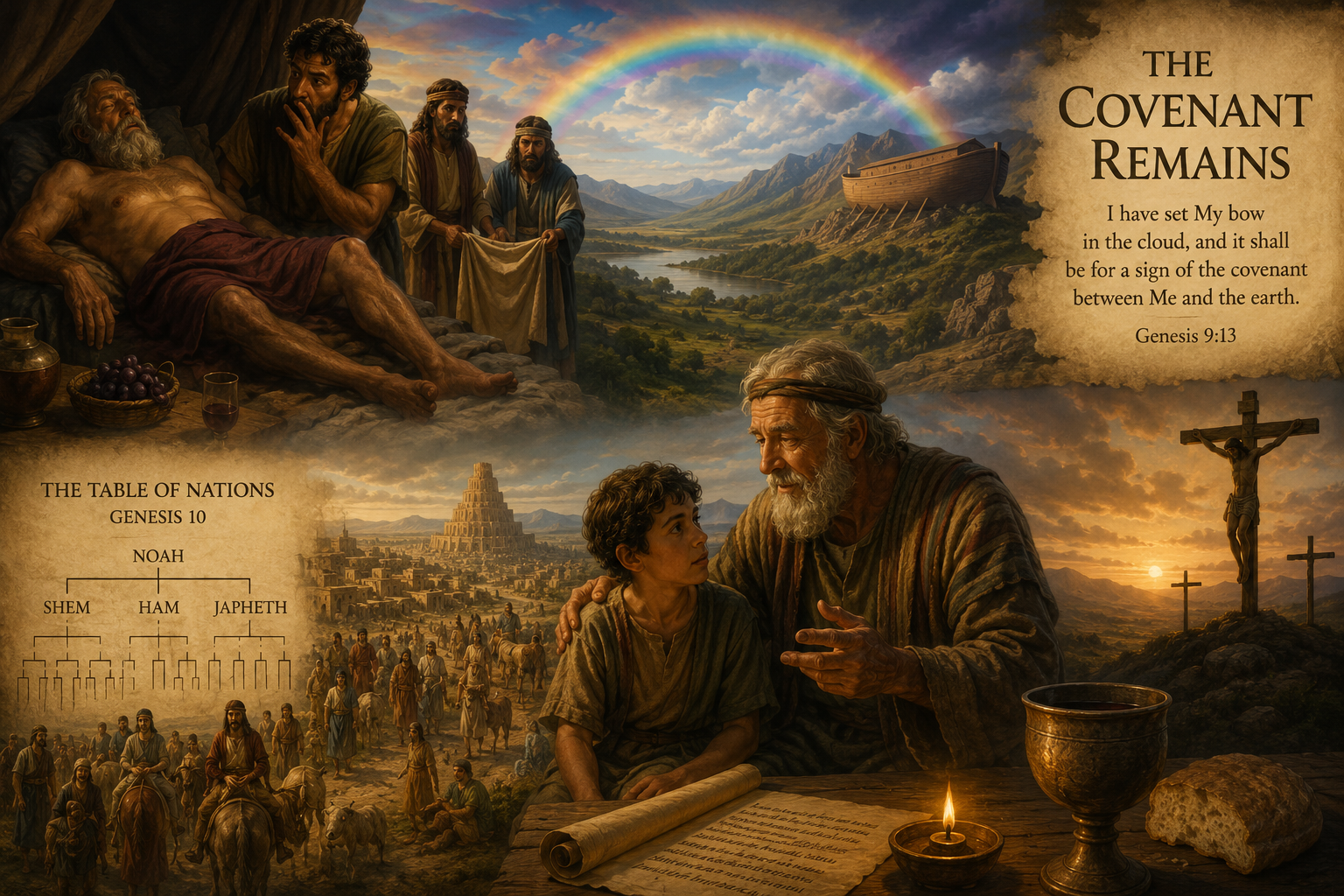
The Covenant Remains
When we left Noah, the floodwaters had receded, the ark rested upon dry ground, and the rainbow stretched across the sky as the sign of an everlasting covenant. The Father had preserved life, blessed Noah and his family, and commanded them to be fruitful, multiply, and fill the earth. He had promised that never again would a flood destroy every living creature.
If we were writing the story ourselves, this is probably where we would stop. The judgment is over. The ark is empty. The rainbow shines across the sky, and humanity has been given a fresh beginning beneath the blessing of God.
But the Father is not finished telling His story.
The flood changed the face of the earth, but it did not change the human heart. Remarkably, that was never a surprise to God. Even before Noah planted his vineyard, the Father had already acknowledged that “the imagination of man’s heart is evil from his youth.” He understood the weakness that remained within humanity, and still He blessed Noah. Still He established His covenant. Still He placed His bow in the clouds and promised to preserve the earth.
The covenant was never built upon humanity’s ability to remain faithful. It rested upon the faithfulness of the Father.
Genesis tells us that Noah became a man of the soil and planted a vineyard. He drank from the wine it produced, became intoxicated, and lay uncovered inside his tent. Many sermons immediately turn this moment into a warning about Noah’s failure, but Genesis does not present the account that way. There is no rebuke from God, no declaration that Noah had sinned, and no suggestion that his standing before the Father had changed.
That restraint is worth noticing.
Throughout Scripture, vineyards and wine are frequently associated with harvest, abundance, blessing, and celebration. The prophets looked forward to a day when people would again plant vineyards and enjoy their fruit. Micah described the peace of the coming kingdom with every man sitting beneath his own vine and fig tree. Isaiah pictured the Lord preparing a feast for the nations, including well-aged wine. Jesus chose a wedding celebration—and the provision of abundant wine—as the setting for His first recorded sign. Later, during His final Passover meal, He lifted the cup and spoke of the New Covenant established through His own blood.
Scripture certainly warns against being mastered by wine, but that does not appear to be the accusation Genesis is making here. Noah’s condition may have created the opportunity for what followed, but Genesis is giving us information about Noah, not placing him on trial before God. The sin in this account belongs somewhere else.
Ham entered the tent and “saw the nakedness of his father.” He then went outside and told his brothers. Shem and Japheth responded very differently. They placed a garment across their shoulders, walked backward into the tent, and covered their father without looking upon him.
The story leaves most readers with an obvious question: If Ham was the one who sinned, why did Noah pronounce the curse upon Ham’s son, Canaan?
The answer may lie in the language Moses uses elsewhere.
The same Moses who recorded Genesis is traditionally understood to have recorded the instructions later found in Leviticus. That matters because Leviticus repeatedly uses the language of “uncovering nakedness” to describe sexual relations, especially within the family. It even explains that the nakedness of a man’s wife may be spoken of as the nakedness of the man himself:
“The nakedness of your father’s wife you shall not uncover; it is your father’s nakedness.”
Genesis tells us that Ham saw his father’s nakedness, but it does not describe every detail of what occurred. The later language of Leviticus has therefore led many readers and ancient interpreters to understand that something far more serious happened than Ham simply seeing Noah unclothed.
Some believe Ham violated his mother and that Canaan was conceived through that act. This would explain why Canaan had already been deliberately named before the incident was described and why the consequence fell upon him rather than directly upon Ham. Ancient writings, including the Book of Jasher, preserve an understanding that something deeply shameful occurred within Noah’s household, although Genesis itself leaves the precise nature of Ham’s offense unstated.
That interpretation also provides a possible motive. In later biblical stories, a son’s sexual possession of his father’s wife or concubines was not merely an act of lust; it could become an attempt to seize the father’s place, authority, and inheritance. Reuben lay with his father Jacob’s concubine. Absalom publicly took David’s concubines while attempting to claim his father’s kingdom. Ham’s action may therefore have been an effort to take something that did not belong to him and secure power within the new world emerging from the flood.
Genesis does not invite us to become fascinated with the scandal, however. Whatever occurred inside Noah’s household was a profound violation of Noah, his marriage, and the order the Father had established within the family. It brought consequences that reached into the following generation, but almost immediately Moses widens the story. Our attention moves away from one family’s tragedy and toward the many families that would soon fill the earth.
Modern readers can easily underestimate how much time passes in these chapters. We read a list of unfamiliar names and imagine a handful of families slowly spreading into the surrounding countryside. But Noah lived another three hundred and fifty years after the flood. His sons also lived extraordinarily long lives, and their households were likely far larger than the comparatively small families familiar to many of us.
Consider how dramatically the population of the United States has grown in roughly two hundred and fifty years, even with relatively short lifespans and modest family sizes. Now imagine several centuries in which people commonly lived for hundreds of years, remained surrounded by many generations of their descendants, and continued obeying the command to be fruitful and multiply. Children became parents, grandparents, great-grandparents, and ancestors of entire tribes while the earliest members of the family were still alive.
Noah could have watched generations of children born to children who had themselves become ancient. His sons could have known descendants separated from them by centuries of family history. What looks like a short transition on the page represents the growth of families into clans, clans into peoples, and peoples into nations.
Genesis 10 is therefore much more than a dry genealogy. It is often called the Table of Nations because these names become the peoples and kingdoms that continue appearing throughout the rest of Scripture. Egypt, Canaan, Assyria, Babylon, and many others trace their biblical beginnings to the families spreading out from Noah’s sons.
The Father’s blessing was unfolding exactly as He had spoken. Noah’s family multiplied. The earth filled. Cities were established, languages and cultures developed, and entire nations emerged from the eight people who had stepped out of the ark.
•••
God’s blessing continued even though humanity’s faithfulness did not.
That may be one of the most important truths hidden within this section. Ham’s sin did not cause the Father to withdraw His blessing from the earth. The failure inside Noah’s family did not cancel the promise made beneath the rainbow. The Father had entered His covenant with full knowledge of the weakness that remained within humanity, and He did not abandon His promise when that weakness appeared again.
The rainbow had never been evidence that mankind had finally become trustworthy. It was evidence that the Father remained trustworthy.
Think about what He knew when He placed His bow in the clouds. He knew Babel would soon rise from the plain. He knew nations would turn toward idols and forget the One who had preserved them. He knew Abraham’s descendants would repeatedly struggle to trust Him. Kings would rebel, prophets would be ignored, and the people He loved would wander from the covenant again and again.
He even knew that when His Son came among them, many would reject Him.
Yet He made the covenant anyway.
The rainbow did not promise the end of sin. It revealed the Father’s determination not to abandon His creation because of sin. It declared that His purposes would continue moving forward, not because humanity had finally made itself worthy, but because He remained committed to the world He had made.
Every covenant that follows carries the story closer to Jesus. The covenant with Noah preserved the earth and the nations. The covenant with Abraham would promise blessing to all the families of the earth. The covenant with Israel would reveal the Father’s holiness and His desire to dwell among His people. The promise made to David would point toward a King whose throne would endure forever. Then, at the Passover table, Jesus lifted the cup and said:
“This cup is the new covenant in My blood, which is poured out for you.”
The covenant beneath the rainbow and the cup in the hands of Jesus are not the same covenant, but they reveal the same faithful Father. He does not turn away when His children fail. He continues moving toward them. He continues preserving life, revealing Himself, and carrying His purpose toward redemption.
As Noah’s descendants spread across the earth, they carried more than children, livestock, tools, and possessions. They carried memories. They carried the accounts of creation and the garden, the voice of the serpent, Cain and Abel, Enoch’s walk with God, the violence of the former world, the building of the ark, the sound of the rain, and the rainbow that appeared after the flood.
Long before there was a written collection of Scripture, the knowledge of the Father was carried through stories. Fathers and mothers told their children what they had received from those who came before them. One generation listened, remembered, and then entrusted the testimony to the next.
Centuries later, Paul would describe the same pattern when he wrote to Timothy:
“The things that you have heard from me among many witnesses, commit these to faithful men who will be able to teach others also.”
Paul told Timothy. Timothy was to entrust the message to faithful people. Those people would then teach others. Four generations of discipleship appear in one sentence, but the pattern was already ancient. Faith was preserved because someone remembered the story, lived beneath its truth, and considered it worthy of being told again.
Among all the branches of Noah’s rapidly expanding family, one line would continue carrying that knowledge toward a man named Abram. According to the chronology preserved in Genesis, Noah was still living during Abram’s early years, while Shem lived throughout Abram’s lifetime and beyond.
The stories of the flood and the rainbow were not distant legends to Abram. They were the testimony of men who had lived them.
Long before Abram heard the Father’s call to leave his homeland, he grew up in a world where Noah and Shem were still living. They were living witnesses to the flood, the covenant, and the faithfulness of the Father. Ancient traditions, including the stories preserved in the Book of Jasher, remember Shem as an important influence within the world Abram inherited. We will return to that remarkable story soon.
Abram’s faith would be extraordinary, but it would not emerge from an empty world. Behind him stood generations of people who had learned something about the Father and passed that knowledge forward: Adam, Seth, Enoch, Methuselah, Lamech, Noah, and Shem. They were not priests in the formal sense later established through Moses and Aaron, yet they carried out something deeply priestly. They preserved the knowledge of God, trusted His promises, built altars, called upon His name, and told His story to those who came after them.
The faith of Abraham would rest upon foundations laid long before Abraham was born.
•••
Through Abram, the Father would begin revealing a promise that would one day reach every nation through Jesus Christ. Yet even Abram’s calling would not represent the beginning of the Father’s faithfulness. It would be another chapter in a story already carried through generations.
That has always been the Father’s way. Humanity forgets Him, yet He continues making Himself known. People violate what He has established, yet He does not surrender His purpose. Generations pass away, but the testimony survives because someone tells the story again.
The flood could not cure the human heart, but the human heart could not undo the Father’s purpose.
The Father blessed Noah knowing what would happen inside his household. He placed the rainbow in the clouds knowing Babel would soon rise. He allowed the nations to spread across the earth knowing many of them would forget Him. Yet rather than abandoning humanity, He quietly preserved the story.
One generation told another.
Noah told Shem.
Long before Abram heard the Father’s call to leave his homeland, he would grow up in a world where Noah and Shem were still living. The stories of the flood and the rainbow were not distant legends to Abram—they were the testimony of men who had lived them. We will return to that remarkable story soon. Through Abram, the Father would begin revealing a promise that would one day reach every nation through Jesus Christ.
Long before there was a Bible to read, there was a story to tell. One generation received it, and another passed it on. Through all the failures of humanity, the Father never abandoned His covenant or His desire to be known.
The covenant remained because the Father remained faithful.
Before reading this week’s reflection, I encourage you to slowly read Genesis 8 through Genesis 9:17.
Do not rush through the story looking for hidden meanings or trying to answer every question. Instead, continue asking the question we have carried with us since Genesis 1:
What does this teach us about the Father?
Listen to this week’s reflection
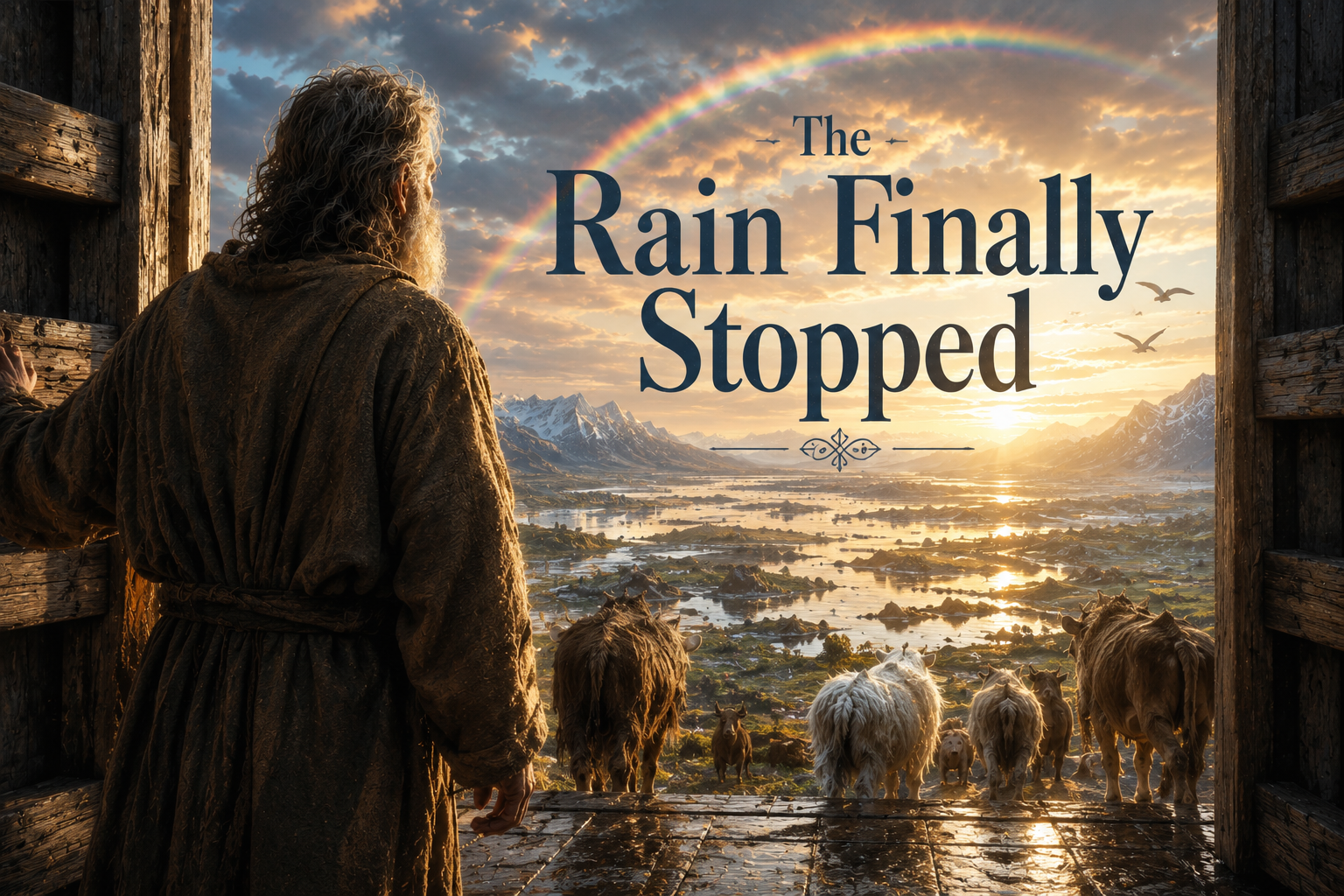
When the Rain Finally Stopped
Last week, we stood with Noah as the door of the ark closed behind him.
We heard the rain begin to fall. We imagined the fountains of the deep breaking open and a world slowly disappearing beneath the waters. It was one of the most difficult stories in Scripture—not because it is difficult to understand, but because it is almost unbearable to imagine.
Genesis 8 feels different.
It begins almost like an invitation to take a deep breath.
The rain has stopped. The violence has ended. The waters begin to recede. After months of darkness, movement, noise, and uncertainty, the ark finally becomes still.
Then Scripture gives us one of the gentlest sentences in the entire flood story:
“But God remembered Noah…”
Not because God had forgotten him.
Noah may have heard nothing from the Father for months, but silence was not abandonment. God had carried the ark through every wave, watched over every life within it, and remained present through every long day when Noah could see nothing beyond those wooden walls.
When Scripture says that God “remembered,” something begins to move. The Father acts on behalf of the one He has not forgotten.
God caused a wind to pass over the earth, and the waters began to fall.
The Hebrew word translated wind is ruach. It can also mean breath or spirit. It is the same word we encountered in Genesis 1, when the Spirit of God hovered over the face of the waters.
Once again, waters cover the earth. Once again, the breath of God moves. Once again, dry ground slowly appears and life prepares to emerge.
Genesis is not merely describing the end of a flood.
It is quietly telling the story of a new creation.
The ark eventually came to rest on the mountains of Ararat. Even that wording carries a beautiful echo. Noah’s name is connected with rest, and now the ark carrying Noah comes to rest.
But Noah did not immediately leave.
That detail has stayed with me.
If I had been inside that ark, I think I would have climbed onto the roof the moment I felt it stop moving. After more than a year inside, I would have wanted fresh air. I would have wanted to see the mountains and feel the sunlight on my face. I would have wanted proof that the nightmare was finally over.
I suspect I would have opened the door.
But Noah waited.
The mountain peaks became visible. Noah sent out the raven and then the dove. The dove eventually returned with a freshly plucked olive leaf, and Noah knew the waters had receded. Later, he removed the covering from the ark and saw with his own eyes that the surface of the ground was drying.
Still, he waited.
The mountain was visible. The ground looked ready. Every natural instinct must have told him it was time to leave.
The mountain was not Noah’s invitation.
The Father’s voice was.
Only when God said, “Go out of the ark,” did Noah step into the world waiting beyond the door.
The more I sit with that scene, the less it feels like simple obedience. It feels like relationship.
Adam saw something desirable and reached for it before it was given. Noah saw an entire new world lying outside the ark, yet he refused to seize the moment for himself.
Adam took.
Noah waited.
Centuries later, Israel would wander through the wilderness while God tried to teach them that humanity does not live by bread alone, but by every word that proceeds from His mouth. Noah had already learned to live that way. He did not place his confidence in the mountain beneath him or in the dry ground he could see.
He waited for the Father’s voice.
Where do you think he learned that kind of faith?
We have spent several weeks tracing the generations before Noah. Adam lived long enough to tell the stories. Seth carried them. Enoch demonstrated that it was still possible to walk with God outside Eden. Fathers and grandfathers remembered their encounters with the Father and passed them from one generation to another.
Noah did not suddenly manufacture faith when the rain began. His faith had been quietly formed through years of hearing the stories of men who had walked with God, failed, received mercy, and continued walking.
Now those stories carried him through the silence.
When Noah finally stepped onto dry ground, Scripture tells us that the first thing he built was not a house.
It was an altar.
There was shelter to construct, food to find, and an entire world to begin rebuilding. Noah had spent more than a year caring for his family and the animals entrusted to him. Everything outside the ark was unfamiliar, fragile, and scarce.
Yet his first response was worship.
Then Noah took from every clean animal and every clean bird and offered them to the Lord.
I have read those words many times without stopping to consider what they meant.
There were no great herds roaming the earth. There were only the animals that had stepped out of the ark. Whether the seven clean animals were seven total or seven pairs, the number was painfully small. Every animal mattered. Each one represented part of the future of creation.
If I had been Noah, I think I would have counted them carefully. I would have guarded every one and convinced myself that none could be spared.
Noah opened his hands.
He gave to the Father from the little that remained. He placed the future of those creatures back into God's hands because he understood that their future had never truly rested in his own.
Later, Israel would offer the first portion of a harvest before knowing what the rest of the season would bring. Rain could fail. Hail could fall. Locusts could destroy what remained. The offering was not merely a calculation. It was an open-handed confession that tomorrow belonged to the Father.
Noah was living that confession long before Israel received the command.
Then the Father spoke:
“I will never again curse the ground for man's sake, although the imagination of man's heart is evil from his youth…”
Those words may astonish me more than anything else in this chapter.
The first part reaches backward toward Eden. After Adam reached for the fruit, God said, “Cursed is the ground for your sake.” Now, after the flood, the Father speaks again about the ground.
But notice what has—and has not—changed.
The flood did not repair the human heart. God does not say humanity has learned its lesson or become worthy of a new beginning. He says the inclination of the human heart is still bent toward evil.
Although.
That small word carries enormous weight.
Humanity remains broken, and yet the Father promises.
He knows the condition of His children, and yet He moves toward them.
He sees the failures that still lie ahead, and yet He binds Himself in covenant.
This feels like the Gospel before the Gospel.
Centuries later, Paul would write that God was in Christ reconciling the world to Himself, not counting humanity’s trespasses against them. The cross did not persuade a reluctant Father to begin loving His children. Jesus revealed the heart that had been moving toward them from the beginning.
Genesis 8 is already whispering that story.
The Father knows.
And still, He promises.
The rainbow becomes the sign of that covenant. It is more than a beautiful display after a storm. It is the visible reminder of the Father's commitment to the earth, to humanity, and even to every living creature that came out of the ark.
This new beginning reaches far beyond Noah's family.
The Father has not abandoned His creation.
As I read the flood story again, I also began hearing another familiar echo.
Long before the Passover, God had already provided a place where life would be preserved while judgment passed outside. Noah did not invent the ark or design his own rescue. The Father gave the pattern, invited Noah inside, and shut the door Himself.
Centuries later, families in Egypt would enter homes marked by the blood of a lamb. Judgment would pass through the land, but life would be preserved inside what God had provided.
The details are different, but the Father's invitation sounds remarkably familiar.
Come inside.
Trust what I have prepared.
Let Me hold the future
you cannot secure for yourself.
Eventually, Jesus would say, “Abide in Me.”
Again and again, the Father prepares what His children cannot prepare for themselves and invites them to enter.
The ark.
The Passover.
The tabernacle.
The cross.
These are not isolated stories trying to teach unrelated lessons. They are echoes of the same Father and the same invitation.
And the more I sit with Noah, the more I realize that I may have misunderstood the word trust for much of my life.
We often speak of trusting God as though it means believing that everything will eventually turn out well. The illness will be healed. The family will be restored. The prayer will be answered in the way we hope. The storm will pass, and the story will end happily.
But Scripture gives us harder stories than that.
Noah survived the flood, but the world he knew was gone.
Abraham climbed a mountain with his beloved son, not knowing how God's promise could survive what he had been asked to do.
Job buried his children and sat in the ashes without receiving an explanation for his suffering.
Jeremiah watched Jerusalem fall.
Paul surrendered everything he once considered gain and eventually faced death as a prisoner.
Jesus knelt in Gethsemane and prayed that the cup might pass from Him. Then He opened His hands and said, “Not My will, but Yours be done.”
From the cross, His final prayer was not a demand that the Father change the outcome.
It was surrender:
“Father, into Your hands I commit My spirit.”
The truth is already contained in those stories. They do not need much explanation.
Biblical trust is not confidence that life will unfold as I desire.
It is confidence that the Father is worthy of my trust,
even when life does not.
Trust is not pretending the pain does not matter. Isaac mattered. Job's children mattered. Jerusalem mattered. The cross mattered. Trust does not silence grief or remove every question.
It simply releases the need to control the outcome.
It rests in the Father, especially when the ending remains hidden and the path makes no sense.
Perhaps that is why Noah could remain inside the ark after it had come to rest. Perhaps that is why he could wait even after seeing dry ground. Perhaps that is why he built an altar before he built a home and offered from the little that remained.
Noah did not rest in the outcome.
He rested in the Father.
And perhaps that has always been the invitation—not to understand tomorrow, not to secure every outcome, but to know the One who already holds it.
Before reading this week’s reflection, I encourage you to slowly read Genesis 6 and 7.
Do not rush through the story looking for answers to every difficult question. Instead, read it with the same question we have been asking since Genesis 1:
What does this teach us about the Father?
Listen to this week’s reflection
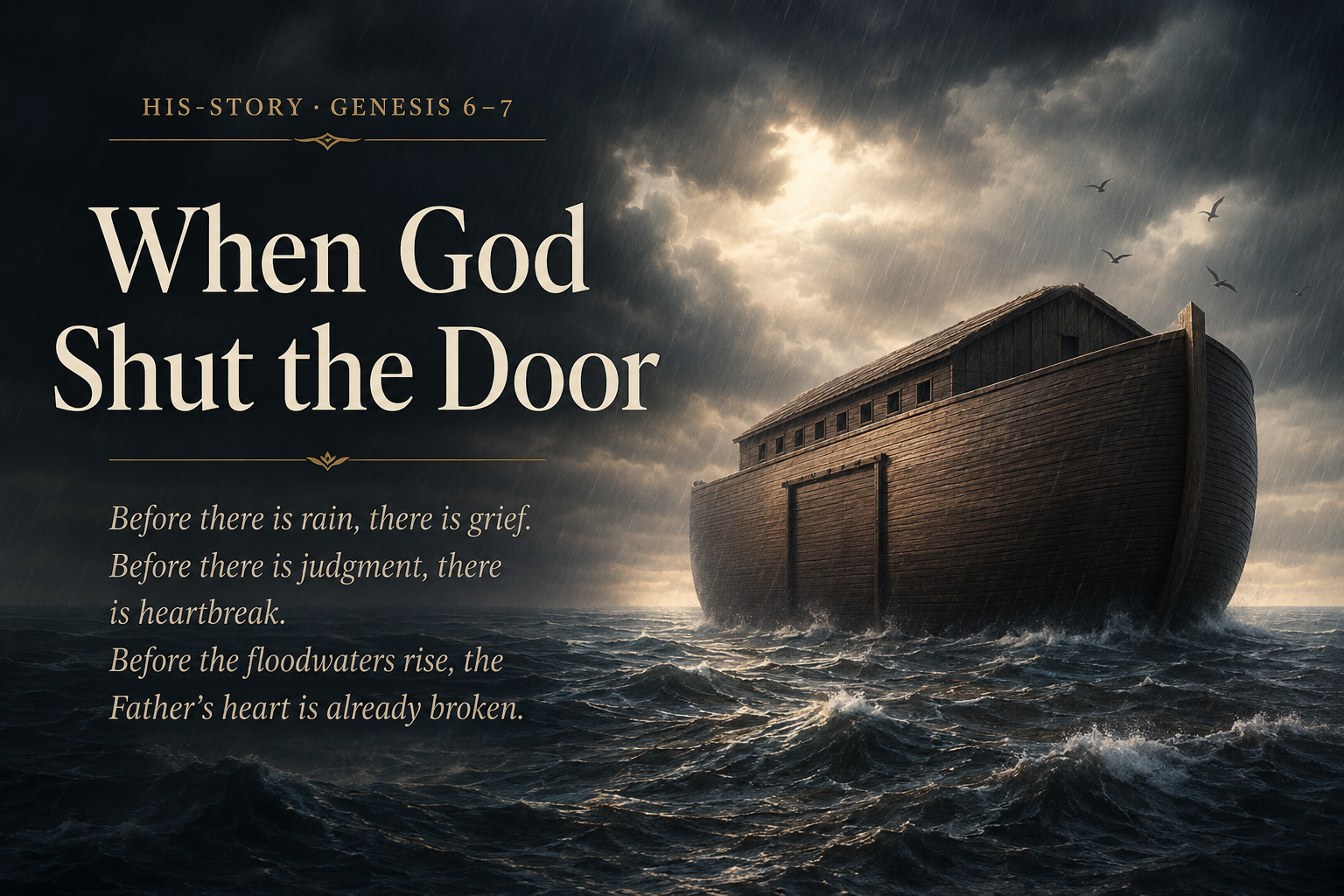
When God Shut the Door
I have been dreading this story.
That may sound strange to say about Noah and the ark. For many of us, this was one of the first Bible stories we ever learned. We saw pictures of smiling animals walking two by two. We colored rainbows. We sang songs about arks and doves and dry ground.
But the actual story is not cute. It is not soft. It is not a children’s decoration for a nursery wall.
The story of Noah is one of the darkest stories in Genesis. And if we are honest, it is one of the hardest stories in Scripture.
For several weeks, we have been walking slowly through the opening chapters of Genesis, asking one central question:
What does this teach us about the Father?
We have seen a Father who created with beauty, order, generosity, and joy. We have seen a Father who placed humanity in a garden, not as servants trembling before a distant ruler, but as children invited into fellowship.
When Adam and Eve failed, the Father came looking.
When shame entered the human story, the Father covered them.
When Cain stood at the edge of violence, the Father warned him before the blood was spilled.
Even after Cain murdered his brother, the Father marked him with protection.
Again and again, the story has surprised us. Judgment was real. Sin mattered. Death entered. But mercy kept appearing. Invitation kept appearing. The Father kept moving toward His children.
Then we come to Genesis 6.
And suddenly, the story becomes much harder to read.
“The Lord saw that the wickedness of man was great in the earth, and that every intent of the thoughts of his heart was only evil continually.”
Every intent.
Only evil.
Continually.
Those words are almost impossible to comprehend.
We live in a fallen world. We know evil exists. We see cruelty, violence, greed, abuse, corruption, and hatred. Some days it feels overwhelming.
But even in our broken world, most of us still know people who are kind. Not perfect. Not necessarily godly. But decent. Loving mothers. Faithful fathers. Honest neighbors. Gentle children. People who laugh, work, help, grieve, forgive, and try again.
Genesis 6 describes something darker.
Not a world where evil existed, but a world where evil had become the atmosphere. A world where human imagination itself had become corrupted. A world where violence filled the earth. A world where the old stories were no longer being heard.
That may be the part that grieves me most.
Because from the beginning, God desired relationship. He wanted His children to walk with Him. Adam had known His voice. Enoch had walked with Him. Noah would walk with Him. But somewhere along the way, much of humanity stopped listening.
One line remembered.
One line forgot.
One family kept telling the stories.
Another path slowly drifted into silence.
By the time Genesis 6 opens, the voices still carrying the old testimony appear to have become painfully few. The world had not merely become immoral. It had become unreachable.
Genesis 6 also introduces one of the most mysterious passages in Scripture. It speaks of the “sons of God,” the “daughters of men,” and the Nephilim. For thousands of years, Jewish rabbis, Christian scholars, and thoughtful believers have wrestled with exactly what those words mean. Were they fallen angels? Powerful rulers? The descendants of Seth and Cain? Giants? Something else entirely?
I honestly do not know.
And perhaps the humility to admit that is healthier than pretending certainty where Scripture has left room for wonder.
What I do know is this: whatever was happening in Noah’s day, Genesis repeats the same conclusion again and again. Violence filled the earth. Corruption spread everywhere. Humanity had reached a level of rebellion I do not think we can fully comprehend.
And then Scripture says something that should stop us in our tracks.
“The Lord was sorry that He had made man on the earth, and He was grieved in His heart.”
I do not fully understand those words.
I do not think any of us do.
When we hear that God was “sorry,” we may imagine regret the way humans experience it, as though God looked back and realized He had made a mistake. But that is not the picture Genesis has been giving us.
This does not read like the confession of a Creator who failed.
It reads like the sorrow of a Father whose children have destroyed themselves.
The grief is not evidence that God stopped loving. The grief is evidence that He loved deeply.
Before there is rain, there is grief.
Before there is judgment, there is heartbreak. Before the floodwaters rise, the Father’s heart is already broken.
That matters.
Because if we begin the flood story with wrath alone, we may miss the first thing Genesis wants us to see.
God loved His creation. But now, God was grieved.
Not annoyed. Not inconvenienced. Not detached.
Grieved to His heart.
The story of the flood does not begin with a monster eager to destroy. It begins with a Father looking at a world He made for life and seeing it filled with violence—intentional death.
And still, in the middle of that darkness, one sentence appears like a breath after drowning.
“But Noah found grace in the eyes of the Lord.”
Grace.
That word matters.
Genesis tells us Noah was a righteous man. It tells us he was blameless in his generation. It tells us Noah walked with God. Those things matter too. Noah was not indifferent. He was not faithless. He was not merely lucky.
He walked with God.
But still, the text says Noah found grace.
Not wages. Not entitlement. Not payment.
Grace.
Centuries later, Paul would write, “By grace you have been saved through faith.” Noah’s story quietly whispers that same truth. Even the most righteous man in his generation did not stand before God because he deserved to. He found grace.
Noah was not saved because he was the hero of the story. Noah was saved because the Father chose to preserve life. Even in judgment, mercy was still moving. Even as one world was ending, God was already preserving the seed of another.
But where did Noah’s faith come from?
I do not think Noah’s trust was born the day God told him to build an ark.
Genesis 5 looked, at first, like a genealogy. Names. Ages. Sons. Deaths. But perhaps it was much more than that. It was the passing of testimony.
Adam lived long enough for his story to be remembered by generations. Enoch walked with God in a world that had already lost Eden. Methuselah carried the memory of a world before the flood. Lamech named his son Noah with hope.
These were not merely names on a family tree. They were men who carried stories.
Stories of a garden. Stories of failure. Stories of mercy. Stories of covering. Stories of Cain. Stories of Enoch. Stories of a Father who still desired to walk with His children.
Noah did not invent faith in isolation. He inherited it. He received it through relationship, through memory, through testimony, through the slow work of generations who refused to let the stories die.
That is discipleship.
Not merely information passed from one mind to another, but stories carried from one heart to another.
Noah walked with God because somewhere along the way, he believed the invitation still existed.
The Garden was closed.
But the Father was not gone.
That belief would soon be tested in a way few men have ever been tested.
God told Noah to build an ark. Not a ship. Not a vessel of exploration. Not something with sails and steering and a destination Noah could control.
An ark.
A great wooden refuge. A box, in one sense. A container. A place of preservation. A place of death and life at the same time.
Inside the ark, life would be preserved.
Outside the ark, life would perish.
There is something deeply unsettling about that.
Noah could build it. Noah could enter it. But Noah could not steer it. Once the door closed, he would not be in control.
And perhaps that is one of the clearest pictures of faith in the entire story.
Noah did not trust his ability to navigate the flood. He trusted the Father who had called him into the ark.
The flood did not teach Noah to trust the Father.
It revealed that he already trusted.
Then came the day.
The animals entered. Noah entered. His wife entered. His sons and their wives entered.
Eight souls inside the ark.
But Noah had lived six hundred years. We should not read that too quickly.
A man does not live six hundred years without relationships. He had known fathers and mothers, brothers and sisters, children, grandchildren, neighbors, workers, friends, enemies, acquaintances, families who lived nearby, children who had grown up around him, people who had laughed at his table, people who had heard his voice, people he had known by name.
Some extra-biblical traditions suggest Noah had other sons and daughters. Scripture does not tell us that, so we should hold that carefully. But we do not need tradition to know this much:
Noah loved people outside the ark.
That is beyond question.
And then Scripture says one of the most painful and powerful sentences in the whole account.
“The Lord shut him in.”
GENESIS 7:16
God shut the door.
I do not want to build too much doctrine on a single detail, but I cannot pass over it quickly.
Noah built the ark. Noah obeyed. Noah gathered. Noah entered.
But God shut the door.
Perhaps that was mercy.
Perhaps there are some doors too heavy for a man to close. Perhaps there are some burdens God does not ask His servants to carry.
I do not know.
But I know this: I would not have asked Noah to shut that door.
And Genesis does not say God asked him to.
God shut the door.
Then came the waiting.
Seven days.
The door was closed, but the rain had not yet begun.
Imagine that silence inside the ark. No open sky. No normal life. No steering. No escape. No going back. Just waiting.
Did Noah hear voices outside? Did he hear questions? Mockery? Panic? Did people come near the ark once they realized the door would not open?
We are not told.
And because Scripture is silent, we must be careful.
But silence does not remove the emotional weight.
Noah was human. He was not made of stone. Faith does not erase grief. Trust does not make a man numb.
When the rain finally began to fall, Noah knew what it meant. When the fountains of the deep broke open, Noah knew what was happening. When the ark lifted from the ground, Noah knew the world beneath him was dying.
How does a man carry that?
How does faith survive the sound of judgment?
Did Noah stand strong the entire time? Or did he fall on his face in the bottom of that ark and weep? Did he ever ask, “Father, are You still good?” Did the stories carry him? Did Adam’s testimony come back to him? Did he remember Enoch? Did his own years of walking with God become the only thing strong enough to hold him together?
We do not know.
But I think we are allowed to wonder.
Not to accuse Noah. Not to accuse God. But to recognize the terror of the moment.
The ark was not a peaceful cruise through a rainstorm. It was a coffin for one world and a womb for another.
Death was everywhere.
Life was hidden inside.
That pattern should sound familiar.
In the beginning, the earth was without form and void, and darkness was over the face of the deep. The Spirit of God hovered over the waters. Out of darkness, God brought life.
Now, in Noah’s day, the waters covered the earth again. Darkness. Chaos. Death.
But hidden in the ark was life.
Not visible yet. Not flourishing yet. Not singing under a rainbow yet. But preserved. Held. Carried.
God often brings life through places that feel like death.
We see it again and again in Scripture. Israel trapped between the sea and Pharaoh’s army. Jonah in the belly of the great fish. Daniel in the lions’ den. Jesus in the tomb.
Darkness first.
Silence first.
Then life.
But in this part of Noah’s story, we are not at the dove yet. We are not at the olive leaf. We are not at the mountain. We are not at the rainbow.
Not yet.
For now, the door is shut. The rain is falling. The deep is breaking open. The ark is rising. And Noah cannot steer.
All he can do is trust the Father whose voice he has learned to know.
That may be where this story reaches us most honestly.
Because there are seasons when faith does not feel like sunlight. Sometimes faith feels like sitting in the dark, inside a door we did not shut, carried by waters we cannot control, trusting a God whose ways we cannot fully understand. Sometimes even in faith we find ourselves on our face, hearing the screams of loved ones, and having to leave those tears with God, often without answers.
I do not say that lightly.
There are parts of this story that still trouble me. The flood is horrifying. The loss is beyond imagination. The questions are real.
I do not want to rush past them. I do not want to pretend that mothers and fathers, sons and daughters, children and neighbors were not swept away. I do not want to make judgment feel easy.
It is not easy.
It should not be easy.
But I also cannot forget what Genesis has already shown us.
The Father I have come to know through these opening chapters of Genesis has not changed. He is still the One who walked into the Garden looking for Adam. The One who covered shame. The One who warned Cain before the blood was spilled. The One who welcomed Enoch into fellowship beyond Eden. The One whose heart was grieved before the rain ever fell.
So I will not pretend I understand everything. But I will keep asking the question.
What does this teach us about the Father?
Perhaps it teaches us that evil grieves Him more deeply than we imagine. Perhaps it teaches us that judgment is never casual in the heart of God. Perhaps it teaches us that mercy may sometimes look like a closed door when destruction is rising outside. Perhaps it teaches us that faith must be formed before the storm comes.
Noah’s faith was not built by the flood.
It was revealed by the flood.
His faith had been formed around campfires, through stories, through generations of men who remembered that the Father still desired to walk with His children. And when the darkest day came, Noah stepped into the ark.
Not because he understood everything. Not because the coming storm made sense. Not because he could control where the waters would take him.
He entered because he trusted the One who called him.
Perhaps that is why Jesus could one day say, “Follow Me,” even to frightened, confused disciples who understood far less than they imagined. The invitation had never changed. Trust the Father. Walk with Him. Let Him lead you through storms you cannot yet understand.
For now, that is where we leave Noah. Inside the ark. Inside the darkness. Inside the grief. Inside the mystery.
But not alone.
The storm has begun. The light has not yet returned. The rainbow has not yet appeared.
But the Father is still there.
Noah did not understand the flood any more than we do.
He simply knew the Father better than he understood the storm.
Perhaps that is where faith begins for us as well.
If these reflections have encouraged your walk with the Father, I would love to hear from you. Feel free to share this article or leave a comment below.
A Song for This Reflection
My son Ryan wrote a song that beautifully echoes the heart of this week’s reflection.
If this article spoke to you, I encourage you to take a few more minutes and listen.