When Humanity Chose Another Voice
Before reading this week's reflection, I encourage you to slowly read Genesis 10 and 11.
If you notice that Genesis 10 already speaks of different languages before chapter 11 says, "the whole earth had one language," don't be discouraged. Genesis often arranges its stories by theme rather than strict chronology. Chapter 10 describes the nations as they eventually became. Chapter 11 then steps back to show one of the defining moments that shaped them.
As you read, don't focus first on the tower.
Instead, continue asking the question we've been asking since Genesis 1:
What does this teach us about the Father?
When Humanity Chose Another Voice
The waters had long since receded. Children who had never seen the ark were now grown, and around evening fires they could still hear Noah tell the story. He spoke of the day God shut the door, the months upon the waters, and the rainbow that appeared when the storm had finally passed.
The memory of God's faithfulness was still fresh.
The Father had not been silent.
Yet humanity listened to another voice.
"Come, let us build ourselves a city, with a tower that reaches to the heavens, so that we may make a name for ourselves..."
— Genesis 11:4
Those words echo another conversation.
Long ago, a different voice whispered,
"Did God really say...?"
— Genesis 3:1
Now humanity speaks with one voice of its own.
"Come, let us..."
The words have changed, but the invitation has not. Both promise life apart from the Father. Both invite us to believe that what He has already spoken is somehow not enough.
At first glance, God's response can seem surprising. Is He opposed to cities? To technology? To people working together?
The rest of Scripture answers that question with a resounding no.
On the night before His crucifixion, Jesus prayed,
"...that they may all be one, just as You, Father, are in Me, and I in You..."
— John 17:21
Jesus was not praying for another Babel.
He was praying for a unity that Babel could never produce—a people whose oneness would not grow from shared ambition, shared language, or shared achievement, but from sharing the very life of the Father.
That kind of unity cannot be manufactured.
It can only be received.
Paul later described the Church as one body with many members. Every member is different, yet every member belongs. The eye does not become the hand, nor the hand the foot. Unity is not found by making everyone the same; it is found when every person discovers the place the Father has prepared for them.
"But in fact God has placed the parts in the body, every one of them, just as He wanted them to be."
— 1 Corinthians 12:18
That is the opposite of Babel.
The people of Babel were not merely building a city.
They were building an identity.
"Let us make a name for ourselves."
There is no mention of seeking God.
No gratitude for the One who had preserved humanity through the flood.
No desire to know the Father more deeply.
Ancient Jewish writers remembered Babel as humanity's attempt to secure its future apart from God. Whether every detail of those traditions is historically accurate matters less than the truth they recognized.
The Father had spoken.
Humanity chose another voice.
Then Moses quietly adds a detail that is easy to overlook.
"Come, let us make bricks..."
There is nothing wrong with bricks. Yet throughout Scripture, God's dwelling places tell a different story. His altars were built with uncut stone. The temple was built of stone. Centuries later Peter reaches back into that same imagery and writes,
"...you also, like living stones, are being built into a spiritual house..."
— 1 Peter 2:5
Bricks are manufactured.
Uniform.
Interchangeable.
Living stones are different. They are shaped over time. Each bears its own marks. Each is placed by the Builder exactly where it belongs.
Human kingdoms create unity by making everyone alike.
The Father's kingdom creates unity by fitting uniquely shaped people together until they become one living house.
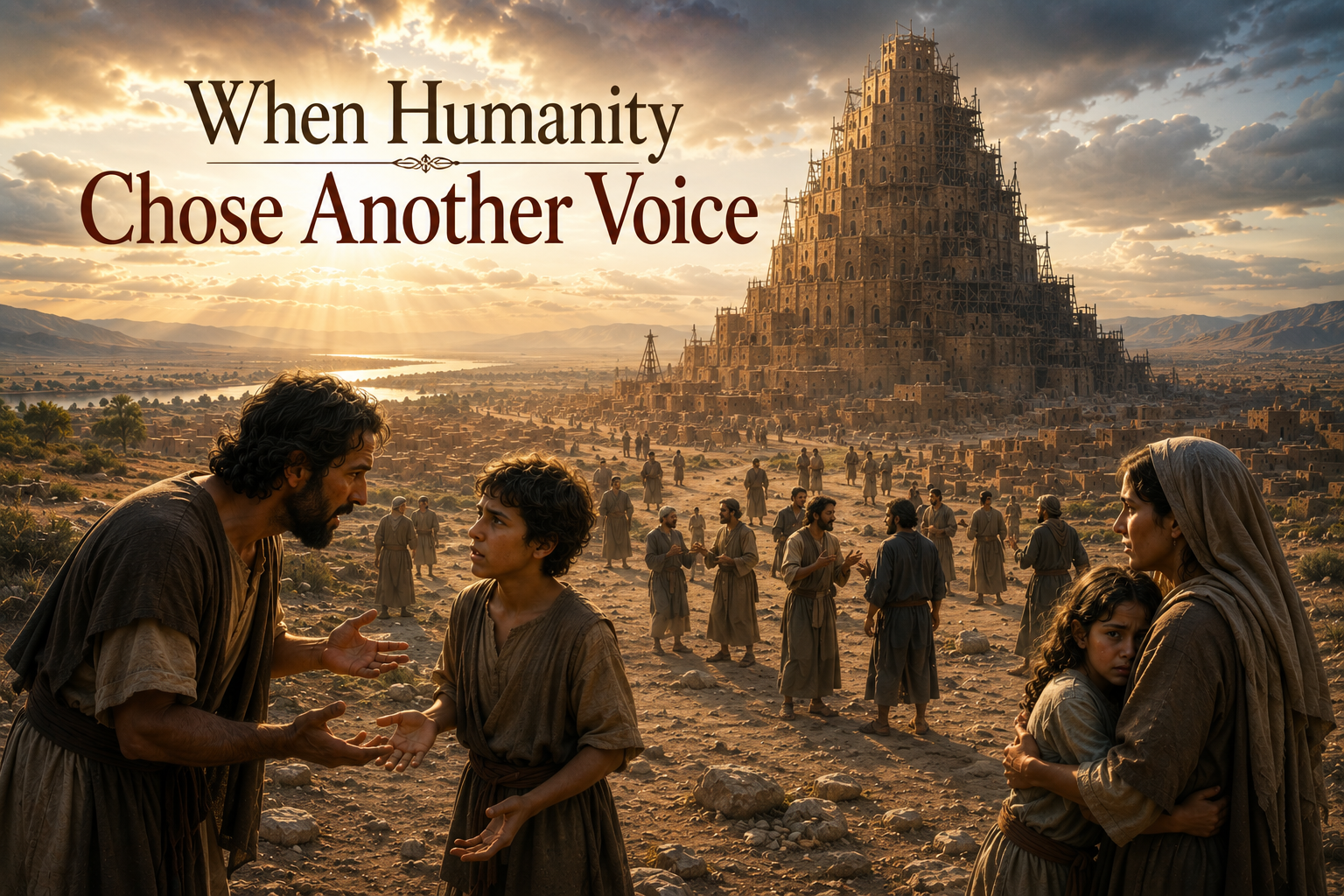
The tower itself was almost certainly a ziggurat—a great temple meant to connect earth and heaven.
Then Moses records one of the most quietly delightful lines in Genesis.
"The LORD came down to see the city and the tower..."
— Genesis 11:5
Humanity believed it had reached heaven.
The Father still had to come down.
No tower has ever bridged the distance between God and man.
Throughout Scripture, the story is never about humanity climbing high enough to reach God. It is always about God graciously coming down to meet His children.
The city became known as Babel. Genesis connects the name with the Hebrew word balal—"to confuse." Ironically, Babylon celebrated itself as "the Gate of God." Humanity believed it had built a doorway into heaven.
The Father simply called it confusion.
Then came the heartbreak.
Imagine a father speaking to his son, only to see confusion in his eyes. A mother reaches for her frightened child, yet the words that once brought comfort now sound foreign. Friends who worked side by side the day before stand in bewildered silence. Families slowly gather with those they can still understand, and communities begin to drift apart.
The tower stopped rising, not because there were no more bricks, but because something far more precious had been broken.
Relationship.
Communication.
Community.
The scattering of Babel was never merely geographical.
It was deeply personal.
Why would the Father allow such pain?
Because sometimes love interrupts what pride refuses to stop.
The Father did not interrupt Babel because He feared what humanity might accomplish. He interrupted Babel because He loved humanity too much to let it continue down a path that could only lead to deeper brokenness.
History has repeated Babel countless times. Empires rise. Nations boast. Civilizations become convinced they no longer need the One who gave them life.
The names change.
The temptation never does.
The greatest danger has never been our ability to build remarkable things.
The greatest danger is believing we no longer need the Father while we build them.
The story of Babel is not the last time Scripture speaks of many languages.
But...
that is a story for another day.
Perhaps this is what Babel teaches us about the Father.
He does not answer human pride with greater power.
He answers it with relationship.
Humanity says,
"Come, let us..."
The very next chapter begins,
"Now the LORD said to Abram..."
— Genesis 12:1
The Father has not stopped speaking.
And once again...
Not with cheap optimism.
Not by pretending humanity's rebellion didn't matter.
But with the quiet, steady hope that has marked His-story from the very beginning—a hope built upon His own faithfulness.
Hope has a name.
Abram.

0 Comments