The Father Who Wrestled With Jacob
Before reading this week's reflection, I encourage you to read Genesis 32:22–33:20. We visited part of this story last week, but this time I want us to consider it from a different perspective. Rather than concentrating on Jacob's desperate struggle, consider the One who came to meet him. Why would the Father wrestle with a frightened man? And what might Jacob discover about Him before the sun rose?
The Father Who Wrestled With Jacob
Jacob was alone.
Across the Jabbok River were his wives, children, servants, and everything he possessed. Somewhere ahead was Esau, the brother who had once threatened to kill him, now approaching with four hundred men.
Jacob had done everything he knew to do. He had divided his household, sent gifts ahead, and pleaded with God to remember His promises. Now there was nothing left to arrange.
And in the darkness, someone came to wrestle with him.
Genesis initially calls this mysterious visitor a man. But Jacob will later declare that he has seen God face to face, and the prophet Hosea describes the encounter as Jacob struggling with God and with an angel (Hosea 12:3–4).
Somehow, in a mystery Scripture never fully explains, Jacob has encountered God.
But notice something remarkable. Jacob didn't go looking for God that night.
Jacob was frightened, exhausted, and uncertain of what the morning would bring. He had already prayed. And now, when he was finally alone, the Father came to meet him.
But why wrestle?
Why not speak words of reassurance, as He had at Bethel? Why not simply tell Jacob everything would be all right? We aren't told.
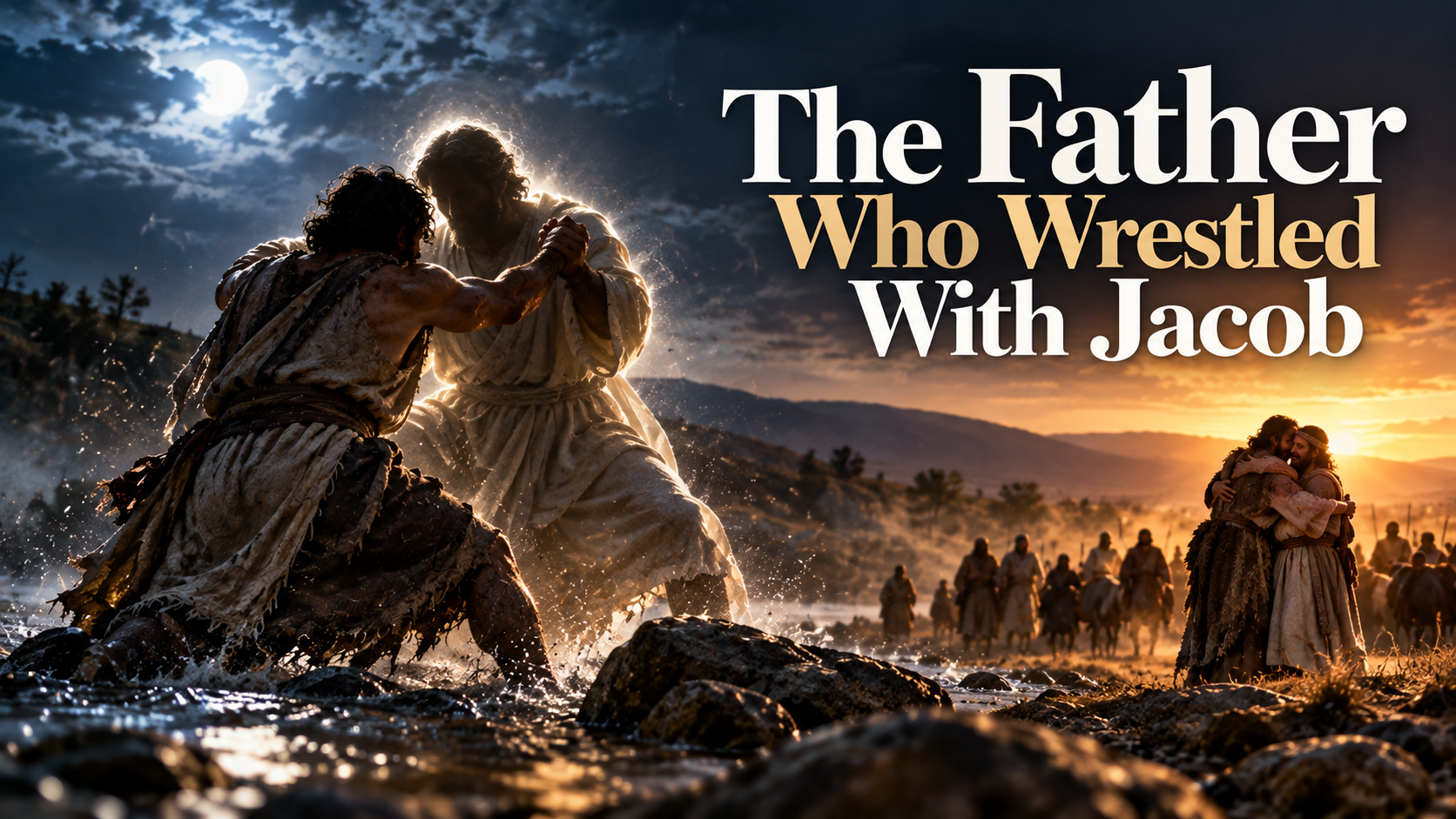
They wrestled through the night. Then, with a simple touch, the mysterious visitor dislocated Jacob's hip.
A touch.
After hours of wrestling, a single touch was enough to leave Jacob wounded. Whatever else we may not understand, this was no contest between equally matched opponents. The One who could disable Jacob with a touch had allowed the struggle to continue.
Perhaps the struggle itself was part of what the Father wanted Jacob to experience.
Jacob had spent much of his life struggling—with his brother, his father, and Laban. Struggling for blessings, for a family, and for a future. And now he was wrestling with God.
But this time, he wasn't trying to take something from another man. He was holding on to the One from whom blessing comes.
When the mysterious visitor told Jacob to release him, Jacob refused.
“I will not let You go unless You bless me!”GENESIS 32:26
Hosea adds a detail Genesis leaves unspoken. Jacob wept and sought favor.
I wonder what those tears carried. Fear for his family? Regret over the past? Exhaustion from years of struggling? Desperation to know that the God who had accompanied him would not abandon him now?
We cannot know everything Jacob felt, but we know he was pleading. And the Father did not turn him away.
Instead, He asked a question.
“What is your name?”
“Jacob.”
Years earlier, when Isaac asked who stood before him, Jacob had answered with his brother's name.
“I am Esau your firstborn.”
Now, beside the Jabbok, he was asked his name again. And this time he answered, “Jacob.”
Was the question intended to confront Jacob with his past? Scripture doesn't say. But the contrast is difficult to miss.
Then came an extraordinary declaration.
“Your name shall no longer be called Jacob, but Israel; for you have struggled with God and with men, and have prevailed.”GENESIS 32:28
Israel.
The name carries the language of struggling or striving with God, although its precise meaning has been understood in more than one way.
The Father gave Jacob a new name. Not because he had conquered his fears or become a man without weaknesses. He was still frightened. His family was still in danger, as far as he knew. And now his hip was injured.
Yet God blessed him.
And that raises another question.
Why wound him?
Jacob had begged for a blessing, and he received one. But he also received a wound.
We might be tempted to explain it by saying God needed to humble Jacob or teach him dependence. Perhaps there is some truth in those possibilities. But Genesis doesn't give us that explanation, and I don't want to put words into the Father's mouth.
What we do know is that Jacob would walk differently after this night. The man who had spent his life running, bargaining, and struggling would now approach his brother with a limp.
And perhaps that limp would forever remind him of something extraordinary. He had wrestled with God, and he had survived.
Jacob asked the mysterious visitor for His name, but received another question instead.
“Why is it that you ask about My name?”
Then He blessed him.
Jacob named the place Peniel, meaning the face of God.
“For I have seen God face to face, and my life is preserved.”GENESIS 32:30
Jacob had known about God all his life. He had heard the stories of Abraham and Isaac. He knew the promises. At Bethel, the Father had spoken directly to him. And for twenty years, Jacob had experienced His faithfulness.
But now he could say something he had never said before.
He had seen God face to face.
I wonder whether that was the greatest blessing of the night. Not the new name. Not the assurance of protection. But the encounter itself.
The Father had come near enough for Jacob to hold on to Him.
And when the sun rose, Jacob walked away limping.
Then he looked up.
Esau was coming.
Four hundred men were approaching, just as the messengers had warned. Whatever Jacob had experienced during the night, he still had to face his brother.
He arranged his family and went ahead of them, bowing repeatedly as he approached Esau. Twenty years had passed since Jacob fled for his life, and now the brother he feared was standing before him.
But Esau did something Jacob could hardly have expected.
He ran toward him.
Not with a sword. Not with an accusation.
He ran to embrace him.
Esau threw his arms around Jacob's neck, kissed him, and they wept together. The man Jacob had feared for twenty years was holding him in his arms.
And Jacob said something extraordinary.
“For indeed I have seen your face as though I had seen the face of God, and you were pleased with me.”GENESIS 33:10
During the night, Jacob had encountered God face to face. Now, in the morning, he looked into the face of the brother he had wronged and saw something that reminded him of God's face.
Welcome. Acceptance. Mercy he had not known how to expect.
It reminds me of another story Jesus would tell centuries later. A son who had squandered his inheritance returned home, uncertain of how his father would receive him.
But while he was still a long way off, his father saw him, ran to him, embraced him, and kissed him (Luke 15:20).
The stories are not identical. Esau is a brother, not a father, and Genesis doesn't tell us that Esau's embrace was a direct act of divine intervention. But the resemblance is beautiful.
A frightened man approaches someone he has wronged. And instead of the rejection he fears, he finds an embrace.
Could it be that Jacob recognized something of the Father's heart in the face of his brother?
Jacob himself seems to invite that question. He had seen the face of God during the night, and now he was speaking of seeing God's face again.
For twenty years, Jacob had experienced God's provision and protection. He had accumulated the blessings of family, livestock, and possessions.
But knowing that God provides is not quite the same as knowing the heart of the One who provides. Knowing the promises is not quite the same as knowing the Father who made them.
Jesus would one day describe eternal life in these words:
“And this is eternal life, that they may know You, the only true God, and Jesus Christ whom You have sent.”JOHN 17:3
To know Him.
Not simply to know about Him. Not merely to receive His gifts. But to know the Father Himself.
We began with a question. Why would the Father come to wrestle with Jacob?
We still don't know exactly why He chose that strange encounter, or why He left Jacob with a wounded hip.
But we do know that the Father came. He did not wait for Jacob to become fearless or to understand everything. He met him in the darkness, allowed him to struggle, heard his pleading, and blessed him.
And when morning came, Jacob discovered that the brother he feared was coming to embrace him.
Jacob entered that night carrying the weight of his past and the fear of his future. He left with a wound, a blessing, and a new name. And perhaps, more importantly, with a deeper knowledge of the One who had promised never to leave him.
The greatest blessing of that night may not have been something the Father gave Jacob.
Perhaps the greatest blessing was that the Father gave Jacob an encounter with Himself.