
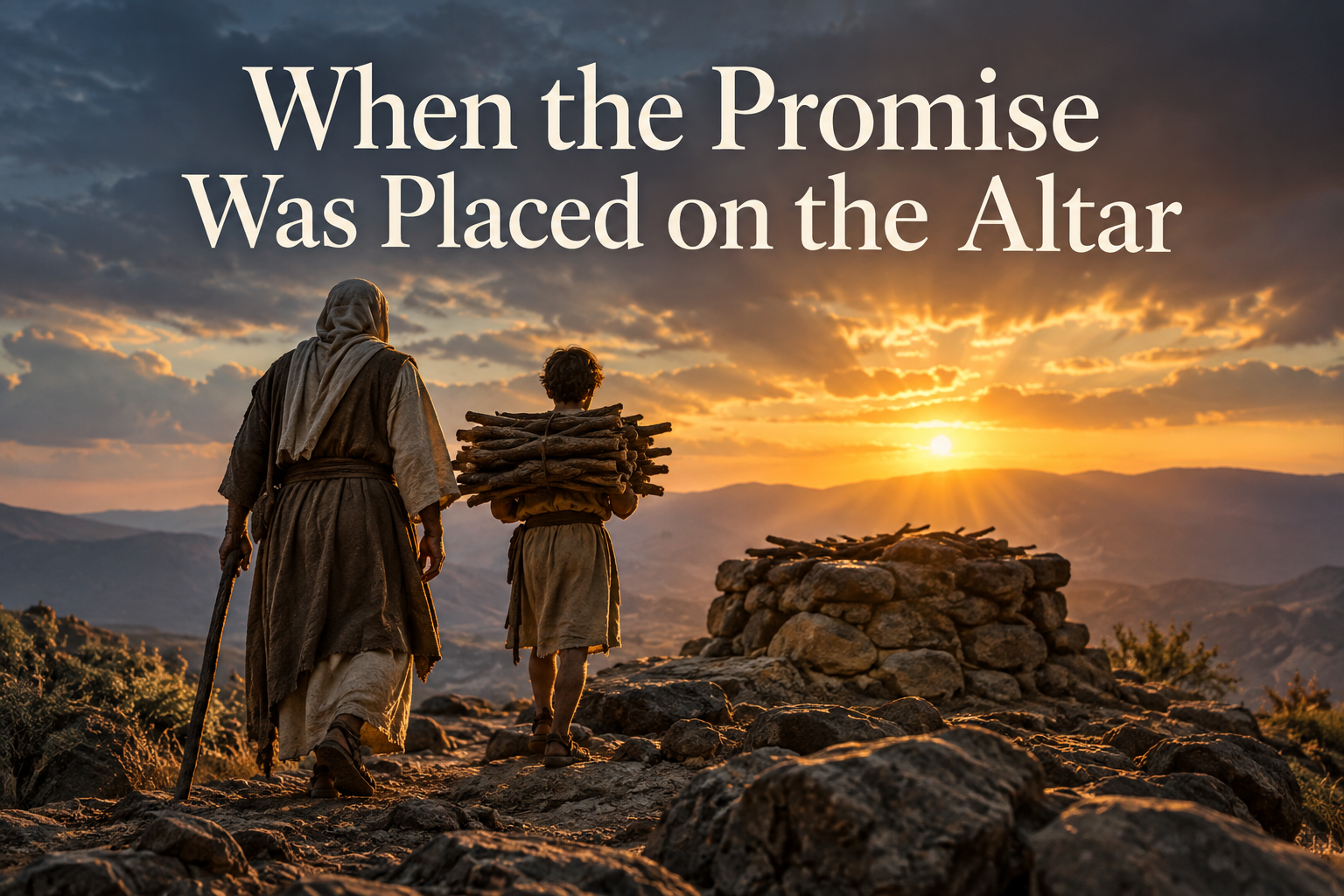
When the Promise Was Placed on the Altar
Before reading this week’s reflection, take a little time to read Genesis 20–22. If you have time, begin with the closing verses of Genesis 19 and follow the story all the way to the mountain.
As you read, don’t rush past the familiar parts. Pay attention to what Abraham says, what Isaac says, and what God does.
And keep asking the question that has guided us from the beginning:
What does this story reveal about the Father?
When the Promise Was Placed on the Altar
After the smoke of Sodom, life continued.
Lot’s story ended painfully, with the beginnings of Moab and Ammon. Abraham moved on too, but some old fears moved with him. In Gerar, he once again told people that Sarah was his sister because he was afraid they might kill him because of her (Genesis 20:11).
It is an uncomfortable story to find this late in Abraham’s journey.
After everything he had seen, everything God had promised, and everything God had already done, Abraham was still capable of fear.
His faith had never grown in a straight line.
He had trusted God enough to leave home without knowing where he was going, then became afraid in Egypt. He believed God’s promise, then tried to make it happen through Hagar. He stood beneath the stars and believed, then years later still tried to protect himself with Abimelech.
Abraham trusted, struggled and failed. And again and again, God remained faithful.
Then the promise finally arrived.
“The LORD visited Sarah as He had said, and the LORD did for Sarah as He had spoken.”
— Genesis 21:1
Sarah gave birth to Isaac.
The child whose name meant laughter filled their home with exactly that.
For years Abraham had carried a promise. Now he could hold the promise in his arms.
But Isaac’s arrival did not mean that the Father had forgotten Ishmael.
When Hagar and Ishmael were sent away and their water was gone, Hagar moved away because she could not bear to watch her son die.
Then came words we have heard before:
“God heard the voice of the lad.”
— Genesis 21:17
The Father opened Hagar’s eyes to water, renewed His promise concerning Ishmael, and Genesis quietly tells us:
“God was with the lad.”
— Genesis 21:20
Isaac was the child of promise.
But Ishmael was not invisible.
Then Genesis turns a corner.
“Now it came to pass after these things that God tested Abraham.”
— Genesis 22:1
God called his name.
“Abraham!”
And Abraham answered:
“Here I am.”
Then came the command.
“Take now your son, your only son Isaac, whom you love... and offer him there as a burnt offering on one of the mountains of which I shall tell you.”
— Genesis 22:2
His son.
His only son.
Isaac.
The son he loved.
This was more than Abraham being asked to surrender someone precious.
Isaac was the promise.
God had told Abraham that his descendants would come through Isaac (Genesis 21:12).
And now God was asking Abraham to place Isaac on an altar.
There is no recorded argument.
When God told Abraham about Sodom, Abraham had asked:
“Shall not the Judge of all the earth do right?”
— Genesis 18:25
He questioned. He pleaded.
But here there is silence.
Early the next morning Abraham rose, saddled his donkey, cut the wood, took two servants and Isaac, and began walking.
For three days.
Genesis tells us almost nothing about those three days.
Maybe that silence is enough.
Three days of walking beside the son he loved, carrying a command he could not understand.
Then Abraham saw the place in the distance.
He turned to the servants and said:
“Stay here with the donkey; the lad and I will go yonder and worship, and we will come back to you.”
— Genesis 22:5
We will come back.
Not I.
We.
Hebrews later tells us that Abraham reasoned that if Isaac died, God was able even to raise him from the dead (Hebrews 11:17–19).
That matters because Abraham had finally reached something he could not reconcile.
God had promised Isaac.
God had asked for Isaac.
Those two things did not fit.
For much of his life, when God’s promises seemed impossible, Abraham had tried to help. He had schemed, protected himself, and tried to make circumstances fit what God had said.
But there was nothing Abraham could do with this.
So he stopped trying to make it fit.
God would have to be faithful to His own word.
“We will come back.”
Perhaps this is one of the deepest moments of faith in Abraham’s entire life.
He no longer had to understand God in order to trust Him.
Abraham placed the wood for the offering on Isaac, while he carried the fire and the knife.
And Genesis says:
“So the two of them went together.”
— Genesis 22:6
Those words are easy to pass over.
Though we often picture Isaac as a small child, Genesis never says that. He was strong enough to carry the wood, and ancient Jewish tradition commonly remembered him as a young man or adult.
Abraham had spent a lifetime learning the faithfulness of God.
Isaac had spent a lifetime watching Abraham learn it.
He had grown up inside these stories—the call, the promise, the waiting, the failures, the laughter that came when God finally did what He had said.
Before Abraham ever walked by faith, someone had told him the stories.
Now Isaac had grown up inside Abraham’s story.
Somewhere along the way, Abraham’s story of faith had become part of Isaac’s foundation of faith.
This is how faith is so often passed from one generation to another. Not merely through explanations, but through lives lived together. Stories remembered. Promises repeated. Failures witnessed. Faithfulness seen.
His-Story becoming their story.
As they walked, Isaac finally spoke.
“My father!”
Abraham answered:
“Here I am, my son.”
Isaac looked at what they were carrying.
“Look, the fire and the wood, but where is the lamb for a burnt offering?”
— Genesis 22:7
Abraham answered:
“My son, God will provide for Himself the lamb for a burnt offering.”
— Genesis 22:8
And then Genesis repeats:
“So the two of them went together.”
— Genesis 22:8
Not Abraham disappearing up the mountain alone.
The two of them went together.
We should be careful not to make the text say more than it says.
But perhaps there were two acts of trust on that mountain.
A father trusting God.
And a son trusting his father.
When they reached the place, Abraham built the altar and arranged the wood.
Then he bound Isaac and placed him upon it.
Genesis records no struggle.
Abraham reached out his hand and took the knife.
And suddenly a voice broke through the silence.
“Abraham, Abraham!”
Again Abraham answered:
“Here I am.”
Then came the words:
“Do not lay your hand on the lad, or do anything to him.”
— Genesis 22:12
The knife stopped.
Abraham lifted his eyes.
There, caught in a thicket by its horns, was a ram.
Abraham took it and offered it as a burnt offering “instead of his son” (Genesis 22:13).
Instead of Isaac.
The son came down from the altar.
Another sacrifice took his place.
Only a short time earlier Isaac had asked:
“Where is the lamb?”
And Abraham had answered:
“God will provide for Himself.”
Now Abraham could see what he had only trusted before.
So he named the place:
YHWH Yireh.
The LORD will provide.
Generations later, Scripture would identify Moriah with the mountain in Jerusalem where Solomon built the Temple (2 Chronicles 3:1).
The mountain of provision would remain part of Israel’s story.
And Christians cannot stand on that mountain without eventually hearing an echo from another story.
A beloved Son would again walk willingly toward sacrifice.
Jesus would say:
“No one takes it from Me, but I lay it down of Myself.”
— John 10:18
And John would later write:
“For God so loved the world that He gave His only begotten Son.”
— John 3:16
We do not need to force those words backward into Genesis.
Abraham said exactly what he said:
“God will provide for Himself the lamb.”
But we know more of His-Story than Abraham did.
Still, before we leave the mountain, we should return to Abraham.
His life had been a long journey of learning trust.
He trusted, became afraid, believed, tried to help, obeyed, stumbled—and again and again the Father remained faithful.
Until finally Abraham stood on a mountain holding the one thing that seemed absolutely necessary for God’s promise to come true.
Isaac.
And Abraham opened his hands.
Not because Isaac no longer mattered.
Not because Abraham understood.
But because after all these years, Abraham had finally learned something greater than understanding.
He had learned the Father.
Abraham had once thought the promise depended upon his ability to protect it.
On Moriah, he placed the promise itself back into the hands of the One who gave it.
And discovered that the Father was already there.
The provision was already there.
Abraham simply could not see it yet.
YHWH Yireh.
The LORD will provide.