
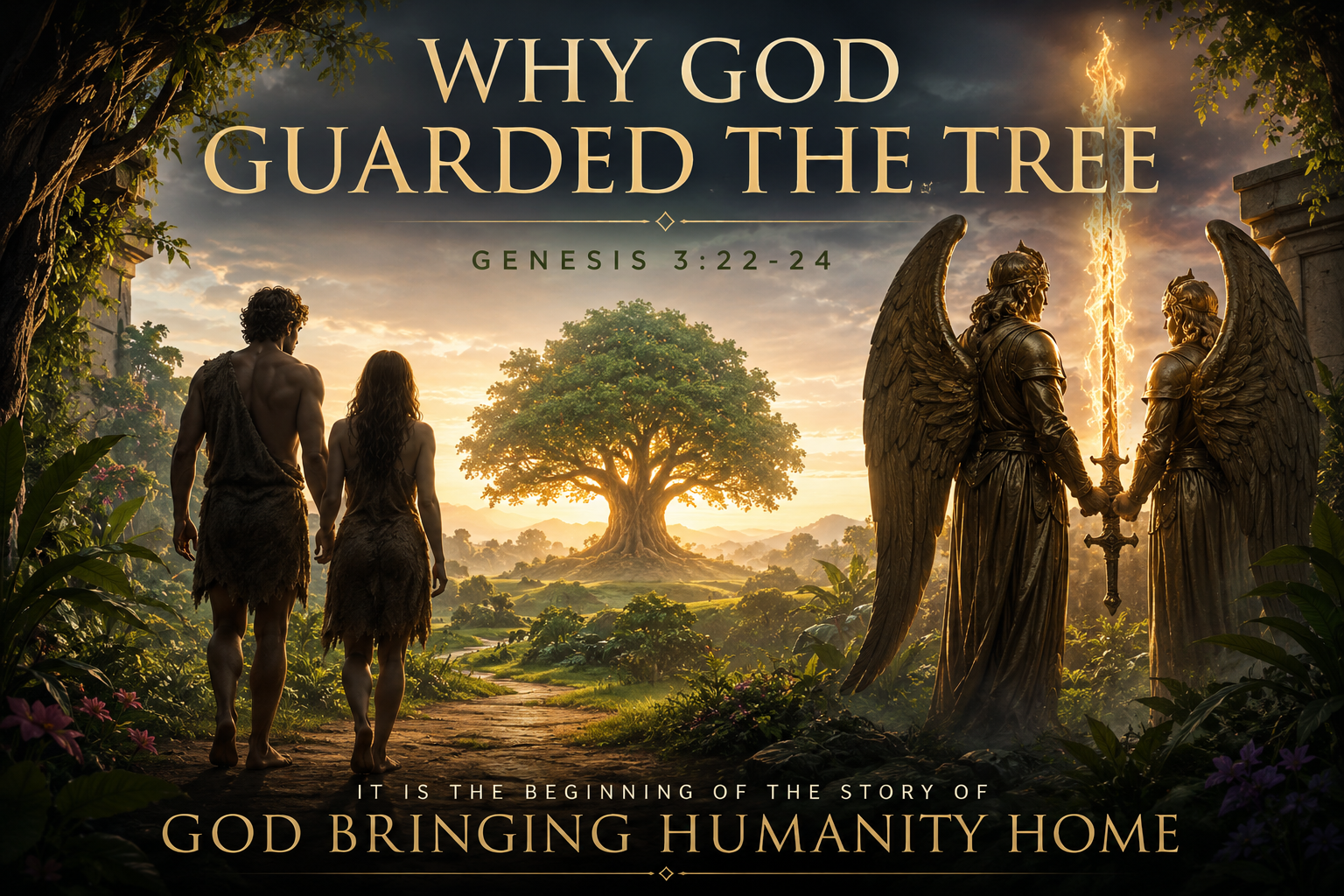
Why God Guarded the Tree
🎧 Listen to the Audio
A Personal Note Before We Begin
This journey through the opening chapters of Genesis has been far more powerful than I ever expected.
That may sound strange considering how much time I have already spent there.
For more than fifteen years I have studied these chapters, taught these chapters, and even written books centered around the first six chapters of Genesis. This is not new territory for me. In many ways, it feels like familiar ground.
And yet, every time I return, another layer seems to emerge.
A detail I had overlooked.
A connection I had missed.
A glimpse of God's character that somehow escaped me before.
This week was one of those moments.
For days I have sat with the final verses of Genesis 3. I have read them repeatedly, followed references throughout Scripture, explored ancient traditions, and wrestled with the text from every angle I know.
The deeper I looked, the more overwhelmed I became.
Not because the passage became more complicated.
Because the Gospel seemed to be shining through it in ways I had never noticed before.
I found myself seeing the Gospel—not merely forgiveness, but resurrection, restoration, and Life itself.
I am not sure my words can fully communicate what I have felt while studying these verses.
But what follows is my best attempt.
Because if what I am beginning to see is true, then the end of Genesis 3 is not merely the story of humanity leaving a garden.
It is the beginning of the story of God bringing humanity home.
Why God Guarded the Tree
"And the LORD God said, Behold, the man is become as one of us, to know good and evil: and now, lest he put forth his hand, and take also of the tree of life, and eat, and live forever:"
"Therefore the LORD God sent him forth from the garden of Eden, to till the ground from whence he was taken."
"So he drove out the man; and he placed at the east of the garden of Eden Cherubims, and a flaming sword which turned every way, to keep the way of the tree of life."
— Genesis 3:22–24
"And the LORD God said, Behold, the man is become as one of us, to know good and evil: and now, lest he put forth his hand, and take also of the tree of life, and eat, and live forever:"
"Therefore the LORD God sent him forth from the garden of Eden, to till the ground from whence he was taken."
"So he drove out the man; and he placed at the east of the garden of Eden Cherubims, and a flaming sword which turned every way, to keep the way of the tree of life."
— Genesis 3:22–24For most of my life, I read these verses as a story of loss.
Adam and Eve are driven from the garden. The Tree of Life is placed beyond their reach. Cherubim appear. A flaming sword blocks the way. The gates seem to close behind them.
The story feels tragic.
And in many ways, it is.
Yet the more I sat with the passage, the more one question refused to leave me alone:
Why did God guard the Tree?
Not destroy it.
Not uproot it.
Not remove it from the story.
Guard it.
The more I pondered that question, the more significant it became.
If the Tree no longer mattered, why preserve it? If humanity would never again receive what it represented, why station cherubim there at all? Why not simply allow it to disappear from the story?
Yet God does not destroy the Tree.
He protects it.
He preserves it.
He guards it.
And suddenly I began to wonder if there was more happening here than I had ever realized.
The text itself gives us God's reason.
"Lest he put forth his hand, and take also of the tree of life, and eat, and live forever."
For years I read those words as judgment.
Now I wonder if they are mercy.
Because the question is not whether Adam and Eve would live forever.
The question is: forever as what?
By this point in the story, fear has entered their hearts. Shame has entered their relationship. Suspicion has entered their understanding of God. They are hiding among the trees from the One who came looking for them.
Death has entered the story.
Not merely physical death waiting somewhere in the future, but a condition already at work within them.
The man and woman who once walked freely with God now hide from His voice. The ones who once stood unashamed now cover themselves. The ones who once trusted now fear.
Imagine fear becoming permanent.
Imagine shame becoming permanent.
Imagine hiding becoming permanent.
Imagine living forever while remaining trapped in the very thing that is destroying you.
Would that be life?
Or would it be an eternal prison?
The longer I sat with that thought, the more one realization gripped me.
Perhaps God was not denying humanity Life.
Perhaps He was refusing to let death become permanent.
Suddenly the exile begins to look less like rejection and more like mercy.
If that is true, then everything begins to look different.
The guarded Tree is no longer merely a symbol of exile.
It becomes a symbol of mercy.
The promise has not been cancelled.
The destination has not been removed.
Life is still there.
God is not erasing His purpose for humanity—He is preserving it.
The way is closed, but the promise remains.
The next verse tells us that God sent Adam out to till the ground from which he was taken.
At first glance, it feels like a small detail.
Yet I wonder what Adam saw every year as he worked that soil.
The ground would be broken open.
Seeds would disappear beneath the earth.
For a time they would seem lost.
Buried.
Gone.
And then life would emerge.
Again.
And again.
And again.
The very earth from which Adam had been formed would continually tell the same story.
Life from death.
Harvest from burial.
Hope from what appeared lost.
As though the earth itself had become a living parable of resurrection.
Almost as though creation had been whispering the promise of resurrection from the very beginning.
Then another detail begins to stand out.
The cherubim.
Throughout Scripture, cherubim are associated with sacred space. They stand above the Ark of the Covenant. They appear throughout the Tabernacle and the Temple. They are guardians of places where heaven and earth meet.
The more I followed those threads, the more Eden began to look like something more than a garden.
It looked like a sanctuary.
A holy place.
A place where God and humanity walked together.
And if that is true, then the cherubim are not merely guarding a tree.
They are guarding the way back to the presence of God.
Even the flaming sword begins to take on a different meaning.
Throughout Scripture, fire often accompanies God's presence. Moses encounters God in a burning bush. Israel follows a pillar of fire through the wilderness. Mount Sinai burns with divine glory. Scripture describes God Himself as a consuming fire.
And so a question begins echoing through the rest of the biblical story:
Who can return?
Who can pass through the fire?
Who can lead humanity back to Life?
Centuries later, Jesus steps into that question and answers it Himself.
"I am the way."
John 14:6And again:
"I am the resurrection, and the life."
John 11:25Those words have never felt larger to me than they do now.
For most of my life, I heard the Christian hope described primarily as life after death.
Yet the more I read the New Testament, the more I encounter a different emphasis.
Resurrection.
Again and again the apostles speak of resurrection.
Again and again they point toward renewal.
Again and again they speak of a world made new, a curse removed, and God dwelling with humanity once more.
The more I sat with these verses, the more I realized that the Gospel is larger than I had imagined.
Forgiveness remains essential.
The cross remains essential.
Grace remains essential.
But forgiveness is not the destination.
It is the doorway.
Life is what lies beyond it.
The story is moving toward restoration.
Toward resurrection.
Toward the recovery of everything that was lost.
Then I found myself thinking about another statement Jesus made.
"Today shalt thou be with me in paradise."
Luke 23:43For years I heard those words and immediately translated them into the language of heaven.
Yet Scripture itself paints a richer picture.
Near the beginning of Revelation, Jesus says:
"To the one who conquers I will grant to eat of the tree of life, which is in the paradise of God."
Revelation 2:7Paradise.
Tree of Life.
Together in the same sentence.
I am not attempting to answer every question about life after death.
But I cannot help noticing the story.
Genesis begins in a garden.
Jesus speaks of paradise.
Revelation places the Tree of Life in the paradise of God.
The story seems to move steadily toward restoration.
Toward Life.
Toward the presence of God.
Toward home.
Then, in the closing pages of Scripture, the Tree appears again.
"On either side of the river, was there the tree of life..."
Revelation 22:2And then comes the declaration:
"And there shall be no more curse."
Revelation 22:3I find that astonishing.
After Abraham.
After Moses.
After David.
After exile.
After the prophets.
After the cross.
After the empty tomb.
John looks and the Tree is still there.
Waiting.
Standing.
Unforgotten.
The promise survived every chapter of the story.
The Bible begins with a tree and ends with a tree. Between them stands another tree—the one upon which Christ bore the curse of humanity so that humanity might receive Life.
Suddenly the cherubim look different.
The sword looks different.
The exile looks different.
Adam and Eve saw a closed gate.
God was guarding a promise.
The Tree remained.
Life remained.
Hope remained.
The way was closed, but the destination was preserved.
The cherubim were not guarding a punishment.
They were guarding a promise.
And if what I am beginning to see is true, then the end of Genesis 3 is not merely the story of humanity leaving a garden.
It is the beginning of the story of God bringing humanity home.
🎵 A Song Inspired by This Story
My son, Ryan Rush, wrote this song to accompany this week's His-Story. As I worked through Genesis 3, seeing the beauty of God's promise, Ryan captured that same hope in music.
If this story stirred something in your heart, I encourage you to listen. Sometimes music has a way of carrying truth where words alone cannot.

0 Comments