“Before there was anything… there was God. Before there was time, light, or even matter— His Spirit was already moving. And He’s still moving now.”
Scripture Text: Genesis 1:1-2
“In the beginning, God created the heavens and the earth.”
Pause. Don’t rush past the first four words: In the beginning, God.
That’s the foundation of everything—of faith, of hope, of life itself. Before there was light, land, stars, or breath… there was God.
This is the line in the sand between belief and disbelief. Some live their lives shaped by the truth that God is—that He was before all things, and by Him all things were made. Others, as Romans 1 describes, refuse to acknowledge Him. They suppress the truth. That’s not just a philosophical disagreement—it’s the root of every kind of brokenness and rebellion.
But from the first sentence of Scripture, God reveals Himself—not just in words, but in the very fabric of creation.
As Psalm 19:1 says: “The heavens declare the glory of God. The expanse shows his handiwork.”
We don’t begin with a religion. We begin with a God who is—and who made all things on purpose. That includes the stars, the sea… and you.
The Spirit in the Chaos
“The earth was formless and empty. Darkness was on the surface of the deep. God’s Spirit was hovering over the surface of the waters.”
The Hebrew phrase here—tohu va-bohu—is so raw and layered that no single English translation can do it justice. It doesn’t merely mean “formless and empty.” It speaks of chaotic desolation—a wild, unstructured void where nothing lives, nothing forms, and nothing makes sense. Time and space are without rhythm. Matter exists without form. It’s not a clean slate; it’s a storm of potential with no order… yet.
No shape. No consistency. No life. No measurement. No light. Just a void.
And yet—even in that, everything needed for creation already existed. In that moment of confusion and cosmic unrest… God’s Spirit hovered.
Like a flash of lightning waiting to strike, like breath waiting to be spoken—He was there.
There’s deep comfort in this: In the darkest, blackest, most disordered corners of the universe—God shows up. He doesn’t run from the chaos. He doesn’t fear the void. He doesn’t hide from darkness.
He enters it. He hovers over it. And He speaks.
This is who He is—not a distant deity, but a present Spirit. The kind of God who doesn’t avoid our mess, but moves into it—bringing light, order, and meaning.
Video Reflection:
Pondering Questions (from the videos):
What would change if you truly lived as if God was already present in the middle of your unknowns?
What does it mean that the Spirit of God hovered over formless chaos?
Can you sense that same presence hovering over you today?
Pause and Reflect…
Before there was time… Before light… Before shape or sound… there was God.
In the quiet. In the chaos. In the darkness… He was already there.
You may not see Him clearly right now. But He’s there. Hovering over your deep places… Present… even when everything feels undone.
He was there. And He still is.
What does it mean to you that God was “in the beginning”?
Where do you see Him in your own beginning—or in the chaos you may be feeling today?
Scripture Connections:
Psalm 19:1 “The heavens declare the glory of God. The expanse shows his handiwork.”
John 1:1 “In the beginning was the Word, and the Word was with God, and the Word was God.”
This isn’t just poetic language—it’s a deliberate echo. John was reaching all the way back to Genesis. God spoke the universe into existence. Creation didn’t begin with clay in His hands, but with a Word on His lips.
And that Word… was Jesus.
Let that settle in for a moment: The voice that pierced the silence at the dawn of creation… is the same Word who became flesh and dwelled among us.
Hebrews 11:3 “By faith, we understand that the universe has been framed by the word of God, so that what is seen has not been made out of things which are visible.”
Guided Journaling
What does it mean to you that God’s Spirit hovers over chaos—over formlessness, darkness, and confusion?
Think of a time in your life when everything felt like a void—when nothing made sense, and you couldn’t see a way forward. What would it mean to believe that God was already there, hovering, waiting to speak light into it?
What does it mean to you personally that God was there “in the beginning”?
How does that truth affect the way you view your own beginning—your life, your story, your chaos?
Write it down—on paper, in your phone, or in the space provided in your book. You can also share your story or insight with others below.
The measure of a man isn’t found in the approval of others. It’s found in the quiet moments when he stands alone.
Joshua was not the loudest voice in the crowd. He wasn’t a showman. He didn’t spend his life trying to win the favor of men. His life was forged in a harder fire: the fire of obedience to God when everyone else turned away.
When Moses sent twelve men to scout the Promised Land, ten of them returned with fear. Only Joshua and Caleb came back with courage. Ten said, “We can’t.” Two said, “God can.” The consensus was fear. Joshua’s courage made him an outsider.
He didn’t win a popularity contest that day. He won something better: God’s approval.
Joshua’s courage wasn’t reckless. It was rooted in trust.
He had seen God move. He had tasted manna in the wilderness. He had stood at the foot of Mount Sinai and heard the thunder of God’s voice. He knew: if God said the land was theirs, it didn’t matter how big the giants were.
Courage like Joshua’s isn’t blind. It sees the size of the enemy clearly — and trusts God even more clearly.
It was this kind of courage that forged Joshua into the man who would lead a nation. It was this kind of fire that prepared him to hear God’s personal command later:
“Have I not commanded you? Be strong and courageous. Do not be afraid; do not be discouraged, for the Lord your God will be with you wherever you go.” — Joshua 1:9
Joshua didn’t rise to leadership because he demanded it. He rose because when it mattered, he stood alone — not for himself, but for the honor of God.
Today, the world still bows to consensus.
Majority opinion sways like the wind. Fear drives decisions. Safety is celebrated as wisdom. But a man forged by God doesn’t take his cues from the crowd. He doesn’t measure truth by counting noses. He measures it by the Word of God — even when that means standing alone.
Sometimes real strength is not winning an argument. It’s standing firm when the crowd has already decided against you.
Joshua teaches us that courage is not about being fearless. It’s about fearing God more than you fear man.
Reflect:
Where am I letting fear of others’ opinions shape my decisions?
Would I be willing to stand alone if it meant honoring God?
Forged in Fire men are not called to blend in. They are called to stand out — courage over consensus, obedience over approval, God over giants.
“Before I formed you in the womb I knew you, before you were born I set you apart.” — Jeremiah 1:5
“For you created my inmost being; you knit me together in my mother’s womb. I praise you because I am fearfully and wonderfully made; your works are wonderful, I know that full well.” — Psalm 139:13–14
Before you spoke a word, He knew you. Before you took a breath, He loved you. Before you lived a single day, He had already dreamed of you.
You are not an accident. You are a deliberate, deeply loved creation of the King of Heaven.
He didn’t simply allow you to exist — He wanted you. He crafted you. Every fiber of your being was knit together by His hands, woven with love and infinite attention. You are fearfully and wonderfully made because He treasures you.
Do We Treasure Him in Return?
As staggering as it is to realize that the God of all creation treasures us, there’s a question that stirs the heart:
Do we treasure Him in return?
“Do not lay up for yourselves treasures on earth, where moth and rust destroy and where thieves break in and steal, but lay up for yourselves treasures in heaven, where neither moth nor rust destroys and where thieves do not break in and steal. For where your treasure is, there your heart will be also.” — Matthew 6:19–21
If He loved us enough to create us, to call us by name, to walk with us through every moment of life — where is our treasure? Where is our heart?
It’s easy to invest ourselves in earthly things — money, approval, success, comfort. But none of these will last. One day, everything that seems so urgent now will vanish like mist. Only the treasures we lay up in heaven will remain.
When we realize how deeply we are loved — how highly we are valued — it stirs something inside us: a longing to treasure Him above all else. Not out of guilt. Not out of duty. But out of love.
Because when your heart treasures God — the One who first treasured you — you begin to store up a different kind of treasure: the kind that can never be stolen, never rot, never fade.
A Place for Your Heart
Today, pause and remember: You are loved more than you can imagine. You are treasured by the Maker of heaven and earth.
And in return, treasure Him. Lay up your treasure where your heart was meant to be — in His hands.
If this encouraged you, share it with a friend who needs to be reminded: You are deeply treasured. ❤️
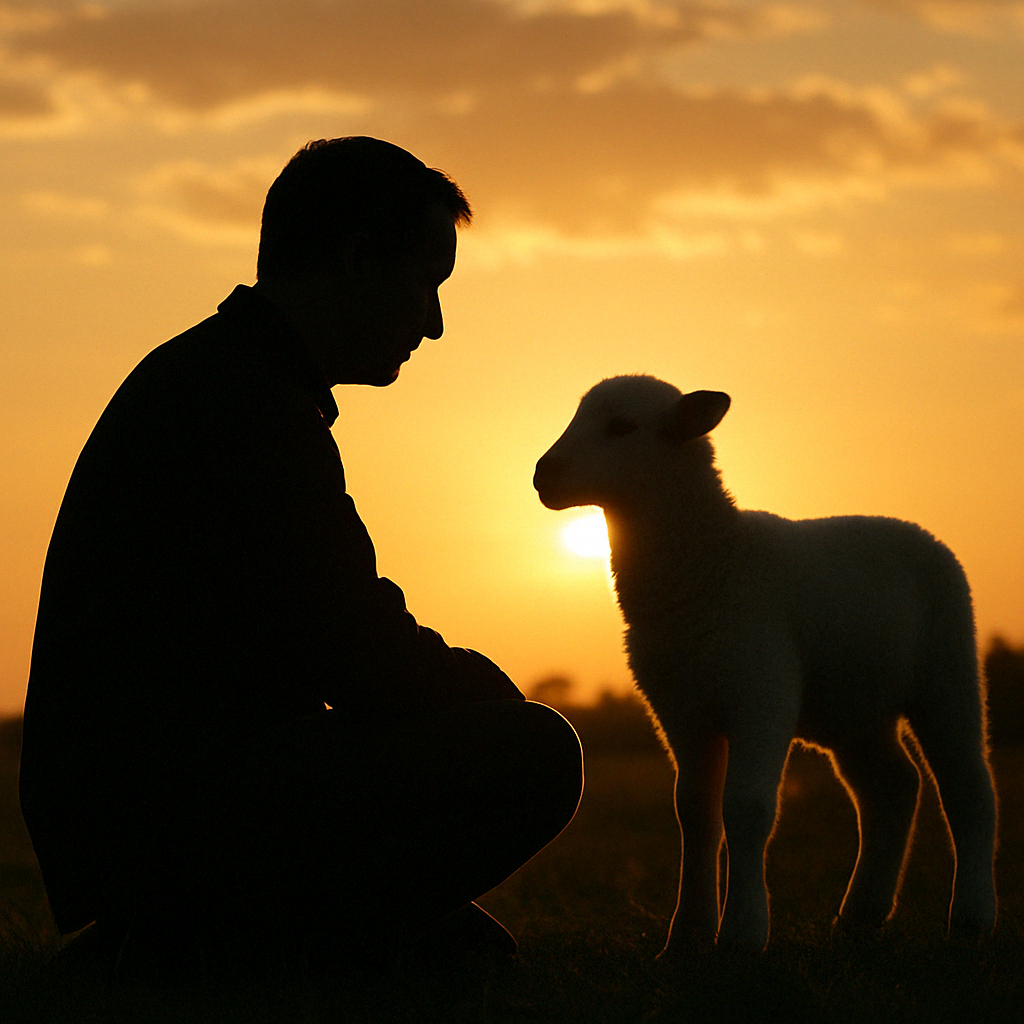
I spent my Easter morning with a lamb. Not a symbol, not a sermon—an actual lamb. And in that quiet moment, I was reminded of what today is really about.
It’s not about breakfast. It’s not about Easter eggs. It’s about the Lamb.
John the Baptist saw Him coming and said,
“Behold the Lamb of God, who takes away the sin of the world.” (John 1:29)
Later, in exile on the island of Patmos, John saw a vision of the risen Christ:
“Then I saw a Lamb, looking as if it had been slain, standing at the center of the throne, encircled by the four living creatures and the elders.” (Revelation 5:6)
This Lamb is Jesus. Slain. Risen. Exalted.
As I sat on the ground with that lamb this morning, I couldn’t help but remember a scene I once imagined—when God first created the lamb. I picture Him kneeling in the dust, forming it with His hands, and pausing for a moment. Maybe He looked into its innocent eyes and whispered something only the heavens heard. Perhaps there was a tear. He knew the future of this creature. That one day, lambs would be offered as sacrifices. And ultimately, one day, His Lamb—His own Son—would be offered.
These soft, gentle creatures were not an accident. They were made with intention—to reflect something far greater.
Easter isn’t about tradition. It’s about redemption. It’s not about a holiday. It’s about a Lamb.
The Lamb who was slain. The Lamb who lives. The Lamb who will one day be at the very center of all things.
So this morning, I sat on the ground with the Lamb.
We say it every year. We hear it sung in churches, printed on cards, and whispered in reverent tones: He is risen!
But maybe today, as the world spins with chaos and quiet personal battles, you wonder: Why does that matter now?
It mattered then because a crucified man walked out of a grave. It matters now because the One who defeated death hasn’t changed—and neither has His power.
If Jesus conquered death, then nothing in your life is beyond redemption. Not your past. Not your pain. Not even that silent ache you carry when no one’s looking.
But if you’re honest, maybe you still don’t feel it. Maybe that resurrection power doesn’t seem to show up in your life. Not when you’re exhausted. Not when you’re lonely. Not when the week has been long and the prayers seem unanswered.
We often hear the verse:
“The same power that raised Jesus from the dead lives in you.” (Romans 8:11)
And we whisper, “Wow. That’s amazing.” But quietly, we add, “It doesn’t feel like it’s true for me.”
Here’s the twist we often miss: In the original language, that verse doesn’t say “you” singular—it says “y’all” plural. Not “you, the individual.” But you all. Us – together.
That resurrection power lives in the body of Christ—not just in me, not just in you, but in us… “y’all”
It’s not always thunder or miracles. Sometimes it’s a meal delivered in a time of need. A word of comfort at the perfect moment. A hug that says, “You’re not alone.” A teaching, a prayer, a shared tear, or a laugh that reminds someone: There is life here.
When the women came to the tomb, they were prepared for closure—ready to anoint a corpse. Instead, they were given a mission. “Go. Tell the others. He’s alive.”
That same resurrection life now pulses through a community of believers who:
Love without conditions
Carry one another’s burdens
Teach with grace
Heal with compassion
Forgive what seems unforgivable
Shine light in the darkness
And draw one another to the feet of Jesus
This is Easter power. Not a moment, but a movement. Not a monument, but a body—alive.
So maybe you don’t feel powerful today. But you are part of something that is.
He is risen. And the same power that raised Him from the dead dwells in us.
Scripture to Remember
“If the Spirit of him who raised Jesus from the dead dwells in you (plural), he who raised Christ Jesus from the dead will also give life to your mortal bodies through his Spirit who dwells in you.” —Romans 8:11 (ESV, emphasis added)
“Now you are the body of Christ, and individually members of it.” —1 Corinthians 12:27
“Carry one another’s burdens, and in this way you will fulfill the law of Christ.” —Galatians 6:2
A Challenge to Live It Out
This Easter, don’t just celebrate an empty tomb. Be a living testimony to resurrection power.
Ask yourself:
Who in my life needs to see resurrection love today?
How can I be part of the power God placed in us?
What small act of care, compassion, or courage can I offer this week?
Remember—the same power that raised Jesus lives in the body of Christ. Let that body move through you.