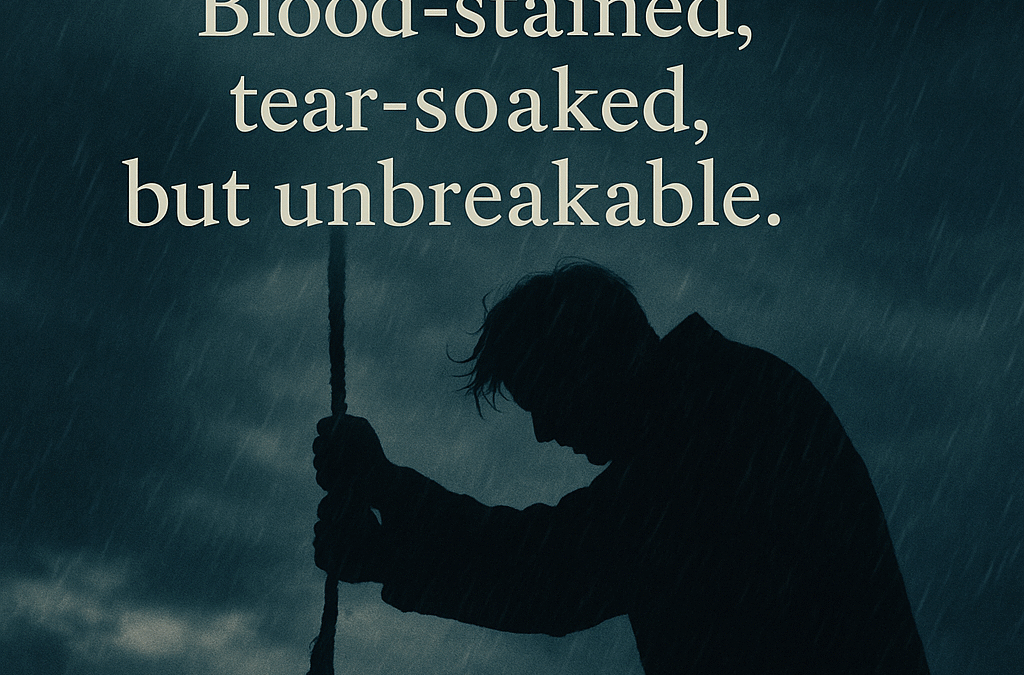
When We Scream at the One Who Holds Us
When We Scream at the One Who Holds Us
🎧 Listen to the Devotional
Click the play button to hear an audio reading of this week’s devotional: “When We Scream at the One Who Holds Us.”
When We Scream at the One Who Holds Us—and Trust Anyway
There’s a belief—often unspoken—that if we trust God, He will make things better. That prayer will shield us. That faith will smooth the road.
But then a flood comes.
And it takes a Christian summer camp filled with children.
And the question is spoken aloud:
“Where was your God?”
These are the moments when clichés collapse. When bumper-sticker faith peels off in the rain. When the phrases we’ve rehearsed—“God has a plan,” “Everything happens for a reason”—start to feel more like salt than salve.
What do we do when trusting God doesn’t stop the pain?
What do we do when He could have stopped it—and didn’t?
Trust and Suffering Are Not Opposites
This is where many lose their faith. But it’s also where the Bible gets brutally honest.
Job was a good man. Blameless, in fact. And yet he lost everything—his children, his wealth, his health, even the respect of his friends. His wife, devastated by the suffering, looked at him and said, “Curse God and die.”
She wasn’t weak. She was human. And I understand her.
Job didn’t receive answers. God didn’t explain Himself. He didn’t offer reasons. He just was. And Job, sitting in the ashes said:
“Though He slay me, yet will I trust Him.” (Job 13:15)
Not because it made sense. Not because it felt good. But because Job trusted in the fact that God is beyond our understanding. And that was enough to keep holding on.
Habakkuk: The Prophet Who Screamed and Stayed
Another voice from the pages of Scripture—Habakkuk—didn’t just cry out to God. He screamed in anguish and frustration:
“How long, Lord, must I call for help, but You do not listen?
Or cry out to You, ‘Violence!’ but You do not save?” (Habakkuk 1:2)
He saw chaos, injustice, silence, and he said so – boldly. But here’s what’s so staggering:
He screamed at the very One he was still clinging to.
He planted himself on the watchtower and waited for an answer. And when God finally spoke, it wasn’t the answer he wanted.
Yet by the end of the book, Habakkuk said this:
“Though the fig tree does not bud
and there are no grapes on the vines…
yet I will rejoice in the Lord.” (Habakkuk 3:17–18)
He didn’t say this because things had improved.
He said it in spite of the fact that they hadn’t.
Habakkuk didn’t walk away. He rested in the One he had shouted at.
This is not easy faith. This is faith with a limp.
Crimson Cord Faith
I won’t make excuses for God. I won’t pretend to understand His ways.
But I believe—no, I cling—to the truth that He is still who He says He is. He does not change. He is just. He is love. And somehow—through agony, through silence, through death—He is working redemption that I cannot yet see.
The Hebrew word for hope is tikvah—which also means cord or rope. It’s the word used for the scarlet cord Rahab tied in her window. A symbol of rescue. A thread of survival.
That’s what I’m holding on to. Crimson cord faith.
Blood-stained, tear-soaked, but unbreakable.
The Mirror in the Doctor’s Office
Years ago, Dr. James Dobson told a story about his small child suffering from a serious ear infection. The doctor had to act fast—no anesthesia, no preparation. He had to cut something out immediately.
Dobson held his son across his knees while the child screamed, unable to comprehend why his father was letting this happen.
But in the room was a mirror. And in that mirror, the child caught his father’s eyes.
Eyes full of pain.
The child didn’t understand the why.
But he was being held.
And he saw the face of love.
That image stays with me. Because sometimes we are that child. Screaming in pain. Helpless. Confused. Asking why the One who claims to love us allows such agony.
And sometimes all we get is a glimpse of His eyes.
And the knowledge that He hasn’t let go.
When the Hurt Is Yours—or Someone You Love
Maybe you’ve carried a deep loss.
Maybe someone you love has suffered unfairly, unbearably, and you have no answers—just ache.
You don’t have to pretend it’s okay. The Bible never asks you to. In fact, it gives you permission to scream at the God who holds you.
Because real faith doesn’t mean silence.
It means still facing Him, even when you don’t understand.
You don’t have to explain it.
You don’t have to fix it.
You just have to hold on.
Dig in your heels.
Clutch the crimson cord.
And whisper with every shred of hope left:
“Though He slay me, yet will I trust Him.”
Because I’ve seen His eyes in the mirror.
And I know—He’s still there.
💬 Know someone who’s suffering right now?
Send them this post—or just sit with them and be present.
Sometimes trust sounds less like answers, and more like being there.
Week of 7/11/25 🔥 This Week in the RUMble Machine – Real Trades, Real Profits
🔥 This Week in the RUMble Machine – Real Trades, Real Profits
This is a full recap of how I operated the Machine this week. Nothing flashy. No moonshots. Just strategic covered calls, micro-trims, and disciplined use of margin to stack weekly premium.
📅 Daily Breakdown – What I Did and Why
🗓 Monday, July 7
- ➡️ Bought back 1x $9 Call @ $0.58 (–$58.04)
- ➡️ Bought back 1x $8 Call (Oct) @ $1.95 (–$195.04)
- ➡️ Transferred $400 out to cover bills (life happens)
🗓 Tuesday, July 8
- ➡️ Sold 2x $9.50 Calls @ $0.30 (+$59.91)
- ➡️ Bought more RUM shares via recurring and fractional buys (~$20)
- ➡️ Transferred $200 in, then $220 out again for life needs
🗓 Wednesday, July 9
- ➡️ Sold 2x $9 Calls @ $0.40 each (+$79.90)
- ➡️ Bought back 2x $9.50 Calls @ $0.25 (–$50.08)
- ➡️ Recurring buys continued, ~4 new shares added around $8.90–$9.05
🗓 Thursday, July 10
- ➡️ Bought 80 RUM shares @ $9.45 on margin (–$755.98)
- ➡️ Bought 10.5 more shares @ $9.49 (–$100)
- ➡️ Sold 1x $9 Call @ $0.65 (+$64.95)
🗓 Friday, July 11
- ➡️ Bought back 3x $9.50 Calls @ $0.20 (–$60.12)
- ➡️ Sold 3x $9.50 Calls @ $0.25 (+$74.87)
- ➡️ Bought back 3x $9 Calls @ $0.44 (–$132.12)
- ➡️ Sold 3x $9 Calls @ $0.35 (+$104.87)
- ➡️ Recurring buy: 1.08 shares @ $9.22 (–$10)
💰 Weekly P/L Summary
| Category | Amount |
|---|---|
| Options net premium profit | +$144.14 |
| Shares sold profit (from 40 sold at $8.50) | +$20.80 |
| Margin interest | $0 |
| Total Realized Profit | +$165 |
📈 Portfolio Snapshot
- 📊 Portfolio size: ~$2,200
- 📈 Weekly ROI: ~7.5%
- 🧠 Margin balance used: ~80 shares, no interest charged
⚠️ Weekly Strategy Highlights
- ✅ Sold and rolled covered calls for net premium gains
- ✅ Used margin to sell calls earlier (and profit from IV)
- ✅ Bought dips and repositioned strike prices tactically
- ✅ Didn’t panic during drawdowns — just let Theta work
🔥 Final Operator Summary
This was a real week. No moonshots. No YOLOs. Just:
- ✔ Covered calls
- ✔ Rolling and repositioning
- ✔ Margin used wisely
- ✔ Micro-trims and premium stacking
Even while paying bills and pulling funds, I still cleared **+7.5% ROI this week**. That’s what a well-run Machine can do when you stay sharp and let the Greeks work in your favor.
💡 Your Next Move:
- ✅ Start your own machine
- ✅ Stick to the system
- ✅ Let Theta and discipline do the work
If you want to learn how this system works, check out my full breakdown here:
🔧 Make Your Own Machine – Part 1
And if you’re just getting started, here’s my Robinhood referral link:
Disclaimer: I am not a financial advisor, and nothing in this blog is financial advice. The content here is for educational and entertainment purposes only, sharing what I do with my own money and strategy. Always do your own research and consult with a qualified financial professional before making investment decisions. Trading and investing involve risk, including the potential loss of principal.

Daily Armor: Living Fully Armored in Union with Christ
Is It Really Compassion to Let Everyone In?
Is It Really Compassion to Let Everyone In?
“Where is your compassion?”
That’s the question often thrown at anyone who believes in border security or the deportation of illegal immigrants – especially those with criminal records.
The argument goes like this:
We should welcome everyone because people matter.
Keeping people out is selfish and un-Christlike.
True compassion means opening our borders and letting them stay.
But is that really true compassion? Or is it shortsighted empathy that feels good today but harms millions tomorrow?
The Founders’ Vision of Compassion
America’s Founders believed in compassion. They saw each human as created equal by God, endowed with unalienable rights. But their compassion was grounded in responsibility and sustainability.
Thomas Jefferson said:
“To compel a man to furnish funds for the propagation of ideas he disbelieves and abhors is sinful and tyrannical.”
That same logic applies to immigration. Is it compassionate to force citizens to fund the welfare, medical costs, housing, and policing required by uncontrolled immigration – especially when it places their own families and communities at risk?
Or is it compassionate to protect your citizens first, build a strong, free, thriving nation, and then help others from a place of strength rather than weakness?
Short-Term Feelings vs. Long-Term Compassion
Let’s be honest. It feels compassionate to let everyone in. It makes for good Instagram posts. It soothes guilt. It avoids confrontation.
But what happens long-term?
- ✅ Communities are overwhelmed. Hospitals close maternity wards under financial strain. Schools collapse under overcrowding. Social services designed for citizens cannot keep up.
- ✅ Wages stagnate. Low-skilled American workers – often immigrants themselves who came legally – are forced to compete against illegal labor willing to work off-books for less.
- ✅ Crime rises. Not all illegal immigrants commit violent crimes. But a portion do. If even 1% commit felonies, that is thousands of innocent victims who would not have suffered if immigration laws were enforced.
- ✅ National unity fractures. Compassion turns into resentment as citizens watch their government prioritize non-citizens over their own veterans, elderly, and children.
True Compassion: Strong Borders, Strong Nation
If Trump’s second term focuses on:
- Removing illegal immigrants with criminal records
- Securing the border to end the cartel human trafficking pipeline
- Enforcing laws fairly while expanding legal immigration based on merit and national needs
…then this is not cruelty. It is compassion rightly ordered.
Here’s why:
- ✔️ It protects citizens. The first duty of any government is to its own people. Without that, it is no government at all.
- ✔️ It builds a nation worth immigrating to. A collapsing economy, overwhelmed hospitals, and rising crime help no one.
- ✔️ It preserves dignity. Illegal immigrants live in fear, exploited for labor, unable to participate fully in American life. A strong legal system upholds their dignity by ending that exploitation.
- ✔️ It helps future generations. Children raised in a stable, safe, economically strong nation grow up to invent, build, and lead – creating advancements that bless the entire world.
Compassion That Lasts
Those accusing border security advocates of lacking compassion often confuse emotion with virtue. It feels good to welcome, but true virtue asks:
What are the consequences?
Who pays the cost?
Will this help or harm the people entrusted to my care?
Biblically, compassion begins with family and community. 1 Timothy 5:8 warns:
“But if anyone does not provide for his own, and especially for those of his household, he has denied the faith and is worse than an unbeliever.”
That provision extends outward, but it starts at home.
America’s Founders Understood This
They built a system designed to bless generations. By securing borders, enforcing immigration law, and building economic strength, we create a nation that can:
- ✅ Bless the world with trade and innovation
- ✅ Send missionaries and humanitarian aid abroad
- ✅ Receive legal immigrants who integrate and thrive
Compassion rooted in founding principles builds freedom, dignity, and prosperity – not just for us, but for the world.
Invitation to Think
True compassion isn’t opening the door without wisdom.
It’s building a home so strong, so free, so virtuous, and so prosperous that when you open the door, you have something worth sharing.
That’s what Trump’s second term vision seeks to restore. And that’s what the Founders intended all along.
Is Trump a Dictator – or Just Giving Voters What They Asked For?
Is Trump a Dictator – or Just Giving Voters What They Asked For?
We hear it every day:
“Trump is a dictator.”
“Trump is a fascist.”
“He’s trying to dismantle democracy.”
But what if, instead, Trump is simply delivering what a large portion of voters actually want?
The Founders’ Vision Revisited
In my last article, we imagined America as the Founders intended:
- ✅ No federal income tax
- ✅ No nationwide welfare system
- ✅ Local and state-based charity
- ✅ Limited federal government – strong on defense and foreign policy, almost silent on your day-to-day life
It’s a model where freedom and responsibility coexist, and federal power is so small that no matter who becomes President, your life remains largely in your hands.
The MAGA Vision
Now let’s look at MAGA’s stated goals:
- Reduce federal regulations
- Bring back manufacturing and local economic strength
- Cut taxes
- Secure borders and maintain strong national defense
- Remove federal influence from local schools, businesses, and personal medical decisions
If you set aside the media noise and analyze it through a Founders’ lens, this isn’t the vision of a dictator. In many ways, it is a restoration of the original constitutional model:
- ✔️ Less centralized power
- ✔️ More local and personal authority
- ✔️ Greater economic freedom
But Why Does It Feel Dictatorial to Some?
Because in modern America, we’ve grown accustomed to:
- A powerful centralized bureaucracy
- Executive agencies that regulate everything from farming to toilets
- Redistribution systems where Washington collects and spends trillions annually
To dismantle this structure feels violent to those who see government as caretaker. But to those who see government as servant, it feels like liberation.
Trump: The Dictator or the Rebuilder?
If Trump’s second term focuses on:
- ✅ Stripping power from unelected agencies
- ✅ Returning decision-making to states and individuals
- ✅ Ending federal micromanagement of daily life
…then by definition, he is reducing his own power, not consolidating it.
Dictators centralize authority.
Rebuilders decentralize it.
The True Threat to Tyrants
Ironically, the Founders’ model – which Trump’s base often calls to restore – is the greatest threat to any would-be tyrant. If federal power is weak, no single man can become king. That was the design.
When people say “Trump wants to rule us all,” it’s worth asking:
What policies is he proposing that put more of your life under federal control?
Or is he proposing policies that remove federal control from your life?
Invitation to Think
If you oppose Trump, oppose him on honest grounds. But if you believe he’s a dictator because he wants to decentralize power, perhaps it’s worth reexamining the narrative.
Maybe he isn’t a fascist trying to control every part of your life.
Maybe he’s just giving voters what they asked for:
- ✅ Less government
- ✅ More freedom
- ✅ Responsibility returned to the people
And perhaps… that scares some far more than dictatorship ever could.