
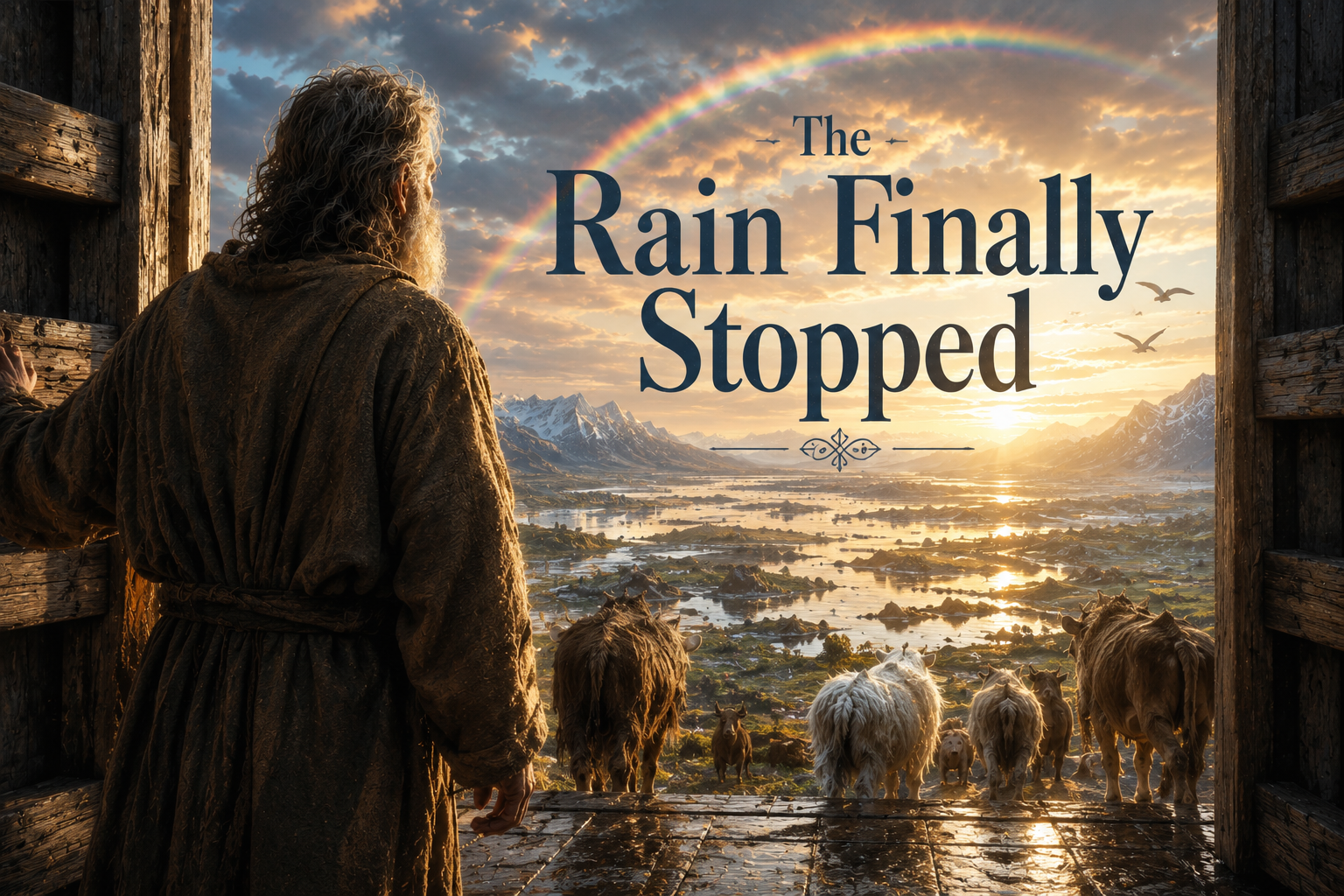
Before reading this week’s reflection, I encourage you to slowly read Genesis 8 through Genesis 9:17.
Do not rush through the story looking for hidden meanings or trying to answer every question. Instead, continue asking the question we have carried with us since Genesis 1:
What does this teach us about the Father?
Listen to this week’s reflection
When the Rain Finally Stopped
Last week, we stood with Noah as the door of the ark closed behind him.
We heard the rain begin to fall. We imagined the fountains of the deep breaking open and a world slowly disappearing beneath the waters. It was one of the most difficult stories in Scripture—not because it is difficult to understand, but because it is almost unbearable to imagine.
Genesis 8 feels different.
It begins almost like an invitation to take a deep breath.
The rain has stopped. The violence has ended. The waters begin to recede. After months of darkness, movement, noise, and uncertainty, the ark finally becomes still.
Then Scripture gives us one of the gentlest sentences in the entire flood story:
“But God remembered Noah…”
Not because God had forgotten him.
Noah may have heard nothing from the Father for months, but silence was not abandonment. God had carried the ark through every wave, watched over every life within it, and remained present through every long day when Noah could see nothing beyond those wooden walls.
When Scripture says that God “remembered,” something begins to move. The Father acts on behalf of the one He has not forgotten.
God caused a wind to pass over the earth, and the waters began to fall.
The Hebrew word translated wind is ruach. It can also mean breath or spirit. It is the same word we encountered in Genesis 1, when the Spirit of God hovered over the face of the waters.
Once again, waters cover the earth. Once again, the breath of God moves. Once again, dry ground slowly appears and life prepares to emerge.
Genesis is not merely describing the end of a flood.
It is quietly telling the story of a new creation.
The ark eventually came to rest on the mountains of Ararat. Even that wording carries a beautiful echo. Noah’s name is connected with rest, and now the ark carrying Noah comes to rest.
But Noah did not immediately leave.
That detail has stayed with me.
If I had been inside that ark, I think I would have climbed onto the roof the moment I felt it stop moving. After more than a year inside, I would have wanted fresh air. I would have wanted to see the mountains and feel the sunlight on my face. I would have wanted proof that the nightmare was finally over.
I suspect I would have opened the door.
But Noah waited.
The mountain peaks became visible. Noah sent out the raven and then the dove. The dove eventually returned with a freshly plucked olive leaf, and Noah knew the waters had receded. Later, he removed the covering from the ark and saw with his own eyes that the surface of the ground was drying.
Still, he waited.
The mountain was visible. The ground looked ready. Every natural instinct must have told him it was time to leave.
The mountain was not Noah’s invitation.
The Father’s voice was.
Only when God said, “Go out of the ark,” did Noah step into the world waiting beyond the door.
The more I sit with that scene, the less it feels like simple obedience. It feels like relationship.
Adam saw something desirable and reached for it before it was given. Noah saw an entire new world lying outside the ark, yet he refused to seize the moment for himself.
Adam took.
Noah waited.
Centuries later, Israel would wander through the wilderness while God tried to teach them that humanity does not live by bread alone, but by every word that proceeds from His mouth. Noah had already learned to live that way. He did not place his confidence in the mountain beneath him or in the dry ground he could see.
He waited for the Father’s voice.
Where do you think he learned that kind of faith?
We have spent several weeks tracing the generations before Noah. Adam lived long enough to tell the stories. Seth carried them. Enoch demonstrated that it was still possible to walk with God outside Eden. Fathers and grandfathers remembered their encounters with the Father and passed them from one generation to another.
Noah did not suddenly manufacture faith when the rain began. His faith had been quietly formed through years of hearing the stories of men who had walked with God, failed, received mercy, and continued walking.
Now those stories carried him through the silence.
When Noah finally stepped onto dry ground, Scripture tells us that the first thing he built was not a house.
It was an altar.
There was shelter to construct, food to find, and an entire world to begin rebuilding. Noah had spent more than a year caring for his family and the animals entrusted to him. Everything outside the ark was unfamiliar, fragile, and scarce.
Yet his first response was worship.
Then Noah took from every clean animal and every clean bird and offered them to the Lord.
I have read those words many times without stopping to consider what they meant.
There were no great herds roaming the earth. There were only the animals that had stepped out of the ark. Whether the seven clean animals were seven total or seven pairs, the number was painfully small. Every animal mattered. Each one represented part of the future of creation.
If I had been Noah, I think I would have counted them carefully. I would have guarded every one and convinced myself that none could be spared.
Noah opened his hands.
He gave to the Father from the little that remained. He placed the future of those creatures back into God's hands because he understood that their future had never truly rested in his own.
Later, Israel would offer the first portion of a harvest before knowing what the rest of the season would bring. Rain could fail. Hail could fall. Locusts could destroy what remained. The offering was not merely a calculation. It was an open-handed confession that tomorrow belonged to the Father.
Noah was living that confession long before Israel received the command.
Then the Father spoke:
“I will never again curse the ground for man's sake, although the imagination of man's heart is evil from his youth…”
Those words may astonish me more than anything else in this chapter.
The first part reaches backward toward Eden. After Adam reached for the fruit, God said, “Cursed is the ground for your sake.” Now, after the flood, the Father speaks again about the ground.
But notice what has—and has not—changed.
The flood did not repair the human heart. God does not say humanity has learned its lesson or become worthy of a new beginning. He says the inclination of the human heart is still bent toward evil.
Although.
That small word carries enormous weight.
Humanity remains broken, and yet the Father promises.
He knows the condition of His children, and yet He moves toward them.
He sees the failures that still lie ahead, and yet He binds Himself in covenant.
This feels like the Gospel before the Gospel.
Centuries later, Paul would write that God was in Christ reconciling the world to Himself, not counting humanity’s trespasses against them. The cross did not persuade a reluctant Father to begin loving His children. Jesus revealed the heart that had been moving toward them from the beginning.
Genesis 8 is already whispering that story.
The Father knows.
And still, He promises.
The rainbow becomes the sign of that covenant. It is more than a beautiful display after a storm. It is the visible reminder of the Father's commitment to the earth, to humanity, and even to every living creature that came out of the ark.
This new beginning reaches far beyond Noah's family.
The Father has not abandoned His creation.
As I read the flood story again, I also began hearing another familiar echo.
Long before the Passover, God had already provided a place where life would be preserved while judgment passed outside. Noah did not invent the ark or design his own rescue. The Father gave the pattern, invited Noah inside, and shut the door Himself.
Centuries later, families in Egypt would enter homes marked by the blood of a lamb. Judgment would pass through the land, but life would be preserved inside what God had provided.
The details are different, but the Father's invitation sounds remarkably familiar.
Come inside.
Trust what I have prepared.
Let Me hold the future
you cannot secure for yourself.
Eventually, Jesus would say, “Abide in Me.”
Again and again, the Father prepares what His children cannot prepare for themselves and invites them to enter.
The ark.
The Passover.
The tabernacle.
The cross.
These are not isolated stories trying to teach unrelated lessons. They are echoes of the same Father and the same invitation.
And the more I sit with Noah, the more I realize that I may have misunderstood the word trust for much of my life.
We often speak of trusting God as though it means believing that everything will eventually turn out well. The illness will be healed. The family will be restored. The prayer will be answered in the way we hope. The storm will pass, and the story will end happily.
But Scripture gives us harder stories than that.
Noah survived the flood, but the world he knew was gone.
Abraham climbed a mountain with his beloved son, not knowing how God's promise could survive what he had been asked to do.
Job buried his children and sat in the ashes without receiving an explanation for his suffering.
Jeremiah watched Jerusalem fall.
Paul surrendered everything he once considered gain and eventually faced death as a prisoner.
Jesus knelt in Gethsemane and prayed that the cup might pass from Him. Then He opened His hands and said, “Not My will, but Yours be done.”
From the cross, His final prayer was not a demand that the Father change the outcome.
It was surrender:
“Father, into Your hands I commit My spirit.”
The truth is already contained in those stories. They do not need much explanation.
Biblical trust is not confidence that life will unfold as I desire.
It is confidence that the Father is worthy of my trust,
even when life does not.
Trust is not pretending the pain does not matter. Isaac mattered. Job's children mattered. Jerusalem mattered. The cross mattered. Trust does not silence grief or remove every question.
It simply releases the need to control the outcome.
It rests in the Father, especially when the ending remains hidden and the path makes no sense.
Perhaps that is why Noah could remain inside the ark after it had come to rest. Perhaps that is why he could wait even after seeing dry ground. Perhaps that is why he built an altar before he built a home and offered from the little that remained.
Noah did not rest in the outcome.
He rested in the Father.
And perhaps that has always been the invitation—not to understand tomorrow, not to secure every outcome, but to know the One who already holds it.
Noah knew something greater than the future.
He knew the Father.

0 Comments