Before reading this week’s reflection, I encourage you to slowly read Genesis 9:18–10:32.
Do not become discouraged by the unfamiliar names or rush past the uncomfortable details. Some passages of Scripture require us to slow down and look beneath the surface before their place within the larger story becomes clear.
As we have done from the beginning of Genesis, read these chapters while asking one simple question:
What does this teach us about the Father?
The Covenant Remains
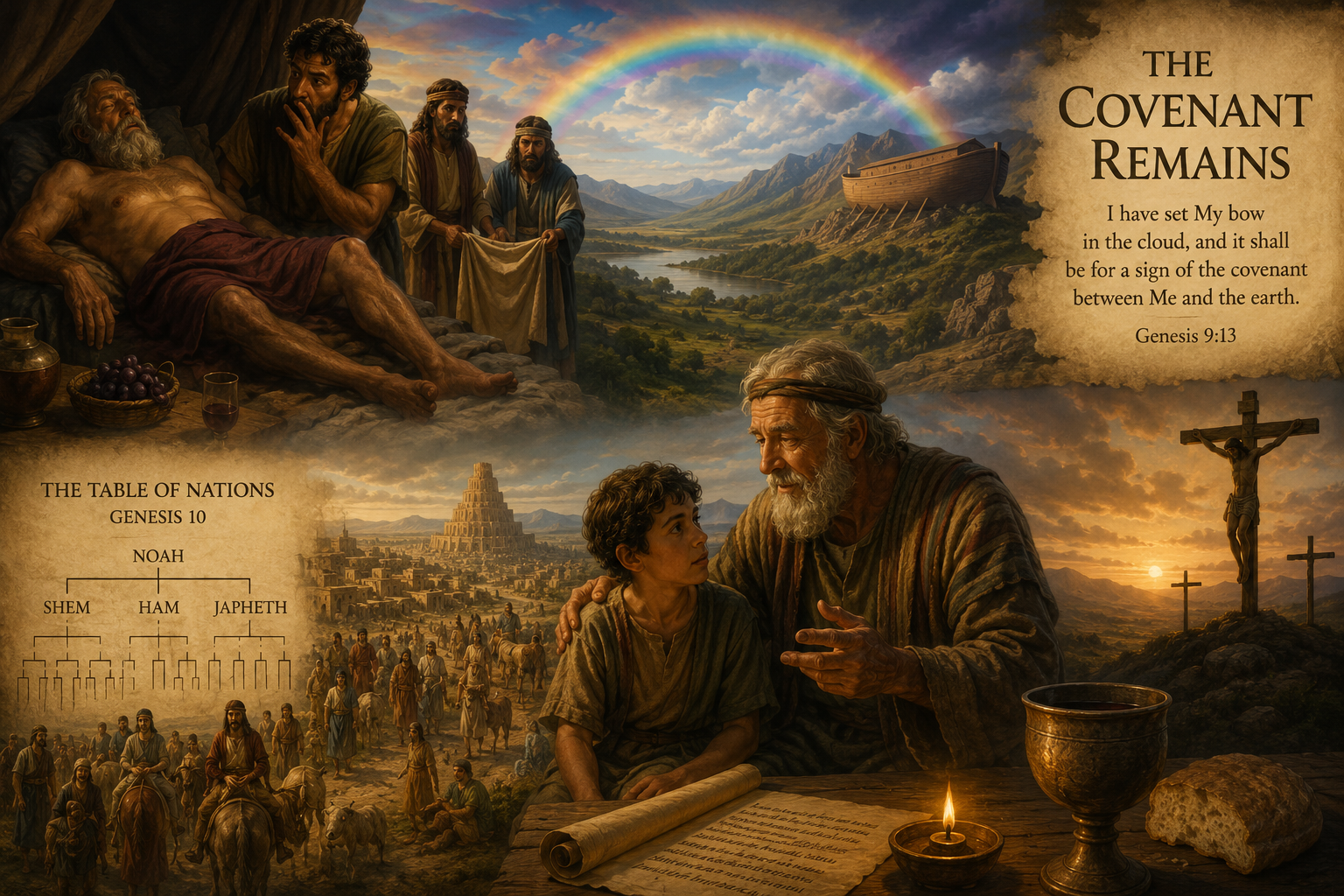
When we left Noah, the floodwaters had receded, the ark rested upon dry ground, and the rainbow stretched across the sky as the sign of an everlasting covenant. The Father had preserved life, blessed Noah and his family, and commanded them to be fruitful, multiply, and fill the earth. He had promised that never again would a flood destroy every living creature.
If we were writing the story ourselves, this is probably where we would stop. The judgment is over. The ark is empty. The rainbow shines across the sky, and humanity has been given a fresh beginning beneath the blessing of God.
But the Father is not finished telling His story.
The flood changed the face of the earth, but it did not change the human heart. Remarkably, that was never a surprise to God. Even before Noah planted his vineyard, the Father had already acknowledged that “the imagination of man’s heart is evil from his youth.” He understood the weakness that remained within humanity, and still He blessed Noah. Still He established His covenant. Still He placed His bow in the clouds and promised to preserve the earth.
The covenant was never built upon humanity’s ability to remain faithful. It rested upon the faithfulness of the Father.
Genesis tells us that Noah became a man of the soil and planted a vineyard. He drank from the wine it produced, became intoxicated, and lay uncovered inside his tent. Many sermons immediately turn this moment into a warning about Noah’s failure, but Genesis does not present the account that way. There is no rebuke from God, no declaration that Noah had sinned, and no suggestion that his standing before the Father had changed.
That restraint is worth noticing.
Throughout Scripture, vineyards and wine are frequently associated with harvest, abundance, blessing, and celebration. The prophets looked forward to a day when people would again plant vineyards and enjoy their fruit. Micah described the peace of the coming kingdom with every man sitting beneath his own vine and fig tree. Isaiah pictured the Lord preparing a feast for the nations, including well-aged wine. Jesus chose a wedding celebration—and the provision of abundant wine—as the setting for His first recorded sign. Later, during His final Passover meal, He lifted the cup and spoke of the New Covenant established through His own blood.
Scripture certainly warns against being mastered by wine, but that does not appear to be the accusation Genesis is making here. Noah’s condition may have created the opportunity for what followed, but Genesis is giving us information about Noah, not placing him on trial before God. The sin in this account belongs somewhere else.
Ham entered the tent and “saw the nakedness of his father.” He then went outside and told his brothers. Shem and Japheth responded very differently. They placed a garment across their shoulders, walked backward into the tent, and covered their father without looking upon him.
The story leaves most readers with an obvious question: If Ham was the one who sinned, why did Noah pronounce the curse upon Ham’s son, Canaan?
The answer may lie in the language Moses uses elsewhere.
The same Moses who recorded Genesis is traditionally understood to have recorded the instructions later found in Leviticus. That matters because Leviticus repeatedly uses the language of “uncovering nakedness” to describe sexual relations, especially within the family. It even explains that the nakedness of a man’s wife may be spoken of as the nakedness of the man himself:
“The nakedness of your father’s wife you shall not uncover; it is your father’s nakedness.”
Genesis tells us that Ham saw his father’s nakedness, but it does not describe every detail of what occurred. The later language of Leviticus has therefore led many readers and ancient interpreters to understand that something far more serious happened than Ham simply seeing Noah unclothed.
Some believe Ham violated his mother and that Canaan was conceived through that act. This would explain why Canaan had already been deliberately named before the incident was described and why the consequence fell upon him rather than directly upon Ham. Ancient writings, including the Book of Jasher, preserve an understanding that something deeply shameful occurred within Noah’s household, although Genesis itself leaves the precise nature of Ham’s offense unstated.
That interpretation also provides a possible motive. In later biblical stories, a son’s sexual possession of his father’s wife or concubines was not merely an act of lust; it could become an attempt to seize the father’s place, authority, and inheritance. Reuben lay with his father Jacob’s concubine. Absalom publicly took David’s concubines while attempting to claim his father’s kingdom. Ham’s action may therefore have been an effort to take something that did not belong to him and secure power within the new world emerging from the flood.
Genesis does not invite us to become fascinated with the scandal, however. Whatever occurred inside Noah’s household was a profound violation of Noah, his marriage, and the order the Father had established within the family. It brought consequences that reached into the following generation, but almost immediately Moses widens the story. Our attention moves away from one family’s tragedy and toward the many families that would soon fill the earth.
Modern readers can easily underestimate how much time passes in these chapters. We read a list of unfamiliar names and imagine a handful of families slowly spreading into the surrounding countryside. But Noah lived another three hundred and fifty years after the flood. His sons also lived extraordinarily long lives, and their households were likely far larger than the comparatively small families familiar to many of us.
Consider how dramatically the population of the United States has grown in roughly two hundred and fifty years, even with relatively short lifespans and modest family sizes. Now imagine several centuries in which people commonly lived for hundreds of years, remained surrounded by many generations of their descendants, and continued obeying the command to be fruitful and multiply. Children became parents, grandparents, great-grandparents, and ancestors of entire tribes while the earliest members of the family were still alive.
Noah could have watched generations of children born to children who had themselves become ancient. His sons could have known descendants separated from them by centuries of family history. What looks like a short transition on the page represents the growth of families into clans, clans into peoples, and peoples into nations.
Genesis 10 is therefore much more than a dry genealogy. It is often called the Table of Nations because these names become the peoples and kingdoms that continue appearing throughout the rest of Scripture. Egypt, Canaan, Assyria, Babylon, and many others trace their biblical beginnings to the families spreading out from Noah’s sons.
The Father’s blessing was unfolding exactly as He had spoken. Noah’s family multiplied. The earth filled. Cities were established, languages and cultures developed, and entire nations emerged from the eight people who had stepped out of the ark.
•••
God’s blessing continued even though humanity’s faithfulness did not.
That may be one of the most important truths hidden within this section. Ham’s sin did not cause the Father to withdraw His blessing from the earth. The failure inside Noah’s family did not cancel the promise made beneath the rainbow. The Father had entered His covenant with full knowledge of the weakness that remained within humanity, and He did not abandon His promise when that weakness appeared again.
The rainbow had never been evidence that mankind had finally become trustworthy. It was evidence that the Father remained trustworthy.
Think about what He knew when He placed His bow in the clouds. He knew Babel would soon rise from the plain. He knew nations would turn toward idols and forget the One who had preserved them. He knew Abraham’s descendants would repeatedly struggle to trust Him. Kings would rebel, prophets would be ignored, and the people He loved would wander from the covenant again and again.
He even knew that when His Son came among them, many would reject Him.
Yet He made the covenant anyway.
The rainbow did not promise the end of sin. It revealed the Father’s determination not to abandon His creation because of sin. It declared that His purposes would continue moving forward, not because humanity had finally made itself worthy, but because He remained committed to the world He had made.
Every covenant that follows carries the story closer to Jesus. The covenant with Noah preserved the earth and the nations. The covenant with Abraham would promise blessing to all the families of the earth. The covenant with Israel would reveal the Father’s holiness and His desire to dwell among His people. The promise made to David would point toward a King whose throne would endure forever. Then, at the Passover table, Jesus lifted the cup and said:
“This cup is the new covenant in My blood, which is poured out for you.”
The covenant beneath the rainbow and the cup in the hands of Jesus are not the same covenant, but they reveal the same faithful Father. He does not turn away when His children fail. He continues moving toward them. He continues preserving life, revealing Himself, and carrying His purpose toward redemption.
As Noah’s descendants spread across the earth, they carried more than children, livestock, tools, and possessions. They carried memories. They carried the accounts of creation and the garden, the voice of the serpent, Cain and Abel, Enoch’s walk with God, the violence of the former world, the building of the ark, the sound of the rain, and the rainbow that appeared after the flood.
Long before there was a written collection of Scripture, the knowledge of the Father was carried through stories. Fathers and mothers told their children what they had received from those who came before them. One generation listened, remembered, and then entrusted the testimony to the next.
Centuries later, Paul would describe the same pattern when he wrote to Timothy:
“The things that you have heard from me among many witnesses, commit these to faithful men who will be able to teach others also.”
Paul told Timothy. Timothy was to entrust the message to faithful people. Those people would then teach others. Four generations of discipleship appear in one sentence, but the pattern was already ancient. Faith was preserved because someone remembered the story, lived beneath its truth, and considered it worthy of being told again.
Among all the branches of Noah’s rapidly expanding family, one line would continue carrying that knowledge toward a man named Abram. According to the chronology preserved in Genesis, Noah was still living during Abram’s early years, while Shem lived throughout Abram’s lifetime and beyond.
The stories of the flood and the rainbow were not distant legends to Abram. They were the testimony of men who had lived them.
Long before Abram heard the Father’s call to leave his homeland, he grew up in a world where Noah and Shem were still living. They were living witnesses to the flood, the covenant, and the faithfulness of the Father. Ancient traditions, including the stories preserved in the Book of Jasher, remember Shem as an important influence within the world Abram inherited. We will return to that remarkable story soon.
Abram’s faith would be extraordinary, but it would not emerge from an empty world. Behind him stood generations of people who had learned something about the Father and passed that knowledge forward: Adam, Seth, Enoch, Methuselah, Lamech, Noah, and Shem. They were not priests in the formal sense later established through Moses and Aaron, yet they carried out something deeply priestly. They preserved the knowledge of God, trusted His promises, built altars, called upon His name, and told His story to those who came after them.
The faith of Abraham would rest upon foundations laid long before Abraham was born.
•••
Through Abram, the Father would begin revealing a promise that would one day reach every nation through Jesus Christ. Yet even Abram’s calling would not represent the beginning of the Father’s faithfulness. It would be another chapter in a story already carried through generations.
That has always been the Father’s way. Humanity forgets Him, yet He continues making Himself known. People violate what He has established, yet He does not surrender His purpose. Generations pass away, but the testimony survives because someone tells the story again.
The flood could not cure the human heart, but the human heart could not undo the Father’s purpose.
The Father blessed Noah knowing what would happen inside his household. He placed the rainbow in the clouds knowing Babel would soon rise. He allowed the nations to spread across the earth knowing many of them would forget Him. Yet rather than abandoning humanity, He quietly preserved the story.
One generation told another.
Noah told Shem.
Long before Abram heard the Father’s call to leave his homeland, he would grow up in a world where Noah and Shem were still living. The stories of the flood and the rainbow were not distant legends to Abram—they were the testimony of men who had lived them. We will return to that remarkable story soon. Through Abram, the Father would begin revealing a promise that would one day reach every nation through Jesus Christ.
Long before there was a Bible to read, there was a story to tell. One generation received it, and another passed it on. Through all the failures of humanity, the Father never abandoned His covenant or His desire to be known.
The covenant remained because the Father remained faithful.

0 Comments