
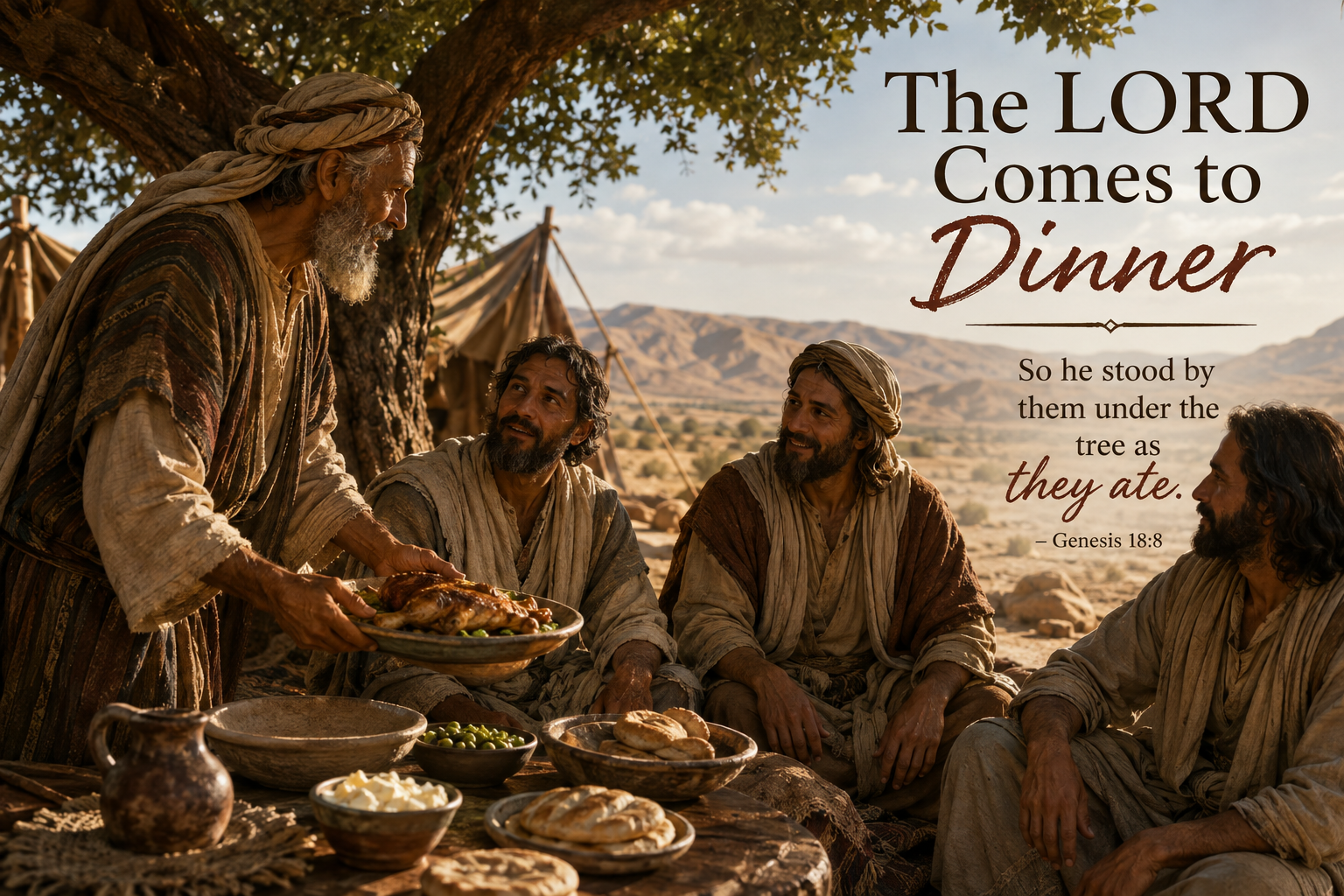
The LORD Comes to Dinner
Before reading this week’s reflection, I encourage you to slowly read Genesis 17 and the first half of Genesis 18.
The LORD Comes to Dinner
Thirteen years have passed.
That is easy to miss when we turn the page from one chapter to the next. When Ishmael was born, Abram was eighty-six years old. Then Genesis 17 begins:
“When Abram was ninety-nine years old, the LORD appeared to Abram...”
— Genesis 17:1
Ishmael is no longer the baby Hagar carried home from the wilderness. He is thirteen years old, becoming a young man. Abram is nearly one hundred. Sarai is nearly ninety. And the promise that began so many years earlier still has not been fulfilled.
Then the LORD appears.
The Father has not forgotten what He said. In fact, this time the promise becomes even more specific.
Abram will become Abraham. Sarai will become Sarah. Before anything has changed in their circumstances, the Father begins calling them by names that speak toward a future they cannot yet see.
And now He says it plainly. The promised son will not simply come from Abraham. He will come through Sarah.
“Sarah your wife shall bear you a son, and you shall call his name Isaac.”
— Genesis 17:19
Abraham falls on his face and laughs.
Perhaps we are too quick to call that unbelief. Abraham has spent years trusting the Father. He has left his homeland, built altars, stood beneath the stars, and watched the Father walk through blood and fire and place Himself behind His promise.
But Abraham is also almost one hundred years old. Sarah is almost ninety.
This is impossible.
And Abraham already has a son whom he loves.
“Oh, that Ishmael might live before You!”
I love the Father’s response:
“As for Ishmael, I have heard you. Behold, I have blessed him...”
— Genesis 17:20
There it is again: I have heard.
The God who heard Hagar in the wilderness has not stopped hearing. Ishmael will be blessed. But the promised son will come through Sarah.
His name will be Isaac.
Laughter.
The Promise Leaves a Mark
Then the Father gives Abraham the sign of circumcision.
For years the promise has concerned Abraham’s seed—the generations that will come from him. Now God places the covenant mark upon the very flesh through which that seed will come. Paul would later call circumcision a sign and seal of the faith Abraham already possessed. The mark did not create the promise; it testified that the promise belonged to God.
But we shouldn’t picture this as a small private ceremony involving Abraham and Ishmael.
Years earlier, Abraham had taken 318 trained men born in his own household into battle to rescue Lot. Those were only his fighting men born in the household. Abraham’s entire community included families, servants, shepherds, children, men purchased from foreign lands, and others living under his care.
This was an enormous household.
And now God said every male was to bear the mark.
Abraham at ninety-nine. Ishmael at thirteen. Grown men. Young boys. Those born in the household and those purchased from somewhere else.
This was intimate, bloody and painful. It affected hundreds of people throughout Abraham’s camp. Whatever mixture of ancient household authority, loyalty and trust was involved, these people followed Abraham into something extraordinarily personal because Abraham said the God he followed had spoken.
And Genesis tells us Abraham did it “that very same day.”
Then Genesis turns the page.
The LORD Comes to Dinner
“Then the LORD appeared to him by the terebinth trees of Mamre...”
— Genesis 18:1
Ancient Jewish tradition imagines this appearance as the Father visiting Abraham while he recovered from circumcision. Genesis doesn’t tell us that is why He came, but it is a tender picture preserved by people who had been pondering this story for generations.
What Genesis does tell us is remarkable enough.
Abraham is sitting at the entrance of his tent during the heat of the day when he looks up and sees three men.
And Abraham runs to meet them.
This ninety-nine-year-old patriarch, leader of an enormous household, runs from his tent and bows to the ground before strangers. He offers water for their feet and shade beneath the tree. He hurries to Sarah and asks her to make bread. Then he runs again to the herd, chooses a calf and has it prepared.
The covenant has just marked Abraham’s household as belonging to God. And almost immediately, we see that household opening itself to strangers.
Bread. Meat. Curds. Milk.
Abraham prepares a table for them.
Then comes a sentence we could easily read without feeling the weight of it:
“So he stood by them under the tree as they ate.”
— Genesis 18:8
They ate.
The Creator of the universe is sitting beneath a tree, eating dinner at Abraham’s home.
It is worth staying here for a moment.
This is the God who spoke light into darkness and hung the stars Abraham once stared at in the night sky. He formed humanity from dust and breathed life into its lungs. He shut Noah inside the ark, scattered Babel, and walked through Abraham’s covenant in smoke and fire.
And now Sarah is baking bread, Abraham is standing nearby serving his guests, and God is beneath their tree eating their food.
Perhaps that shouldn’t surprise us as much as it does.
Because isn’t this what the Father has wanted from the beginning?
In Eden, He walked in the garden with humanity. He did not create men and women merely to rule them from a distant heaven. He made them for relationship—to know Him and trust Him, to enjoy His presence and share life with the Father who gave them life.
Then another voice whispered that perhaps He could not be trusted. Suspicion entered where there had been intimacy. Shame replaced openness. Humanity hid from the very One who had come to walk with them.
Yet the Father’s desire did not change.
Through all the hiding, violence, wandering and mistrust, He continued moving toward humanity.
And here, beneath the trees of Mamre, we catch another glimpse of what He has wanted all along.
And this picture will keep appearing.
Centuries later, Jesus will sit at tables with His friends. He will eat with tax collectors and sinners, with people respectable religious men thought He should avoid. He will accept invitations into homes and invite Himself into others. Again and again, God in flesh will sit down and eat with people.
On the night before the cross, Jesus will gather His closest friends around a table. He will take bread into His hands, break it and pass it among them.
Then, astonishingly, death itself will not end this desire for simple human closeness.
After the resurrection, the disciples will come ashore after a long night on the water and discover Jesus beside a charcoal fire. Fish is cooking. Bread is waiting.
And the resurrected Lord says:
“Come and eat breakfast.”
— John 21:12
I love that.
The One who defeated death wanted breakfast with His friends.
And at the far end of the biblical story, John hears the same desire one more time:
“Behold, the tabernacle of God is with men, and He will dwell with them...”
— Revelation 21:3
Eden.
A tree at Mamre.
Tables throughout Galilee.
An upper room.
Breakfast beside the sea.
And ultimately, God dwelling with humanity forever.
The Father’s desire has never changed.
He wants to be with us.
And there, beneath Abraham’s tree, the conversation turns toward Sarah.
Sarah Laughs
“Where is Sarah your wife?”
She is inside the tent, listening.
Then the visitor says:
“I will certainly return to you according to the time of life, and behold, Sarah your wife shall have a son.”
Sarah laughs within herself.
Can we blame her? She knows her body. She knows Abraham’s age. She knows how long they have waited.
This isn’t merely unlikely anymore. It is impossible.
Then comes the question:
“Is anything too hard for the LORD?”
— Genesis 18:14
Sarah becomes frightened and denies laughing.
“I did not laugh.”
And the LORD answers:
“No, but you did laugh.”
I can’t help but smile at that exchange. There is something wonderfully personal about it.
Sarah laughed. The Father knew. And the promise remained.
He didn’t withdraw it. He didn’t search for a woman with stronger faith. He wasn’t threatened by her questions or her laughter. Her inability to imagine the promise did not limit His ability to fulfill it.
Eventually Sarah will hold that impossible little boy in her arms and laugh again:
“God has made me laugh, and all who hear will laugh with me.”
— Genesis 21:6
He changed what she was laughing about.
Paul later looks back at Abraham’s story and describes the One Abraham trusted as God “who gives life to the dead and calls those things which do not exist as though they did.” — Romans 4:17
That is the Father we’ve been discovering. The One who brings life where life seems impossible. The One who remembers promises after years have passed. The One who isn’t frightened by our questions. The One who hears us.
And the One who comes near.
Abraham had waited. Sarah had grown old. The promise seemed more impossible than ever.
And before Isaac ever arrived, the LORD came to dinner.
He came beneath their tree. He ate their food. He listened to their laughter. He reminded them of His promise.
Sometimes the Father answers our fear by changing the circumstances.
And sometimes, before He changes anything at all...
He simply comes near.

Love this
Thank you Jesseca, I appreciate the encouragement.