
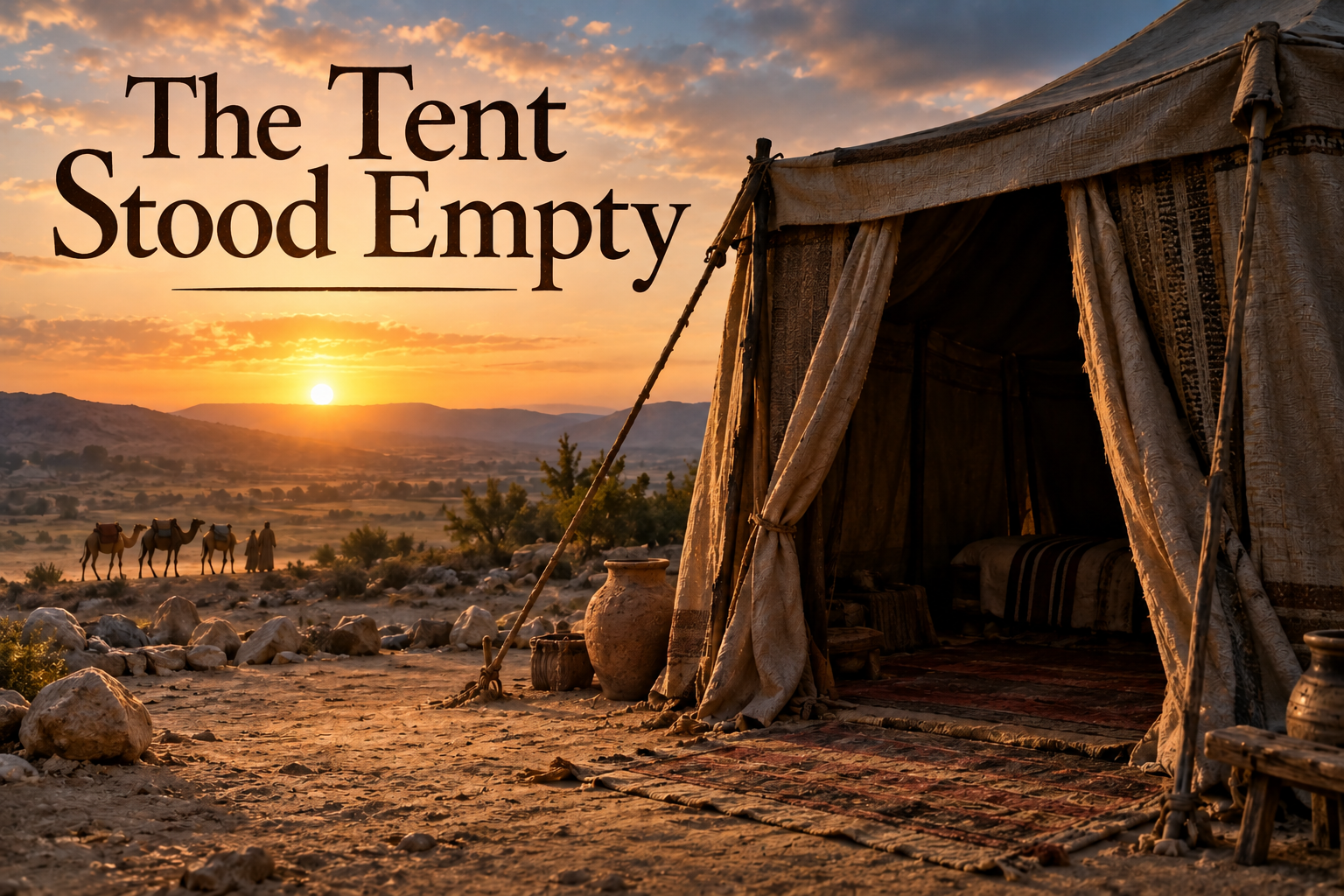
The Tent Stood Empty
Before reading this week’s reflection, I encourage you to slowly read Genesis 23 and 24.
These chapters mark a quiet turning point in the story. Sarah dies. Abraham grows old. Isaac grieves. Yet even as one generation begins to disappear, the promise continues to move forward.
As you read, keep asking the question we have been asking throughout His-Story:
What does this teach us about the Father?
The Tent Stood Empty
Sarah died.
After everything she and Abraham had walked through together, those may be some of the saddest words in Abraham’s story.
She had left home with him when God called. She had wandered through foreign lands beside him. She had known fear and disappointment, barrenness and waiting. She had laughed when God told her the impossible—and then laughed again when she held the impossible in her arms.
Isaac.
The child she had waited nearly a lifetime to hold.
But Sarah would never hold his children.
She would never see the nation God promised or Abraham’s descendants possess the land.
Genesis simply tells us that Sarah lived 127 years.
And then she died.
Abraham wept.
We should let him.
Faith did not make this hurt less. Sarah had walked beside Abraham through most of his story. Whatever Abraham believed about tomorrow, today he had to bury his wife.
And he did not own enough of the Promised Land to bury her.
Decades earlier God had told him:
“To your offspring I will give this land.”
Now Abraham stood before the people who actually lived there and said:
“I am a sojourner and foreigner among you.”
After all those years and all those promises, Abraham was still a foreigner.
So he purchased the field of Ephron containing the cave of Machpelah. Ephron named his price, and Abraham paid it. The field, the cave, the trees, and everything within its boundaries became Abraham’s possession.
The first piece of the Promised Land Abraham ever truly owned was a grave.
Sarah died without seeing the promise fulfilled.
Abraham would too.
But they would both be buried inside the promise.
Many generations later, Hebrews would say of people like Abraham and Sarah:
“These all died in faith, not having received the things promised, but having seen them and greeted them from afar.”
Abraham buried Sarah and somehow still believed.
Then Genesis says something almost startling:
“Now Abraham was old, well advanced in years. And the LORD had blessed Abraham in all things.”
Blessed him in all things?
His wife was dead.
He was an old man living in a foreign land.
The great nation God had promised consisted of one unmarried son.
And the only piece of the Promised Land he owned was a grave.
Yet long ago, when Abraham was still trying to understand how any of God’s promises could possibly happen, God had told him:
“I am your shield, your very great reward.”
Maybe that had always been the blessing.
Through Egypt and Hagar. Through failure and fear. Through years of waiting. Through Isaac’s birth, Moriah, and now Sarah’s death.
God had never left him.
The Father Himself had always been the blessing.
Now Abraham was old, and Isaac needed a wife.
So Abraham entrusted his oldest servant with finding one from among his relatives. He made him swear a solemn oath, placing his hand beneath Abraham’s thigh—an ancient gesture often associated with offspring and descendants.
The future of Abraham’s family was at stake.
Abraham’s instructions were clear: find a wife from among my family, but do not take Isaac back there.
God had called Abraham out of that land.
Isaac was not going back.
Instead Abraham said:
“The LORD… will send his angel before you.”
The younger Abraham had often tried to figure out how to make God’s promise work.
The old Abraham trusted that God would already be ahead of him.
The servant traveled to Abraham’s homeland and stopped beside a well.
And there he prayed.
This unnamed servant had lived in Abraham’s household long enough to know Abraham’s God.
“O LORD, God of my master Abraham… show steadfast love to my master Abraham.”
He asked God for a sign. He would ask a young woman for a drink. If she offered to water his camels as well, he would know God had led him to the right woman.
Before he finished praying, Rebekah appeared.
Genesis tells us she was very beautiful.
Then it shows us her heart.
The servant asked for a little water.
She gave him a drink.
Then she said:
“I will draw water for your camels also, until they have finished drinking.”
There were ten camels.
She hurried. She emptied her jar. She ran back to the well. And she kept drawing until they had finished.
The servant stood silently watching her.
Abraham had once run to meet strangers and hurried to give them far more than they requested.
Now his servant had encountered a young woman who behaved remarkably like the family she was about to join.
And she had no idea yet who he was.
When the camels finished drinking, the servant gave Rebekah a gold nose ring and two gold bracelets.
Then we meet her brother.
Laban.
Genesis tells us:
“As soon as he saw the ring and the bracelets on his sister’s arms…”
Laban ran to meet the servant.
We will meet Laban again.
For now, we can leave that detail where Genesis leaves it.
The servant entered their home, but before he would even eat, he told them why he had come.
He told them about Abraham.
About Isaac.
About the LORD’s faithfulness.
He told them about standing beside the well and praying, and how Rebekah appeared before he had even finished.
This unnamed servant had become a storyteller.
He had spent years watching the Father remain faithful to Abraham.
Now he was telling that story to the family Abraham had left behind.
When he finished, Laban and Bethuel answered:
“The thing has come from the LORD.”
The servant bowed to the ground and worshiped.
The next morning he wanted to leave. Rebekah’s family wanted her to remain a little longer.
So they asked her.
“Will you go with this man?”
Rebekah answered:
“I will go.”
Many years earlier, God had called Abraham to leave his country, his family, and his father’s household and go to a land He would show him.
Now another person stood at the edge of everything familiar.
Rebekah had never seen Isaac.
She did not know the land where she would live.
She had heard the story.
And she went.
Before she left, her family blessed her:
“Our sister, may you become thousands of ten thousands, and may your offspring possess the gate of those who hate him.”
Only one chapter earlier, on Moriah, God had told Abraham:
“Your offspring shall possess the gate of his enemies.”
Perhaps her family did not understand the weight of the words they spoke over her.
But we do.
Rebekah was stepping into the promise.
Sometime later, Isaac was out in the field when he looked up and saw camels approaching.
Rebekah looked up and saw him too.
“Who is that man walking in the field to meet us?”
The servant answered:
“It is my master.”
The journey was over.
Isaac brought Rebekah into the tent of his mother Sarah.
There may have been nothing unusual about Sarah having her own tent. Abraham’s household included Sarah, Hagar, later Keturah, and Genesis also speaks plainly of his concubines.
But Genesis wants us to know whose tent this was.
Sarah’s.
The woman who had lived there was gone.
Her son still grieved her.
Now Rebekah entered.
She became Isaac’s wife.
And Genesis says:
“He loved her.”
Then it says: “So Isaac was comforted after his mother’s death.”
Sarah was not replaced.
She was gone.
But the tent that had stood empty was empty no longer.
While Abraham and Isaac could see only what was in front of them, the Father had already been at work beyond anything they could see.
An old servant had knelt beside a well.
A young woman had come carrying a water jar.
She had heard the story of a God who had been faithful to Abraham.
And when she was asked:
“Will you go?”
She answered:
“I will go.”
Now she was here.
The people carrying the promise were changing.
The Father wasn’t.

0 Comments