
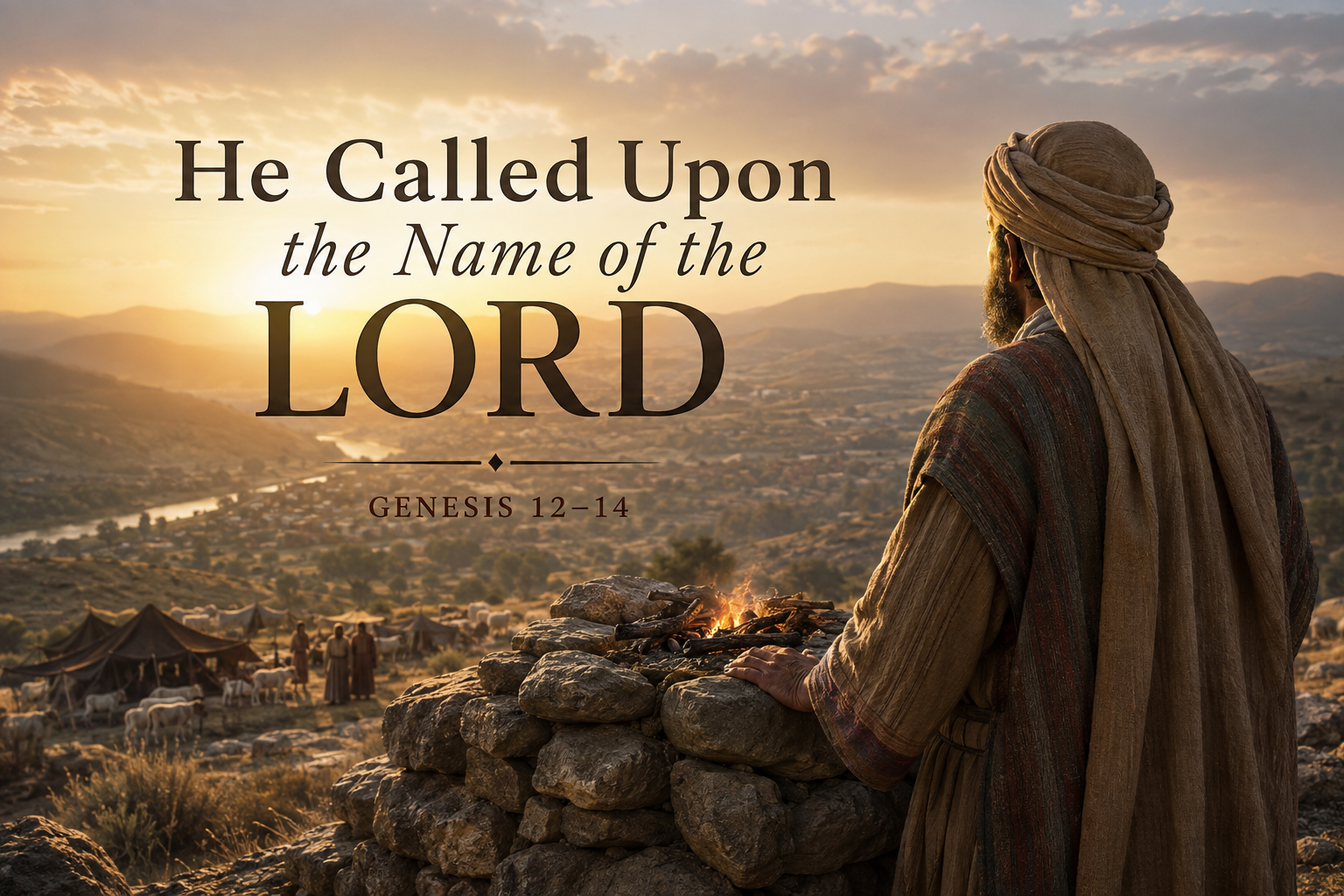
He Called Upon the Name of the LORD
Before reading this week’s reflection, I encourage you to slowly read Genesis 12–14.
As you read, pay attention to a phrase that appears more than once:
“Abram called upon the name of the LORD.”
Listen to this week’s audio reflection:
He Called Upon the Name of the LORD
It is easy to read those words as a simple description of prayer. Abram stopped, built an altar, and worshiped. Yet there is something richer happening here. Abram was not merely speaking privately to God. He was proclaiming the name of Yahweh—announcing His character and making Him known in a land filled with other gods.
That is remarkable when we remember where Abram’s story began.
For decades, Noah and Shem had welcomed him into a home where the Father was known—not merely discussed, but lived. They had not simply taught Abram facts about God. They shared life with him. Abram watched what it looked like to trust the Father, to remember His faithfulness, to listen for His voice, and to walk with Him through ordinary days. Somewhere along the way, the stories became more than stories. Abram came to know the Father for himself.
Now the boy who had listened was becoming a man who would carry that knowledge into the world.
The story begins, as so many stories in Genesis do, with the Father speaking.
“Then the LORD appeared to Abram and said...”
— Genesis 12:7
Before Abram built an altar, the Father appeared. Before Abram called upon His name, the Father spoke.
That has been the pattern from the beginning. God spoke light into darkness. He came looking for Adam in the garden. He spoke to Cain before anger consumed him. He called Noah before the flood. Now He appears to Abram.
The Father always moves first.
Abram responds by building an altar. Certainly sacrifices were associated with altars, but this altar was more than a place of sacrifice. It marked a place of encounter and remembrance. Long after the fire had died and the offering was gone, the stones remained as a quiet testimony:
The Father spoke here.
That idea will echo throughout Scripture. Generations later, after Israel crosses the Jordan, Joshua will pile twelve stones beside the river. When children ask, “What do these stones mean?” their parents are to tell them what the LORD has done. The stones have no power of their own. Their purpose is remembrance. They preserve the story so another generation can know the God who acted there.
Abram’s altar did something similar. It marked a place where Yahweh had appeared, where a promise had been spoken, and where Abram had answered.
Then something unexpected happens.
The Father calls Abram into the land of promise. He promises a blessing that will eventually reach every family of the earth. Abram obeys. He worships. He builds altars. He calls upon the name of Yahweh.
And then a famine comes.
The first thing Abram finds in the land of promise is not abundance. It is hunger.
We often picture Abram and Sarai traveling alone, but Genesis paints a much larger picture. Abram was responsible for servants, shepherds, families, flocks, herds, and possessions. By Genesis 14, he could gather 318 trained men born within his household. Those men represented families and lives of their own. When the land could no longer sustain them, Abram was responsible for far more than his own next meal.
The promise had not changed, but everything Abram could see seemed to contradict it.
Father, You brought us here. Now what?
That question has never really disappeared. We obey, and the road becomes harder. We follow, and provision seems to disappear. We trust, and circumstances appear to contradict the promise.
Genesis does not pretend that the Father’s blessing removes us from a broken world. Abram is blessed, yet famine still comes. Hunger is real. Families still need bread.
Perhaps blessing was never the absence of hardship. Perhaps blessing has always been the presence of the Father.
Abram goes down to Egypt because bread matters. Scripture does not pause to condemn his decision. It simply tells the story of a man trying to preserve the lives entrusted to him while navigating fear, uncertainty, and a foreign king.
And it is difficult not to smile at one detail. Sarai is around seventy-five years old, yet she is still considered so remarkably beautiful that Pharaoh desires her for himself. Genesis has a wonderful way of reminding us that these were not lifeless figures in an ancient painting. They were real people living astonishing lives.
But what begins as a search for bread becomes something far more painful. Sarai is taken into Pharaoh’s house. Abram has left the land the Father promised, and now the woman through whom that promise must continue is in another man’s household. The famine has become more than hunger. Everything Abram has been promised seems suddenly fragile.
Yet the Father remains faithful.
He protects Sarai. He preserves the promise. He does not abandon Abram when the road becomes complicated. Genesis never tells us that the Father withdrew His blessing or reconsidered His call. Abram’s circumstances changed. The Father’s faithfulness did not.
When Abram finally leaves Egypt, Genesis does not merely say that he returned to Bethel. It carefully tells us that he returned:
“to the place of the altar which he had made there at first. And there Abram called on the name of the LORD.”
— Genesis 13:4
He returned to the place of remembrance—the place where Yahweh had appeared, where the Father had spoken.
The altar had remained while Abram was in Egypt.
Its stones still quietly testified to the promise. Famine had come. Egypt had happened. Sarai had been taken. Yet none of those things had erased what the Father had said.
Centuries later, Jesus would stand hungry in another wilderness and answer temptation with the words Moses had given Israel:
“Man shall not live by bread alone, but by every word that proceeds from the mouth of God.”
— Matthew 4:4
Bread matters. Jesus did not deny hunger, and Genesis does not minimize famine. But bread alone cannot sustain the deepest part of us. Eventually, every journey must return to the Father’s voice.
Abram returned to the altar because it reminded him of what the Father had already said.
Then he continued his journey.
Wherever Abram went, he built altars and called upon the name of Yahweh. He carried the knowledge of the Father into places where the Father was not known. Surrounded by pagan nations, local kings, and people who worshiped gods shaped by human hands, Abram announced another name. He proclaimed the character of the living God who speaks, calls, protects, remembers, and remains faithful.
We are not told how many people listened or how many lives were changed. But the blessing had begun to move outward, just as the Father said it would:
“I will bless you... and you shall be a blessing... and in you all the families of the earth shall be blessed.”
— Genesis 12:2–3
The Father never blesses anyone simply for their own sake. He blesses people so His blessing can continue through them.
Noah had received grace and preserved life. Shem had received the stories and preserved the knowledge of God. Now Abram was carrying that inheritance into the nations. What had been lived before his eyes was becoming the life he lived before others.
That makes the closing scene of Genesis 14 especially meaningful.
After rescuing Lot, Abram is met by Melchizedek, king of Salem and priest of God Most High. Genesis gives us very little explanation. Melchizedek brings bread and wine, blesses Abram, and receives a tenth of everything.
Ancient Jewish history identifies Melchizedek as Shem, the son of Noah. This is not the place to defend that connection, but if that ancient understanding is true, the scene becomes deeply personal.
Explore the ancient connection between Melchizedek and Shem:
Who Was Melchizedek?
Decades earlier, a young boy had been welcomed into Shem’s home. Now a grown man stood before him carrying the Father’s name into the nations.
Shem had not simply told Abram about the Father. He had given him a home where the Father’s character was lived before his eyes. Through shared meals, ordinary work, old stories, difficult questions, worship, laughter, and probably tears, Abram had been welcomed into a life where the presence of the Father was known.
How does a man thank someone for such a gift?
Abram gives a tenth of everything.
Not because gratitude can calculate the value of what he received, and certainly not because a percentage could ever repay it. But gratitude naturally overflows toward those through whom we have received something priceless.
Shem had helped preserve Abram’s life. But he had given him something greater than life itself. He had helped Abram come to know the Father.
And God Himself is the blessing.
The land was a gift. The wealth was a gift. The promise of children was a gift. But beneath every gift stood the Giver.
Soon the Father will say to Abram:
“I am your shield, your exceedingly great reward.”
— Genesis 15:1
Not merely, I will give you a reward.
I am your reward.
Famine could not remove the blessing because the blessing was never merely bread. Egypt could not remove the blessing because the blessing was never merely land. Kings could not purchase the blessing because the blessing was never wealth.
The Father Himself was Abram’s reward.
And wherever Abram went, he called upon the name of the LORD.
He spent the rest of his life sharing what had first been shared with him. He remembered the places where the Father had spoken. He proclaimed the One he had come to know. He carried the Father’s character into lands where other gods were worshiped and left behind places that quietly declared:
The Father spoke here.
Perhaps that is how the blessing has always traveled.
One generation remembers the Father.
One generation lives with Him.
And then someone watching comes to know Him for themselves.
The Father never called Abram simply to know Him.
He called Abram to make Him known.

0 Comments