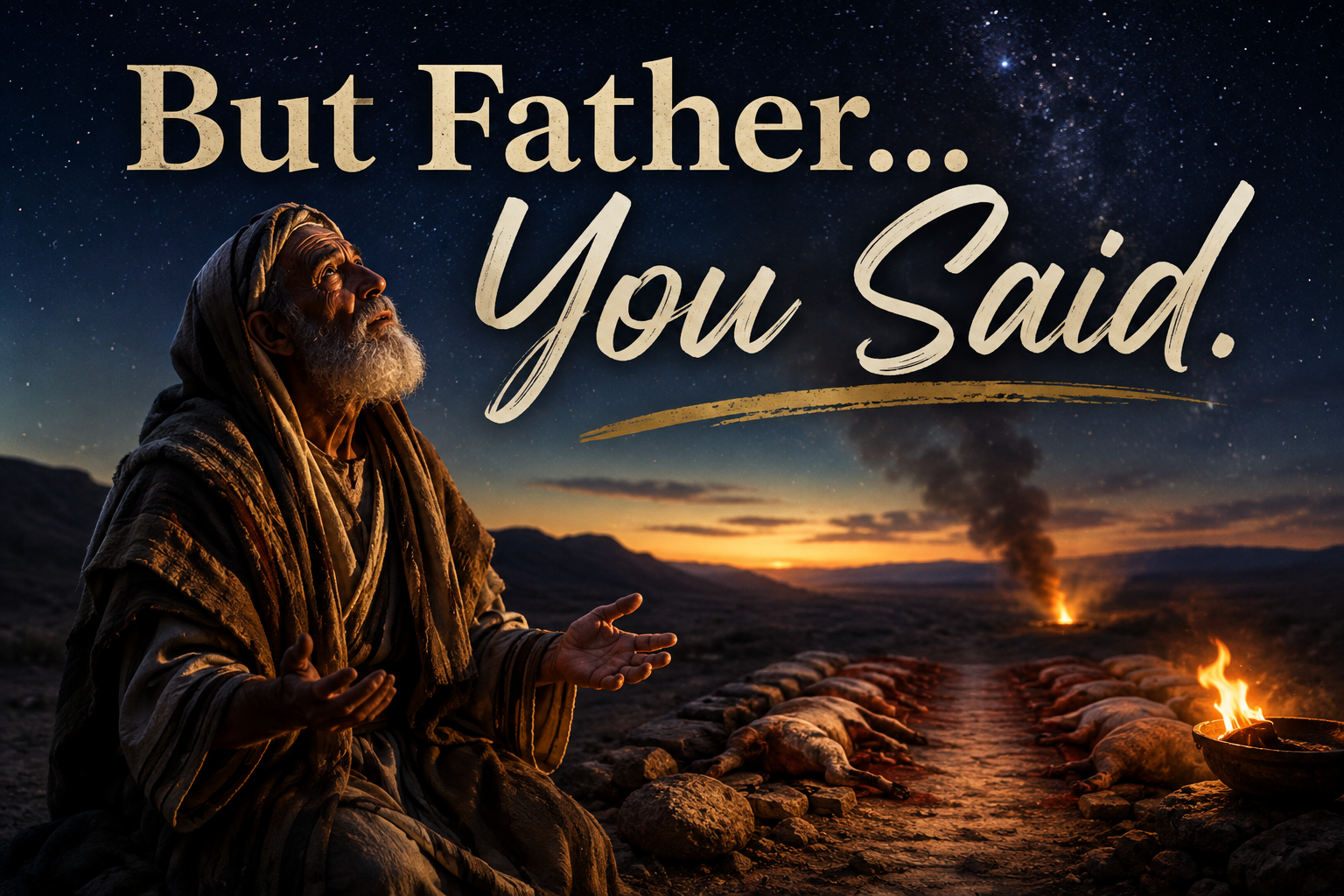
But Father... You Said
Before reading this week’s reflection, I encourage you to slowly read Genesis 15.
🎧 Listen to this week’s reflection
But Father... You Said
Abram has just returned from battle. He has rescued Lot, defeated powerful kings, and refused the riches offered by the king of Sodom. Then the Father comes to him:
“Do not be afraid, Abram. I am your shield, your exceedingly great reward.”
— Genesis 15:1
We ended our last story with a simple truth: God Himself is the blessing.
Now the Father says it Himself.
Not merely, I will reward you.
I am your reward.
But Abram has a problem.
The Father has promised Abram a future that cannot exist without a son. He has promised to make him a great nation and declared that through him the families of the earth will be blessed.
Yet Abram is growing old, and there is no heir.
To us, that may sound like the understandable sorrow of a man who desperately wants a child. But in Abram’s world, an heir represented something even larger. His name, his household, his inheritance, his story—his future—would continue through his descendants. Without an heir, everything appeared to end with him.
And yet the Father had promised generations.
So Abram does something I find beautiful.
He questions God.
Not with disrespect. Not because he has stopped believing. Abram speaks with what Jewish culture might call chutzpah—a boldness born from relationship, the confidence to press someone because you trust them enough to take their words seriously.
Abram is essentially saying:
Abram can question boldly and believe deeply at the same time. His questions are not the opposite of faith.
And the Father is not offended.
He takes Abram outside.
Imagine standing beneath that night sky more than four thousand years ago. No city lights. No glowing horizon. Nothing to dim the vast expanse above him. Abram looks into a darkness filled with more stars than he could possibly count.
Then the Father says:
“Look now toward heaven, and count the stars if you are able to number them... So shall your descendants be.”
— Genesis 15:5
Abram sees no son.
The Father shows him generations.Nothing about Abram’s circumstances has changed. Sarai is still barren. Abram is still old. There is still no child sleeping in their tent.
But now Abram is looking at the impossible while standing beside the One who promised it.
And Genesis gives us one of the most important sentences in all of Scripture:
“And he believed in the LORD, and He accounted it to him for righteousness.”
— Genesis 15:6
Centuries later, Paul will reach all the way back to this night:
“For what does the Scripture say? ‘Abraham believed God, and it was accounted to him for righteousness.’”
— Romans 4:3
Abram’s questions were not evidence that faith had disappeared. Here was a man with honest questions who placed his trust in the One who spoke.
Then Abram asks again:
“Lord GOD, how shall I know that I will inherit it?”
— Genesis 15:8
Again, the Father does not rebuke him.
He answers.
God tells Abram to bring several animals. Abram cuts them in two and places the pieces opposite one another.
To an ancient reader, the scene carried enormous significance. Covenants were serious things. Walking the blood-soaked path between the pieces was a terrible declaration: If I break my word, may what happened to these animals happen to me.
Abram prepares everything.
And then... nothing.
So he waits.
As the hours pass, birds of prey descend upon the animals, and Abram drives them away. He cannot make God come. He cannot make the fire appear. He cannot make the promise happen. All Abram can do is remain faithful to what the Father has placed before him and wait for the Father to move.
Perhaps Abram had been learning that lesson for years.
A son had been promised.
A land had been promised.
A blessing had been promised.
And still, Abram waited.
Later Scripture will remember this very thing about him:
“And so, after he had patiently endured, he obtained the promise.”
— Hebrews 6:15
There are few things more difficult than waiting on a promise from God when you have already done everything you know to do.
Waiting did not mean the Father had forgotten.
Eventually the sun disappears, and a deep and dreadful darkness falls over Abram.
Even here, the Father does not offer an easy story.
He tells Abram that his descendants will indeed inherit the promise—but first they will be strangers in another land. They will suffer. They will be oppressed.
The promise is real.
So is the darkness.
The Father never told Abram that blessing meant the absence of suffering. He told him the truth about the road ahead and remained faithful to the destination.
Then, in the darkness, something appears.
Smoke.
Fire.
Throughout Scripture, fire often accompanies the presence of God. Moses will encounter Him in a bush that burns but is not consumed. Israel will see Him descend upon Sinai in fire. A pillar of fire will lead His people through the wilderness.
When fire appears in a divine encounter, it is worth paying attention.
A smoking oven and a burning torch move between the pieces.
But Abram does not.
Abram had asked:
“How shall I know?”
And the Father answers not merely with another promise, but by placing Himself behind the promise.
I will do it.
And the cost of this covenant rests upon Me.
Centuries later, on another Passover night, Jesus would leave the upper room and cross the Kidron Valley on His way to the garden.
Jerusalem was overflowing with pilgrims, and thousands upon thousands of Passover lambs were being sacrificed. Ancient descriptions of the feast give us a sobering picture of the enormous amount of blood produced by those sacrifices and carried away from the Temple.
Imagine Jesus stepping into the Kidron on His way toward Gethsemane, the water stained with the blood of Passover lambs.
What went through His mind?
Did He remember another blood path?
Another night?
Another covenant?
He was walking toward becoming the sacrifice Himself.
John would describe Jesus as:
“The Lamb of God who takes away the sin of the world!”
— John 1:29
Long before Bethlehem, Gethsemane, or the cross, Genesis had already shown us something about the Father’s heart.
And eventually, He would bear the cost Himself.
Abram began with questions.
The Father did not silence him.
He took him outside.
He showed him the stars.
He allowed him to wait.
He told him the truth about the darkness.
And then He walked the blood path.
Perhaps there are moments when faith sounds less like quiet certainty and more like a child holding tightly to the Father’s words:
The Father is not threatened by that kind of faith.
The promise has never rested upon our ability to understand how He will accomplish it. It rests upon the character of the One who spoke.
He will do it.
And He has always been willing to bear the cost.

0 Comments