They Expected Death

They Expected Death

They Expected Death

🎧 Listen to This Article
Prefer to listen? Press play below and journey through this week's His-Story reflection.
Audio narration of They Expected Death

Before reading this reflection…

Before reading this reflection, I would encourage you to pause for a few moments and read Genesis chapter 3 for yourself.

Read it slowly.

Try, if only for a moment, to set aside everything you have been taught about the story and simply listen to the words.

Then come back and continue reading.

Adam and Eve are standing before God.

They have already hidden among the trees. They have already covered themselves with fig leaves. They have already heard the voice walking through the garden and calling, “Where are you?” And now there is nowhere left to hide.

They know what God said.

“In the day that you eat of it, you shall surely die.”

Then they ate.

Now that day has come.

I do not think we should rush past the terror of that moment. Adam and Eve are not standing there calmly waiting for a theological explanation. They are ashamed, exposed, afraid, and trembling before the One whose voice once meant life to them. The tragedy is that they are now hearing that voice through fear.

And fear has a way of distorting everything.

Fear hears judgment where mercy is speaking. Fear hears rejection where reconciliation is being offered.

Fear hears death
even when Life itself
is standing right in front of it.

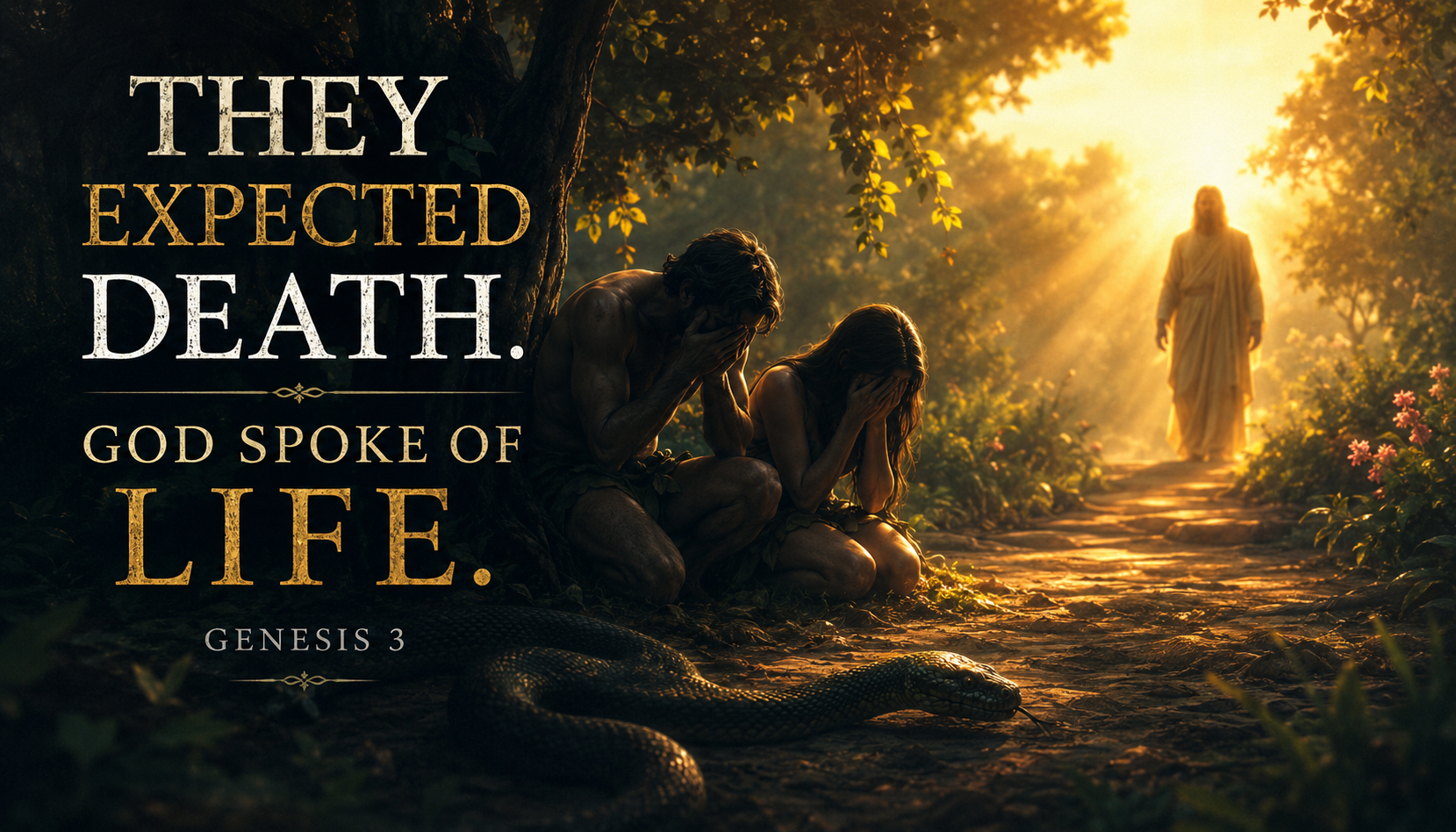
Adam and Eve are expecting death.

The reader is expecting death.

Then God begins to speak.

And the first curse falls.

Not upon Adam.

Not upon Eve.

Upon the serpent.

“Because you have done this,
cursed are you…”

The deceiver is cursed. The liar is cursed. The voice that first taught humanity to distrust God is cursed.

And that alone should make us pause.

For generations many people have spoken as though Adam and Eve were cursed in the garden. Yet the text never says that.

The serpent is cursed.
Later, the ground is cursed.
But Adam and Eve are not directly called cursed.

That may not answer every question, but it is certainly worth noticing.

Then God turns toward Eve.

And if there is a moment in Scripture where we should hold our breath, perhaps this is it.

What comes next?

Condemnation?

Destruction?

Death?

Instead, God begins speaking about children.

Children.

I cannot get past that word.

Adam and Eve are standing before the God they believe is about to pronounce death, and instead He begins speaking of children.

Children mean tomorrow. Children mean family. Children mean future generations. Children mean the story continues. Children mean humanity has not been abandoned.

Whatever else these words contain — and they do contain pain, sorrow, struggle, and consequences — they also contain something almost too beautiful to rush past.

Life.

Adam and Eve are expecting death.

God is speaking of life.

That contrast takes my breath away.

And if we slow down long enough, it should take yours too.

God does not ignore what has happened. The consequences are real. The sorrow is real. The fracture is real. The world they knew is gone. But neither does God speak as though the story is over.

Humanity will continue.

Children will be born.

A future is still coming.

And even more than that, God speaks of an offspring who will one day crush the serpent’s head.

Adam and Eve cannot possibly understand the fullness of those words. They cannot see Bethlehem. They cannot see Calvary. They cannot see the empty tomb.

But they can know this:

The serpent does not get the final word.
The deceiver loses.

And somewhere inside those words, the first notes of the Gospel begin to sing.

Still, the tension remains.

God had said:

“In the day that you eat of it, you shall surely die.”

So what exactly died that day?

Adam is still standing.

Eve is still standing.

Children are coming.

History is continuing.

Life fills the passage.

And yet something undeniably died.

Trust died. Innocence died. Peace died. The ability to stand naked before Love without fear died. Humanity lost the ability to see God clearly.

They were standing in front of Love
and seeing death.

That is astonishing.

And deeply human.

Because if we are honest, most of us have lived inside this story too. We have failed. We have hidden. We have expected condemnation. We have stood before God convinced He was disappointed, angry, or finished with us. And like Adam and Eve, we often struggle to hear what He is actually saying.

Perhaps death is far deeper than a body ceasing to breathe.

Scripture seems to say this again and again.

Jesus later says:

“I have come that they may have life.”

Yet He says this to people who are already breathing.

So perhaps life is more than biological existence. And perhaps death is more than biological ending.

The garden is teaching us how to hear those words.

To be dead is not merely to stop breathing. It is to be cut off from the life we were created to share with God. It is to hide from Love. To distrust the voice of the Father. To live in fear, shame, exile, and separation from the One who is Life itself.

That is the death humanity entered.

And that is the life Jesus came to restore.

This also brings us back to the theme that has been echoing through the garden from the beginning.

Voices.

God asks, “Where are you?”

God asks, “Who told you that you were naked?”

And when He speaks to Adam, He says:

“Because you have listened to the voice of your wife and have eaten of the tree…”

Once again, the question is not merely what was eaten, but whose voice was trusted.

Eve listened to the voice of the serpent.

Adam listened to the voice of another human.

Both stopped listening to the voice of God.

And the result was death.

Not merely because fruit was eaten, but because trust was broken. Humanity listened to the wrong voice and began walking away from life.

Then God says something else that deserves at least a brief pause:

“Cursed is the ground because of you…”

Adam was formed from the dust of the ground. In Hebrew, the connection is woven right into the words: Adam and adamah — man and ground. The human creature, the earth from which he came, and the dust to which he will return are bound together in a way modern readers may not immediately feel.

So when the ground is cursed because of Adam, something mysterious is being revealed about humanity’s relationship with creation itself. The fracture in Eden is larger than one man and one woman. It reaches into the soil beneath their feet.

Centuries later, Paul would write that creation itself groans, waiting to be delivered from corruption. Creation is not the villain in the story. The ground did not deceive humanity. Yet creation suffers under the weight of humanity’s fracture.

Still, even here, notice the mercy.

The serpent is cursed.

The ground is cursed.

But Adam himself is not directly called cursed.

That silence matters.

And perhaps it leaves a question hanging in the air:

If we expected the curse to fall directly on Adam,
why does the text place it on the ground instead?

That question may take us far beyond this moment. It may take us to covenant. To sacrifice. To blood. To a cross. To the One who eventually enters death Himself in order to destroy it.

But even here, in the garden, the Gospel is already beginning to breathe.

The humans expect death.
God speaks life.

The humans expect condemnation.
God speaks of children.

The humans expect the end.
God speaks of a future.

The humans expect the serpent to win.
God speaks of the serpent being crushed.

This is not a small detail.

This is the sound of mercy.

This is the sound of life in the shadow of death.

This is the first whisper that death will not have the final word.

And perhaps this is why the words of Jesus carry so much weight when we finally hear them:

“I have come that they may have life.”

The Gospel is not merely the forgiveness of sin.

It is the restoration of life.

The healing of what was fractured.

The awakening of what died.

The reconciliation of humanity back to the God from whom we hid.

Adam and Eve stood in the presence of Life itself and still believed death was all that remained.

They expected death. God spoke of life.

They expected condemnation. God spoke of children.

They expected the end. God spoke of a future.

They listened to the wrong voice and lost the life they had been created to share with God.

The rest of Scripture is the story of God calling humanity back to His voice.

And perhaps that is the Gospel.

Not merely that sin can be forgiven.

Not merely that guilt can be removed.

But that humanity can learn to hear the voice of Life again.

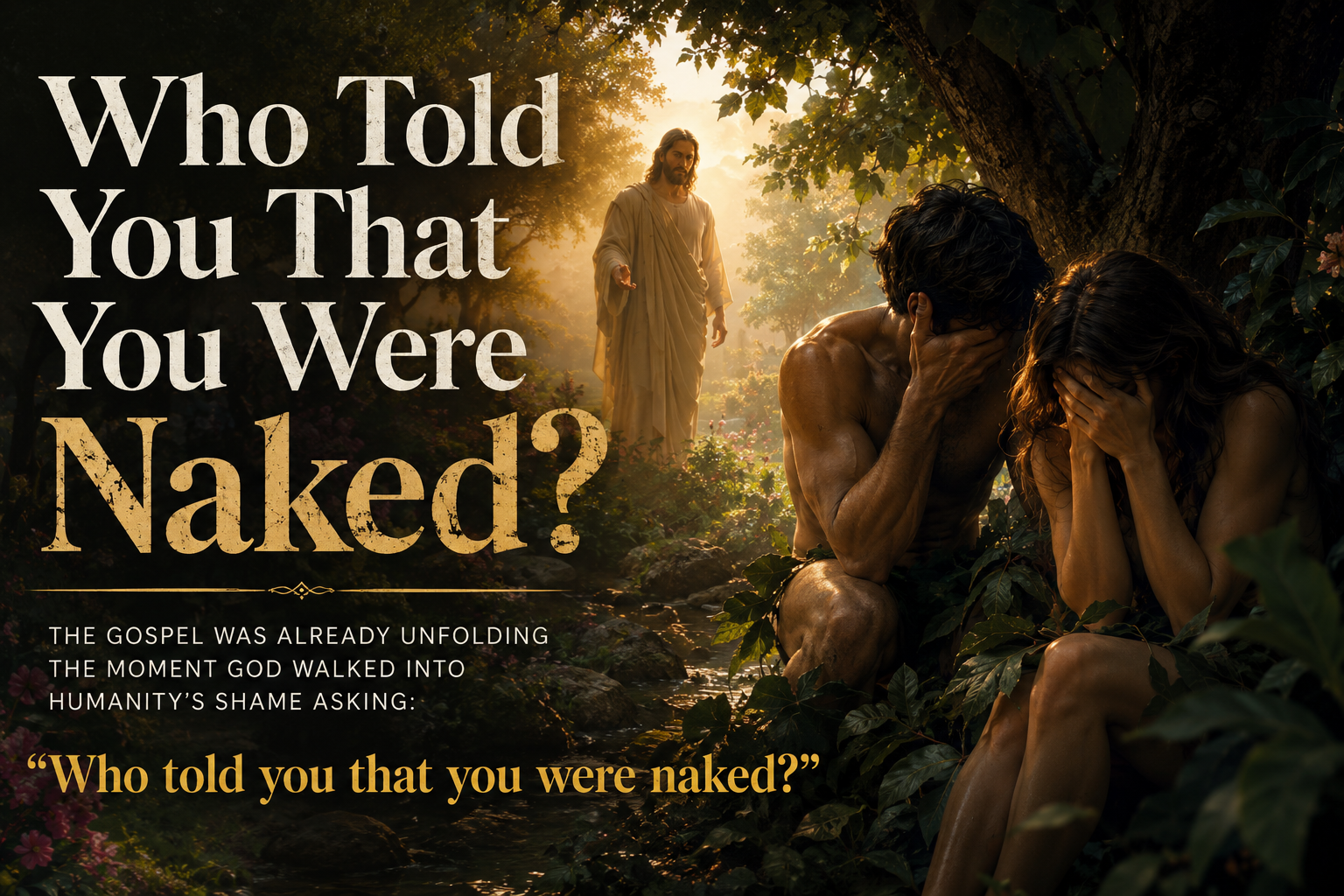
Who told you that you were naked?

Who told you that you were naked?

Who Told You That You Were Naked?

There is something deeply haunting about the next words spoken in the garden.

Last week, humanity hid among the trees while the voice of God walked through the cool of the evening calling, “Where are you?”

Now the story moves deeper still.

Adam finally answers the voice:

“I heard Your voice in the garden, and I was afraid because I was naked; so I hid myself.”

And He said,

“Who told you that you were naked? Have you eaten from the tree from which I commanded you not to eat?”

Genesis 3:10–11

That question may be one of the most profound questions in all of Scripture.

Not, “What have you done?”

But:

“Who told you that...?”

And perhaps this is where modern western readers often miss the depth of the story. Yes, Adam and Eve were literally naked. The story is real. But ancient Hebrew thought often carried layers of meaning inside physical realities. The nakedness in the garden is clearly more than exposed skin. Suddenly humanity feels exposed, vulnerable, ashamed, unsafe, self-conscious, and afraid.

Something inside humanity has shattered.

Before this moment, they stood fully open before God and one another without fear. Now humanity hides.

And perhaps we have been hiding ever since.

Because the question still echoes through every human heart alive today.

Who told you:
you are not enough?
you are unwanted?
you are ugly?
you are too broken?
you are beyond redemption?
that your failures define you?
that God is disappointed in you?

Shame makes humans cover themselves even from the people who love them most. It teaches us to hide parts of ourselves, protect ourselves, explain ourselves, and fear being truly seen.

Then Adam responds:

“The woman whom YOU gave to be with me, she gave me from the tree, and I ate.”

Genesis 3:12

For years I heard this preached almost entirely as blame toward Eve. Perhaps there is some truth in that. But there may be something even deeper happening here.

Notice the weight of Adam’s words:

“The woman whom YOU gave me…”

Something has fractured inside humanity’s trust toward God Himself.

Adam sounds almost like a terrified human being trying desperately to explain the unbearable condition he now finds himself in. Almost, “God… this happened through what You gave me.”

And honestly, is that not still the human story?

“God, why did You allow this?”

“Why did this happen to me?”

“Why does my life feel broken?”

“Why do I feel so lost?”

The fracture is no longer merely internal.

Humanity has begun suspecting the goodness of God Himself.

That may be the deepest poison the serpent introduced into the human story.

Not merely disobedience.

Distrust.

Because the story in the garden is not merely about sin entering humanity. It is about a lie entering humanity — a lie about God, ourselves, love, shame, and belonging.

The serpent did not merely tempt humanity to disobey.

The serpent taught humanity to distrust.

And suddenly Adam and Eve no longer know how to stand exposed before Love without fear.

That is devastating.

Scripture echoes this story again and again. David cries in Psalm 139:

“Where can I flee from Your presence?”

Yet even there, God is still near.

Isaiah speaks of the coming Messiah who would bind up the brokenhearted. Jesus later opens that scroll and declares those words fulfilled in Himself. And when Jesus says:

“You shall know the truth, and the truth shall make you free,”

perhaps He is speaking into the very lie humanity first believed in the garden.

Because humanity’s deepest wound may not be sinful behavior alone.

It may be the lie now living inside the human heart.

And the heartbreaking thing is that God is still there speaking gently through questions. Humanity is unraveling internally while God is still patiently drawing truth out of them.

He does not abandon humanity in shame.

He pursues humanity through it.

The questions themselves feel like mercy.

Because God is not merely exposing sin.

He is exposing the lie now living inside humanity.

And perhaps this is where the Gospel story has been unfolding from the very beginning.

The Gospel did not begin when Jesus was born in Bethlehem.

The Gospel was already unfolding the moment God walked into humanity’s shame asking:

“Who told you that you were naked?”

The God who walked through the garden is the same God later born in a manger, the same God nailed to a cross, the same God who rose again on the third day.

The Gospel is not merely the forgiveness of sin.

It is the healing of humanity from the lie that made us hide from God.

Healing the fear.
Healing the shame.
Healing the distrust.
Healing the fracture inside the human heart.

As John later writes:

“Perfect love casts out fear.”

1 John 4:18

Fear entered the garden.

Love came walking after us.

The serpent’s voice still whispers lies today:
you are abandoned,
you are unsafe in love,
you must hide,
you are no longer wanted by God.

But another voice still walks through the garden as well.

A voice still calling.
Still pursuing.
Still healing.

Still asking every human heart:

“Who told you that you were naked?”

A Song for This Reflection

My son, Ryan Rush, wrote a song to accompany this week’s reflection, carrying the heart of the story through music.

After sitting with the question, “Who told you that you were naked?” take a few quiet moments to listen.

You can also listen on Spotify:

Where Are You?

Where Are You?

Where Are You?

There may be no story in Scripture more deeply human than the story unfolding in the garden.

Not because it explains ancient history.

But because it explains us.

Every human being who has ever lived knows what it feels like to hide. To fear exposure. To cover ourselves. To wonder if we could still be loved if we were truly seen.

And perhaps that is why the next movement in Genesis becomes one of the most profound moments in all of Scripture — a moment that quietly sets the stage for the entire gospel story.

“And when the woman saw that the tree was good for food, and that it was pleasant to the eyes… she took of its fruit and ate, and also gave some to her husband who was with her, and he ate.

Then the eyes of both were opened…”

— Genesis 3:6-7

The story changes in a single moment. The fruit is taken. Adam receives it. And suddenly humanity sees differently.

But the text does not say humanity suddenly became evil. It says their eyes were opened. And the very first thing humanity becomes aware of is shame.

“And they knew that they were naked…”

That line is far deeper than it first appears. The first fracture in the human story is not violence, hatred, or murder.

It is shame.

Exposure. Self-consciousness. Fear.

And what is humanity’s first response after shame enters the story?

Hiding.

“They sewed fig leaves together and made coverings for themselves.”

Humanity begins covering itself, and we have been doing it ever since.

Perhaps you know this feeling — the exhausting effort of trying to hold yourself together while quietly fearing that if anyone truly saw you, they might turn away.

Humanity has been hiding among the trees ever since. Some hide behind religion, success, endless good works, wealth, knowledge, addiction, lust, humor, anger, or carefully crafted images of themselves. Some hide so deeply in shame that they begin destroying themselves entirely.

But beneath all of it is often the same ancient fear:

“If I am fully seen… will I still be loved?”

And yet the next movement in the story changes everything.

“And they heard the voice of Yahweh God walking in the garden in the cool of the day…”

— Genesis 3:8

Notice carefully what the story does not say.

It does not say God withdrew from humanity.

It says humanity hid from God.

Adam and Eve are hiding among the trees, covering themselves, terrified and ashamed. And God comes walking toward them.

Not away from them.

Toward them.

And yet, something fascinating happens in the story. God had warned:

“In the day you eat of it you shall surely die.”

— Genesis 2:17

And yet after the fruit is taken, God still comes walking through the garden calling for them. The relationship is fractured. Shame has entered. Fear has awakened.

But the voice still comes.

They recognized the voice immediately. This was not the approach of a stranger. This was the voice they had always known.

The voice approaching them is not the source of shame —
it is the answer to it.

And then comes one of the most heartbreaking and beautiful questions in all of Scripture:

“Where are you?”

— Genesis 3:9

Not accusation.

Not condemnation.

Not rejection.

It was the voice of love crying out for the beloved.

The beloved were hiding from Love itself.

“Where are you?”

Not because God lacked information, but because relationship had been fractured. God was not walking through the garden searching for strangers. He was calling for the ones He loved.

And Adam answers with words that still echo through every human soul:

“I was afraid… so I hid.”

— Genesis 3:10

Fear enters the relationship.

Not because God changed.

But because humanity’s perception became fractured through shame.

And perhaps this is still the tragedy of mankind. Not merely that we sin, but that shame drives us away from the very presence that can heal us.

The deepest human problem was never merely sin itself. It was that shame taught humanity to run from the very God who was still calling for them.

That is the fracture.

Not merely that Adam ate the fruit —
but that Adam hid from the One who loved him.

Which means the very presence Adam fears…
is actually the only place healing can be found.

And perhaps that is still the great tragedy of humanity. Not merely that we fail, but that we continue hiding from the One who is still pursuing us.

Religion often unknowingly reinforces this hiding. It tells people to clean themselves first, fix themselves first, become worthy first, stop failing first, and then come to God.

But the garden reveals the opposite movement.

God comes walking into humanity’s failure. God moves toward the hiding humans. God calls before Adam ever speaks a word of repentance.

The voice comes first.

The calling comes first.

The pursuit comes first.

This is not merely Adam’s story.

It is ours.

The serpent’s voice still whispers: hide, cover yourself, withdraw, you are no longer safe in love. And humanity still listens.

Yet through all of history, another voice continues to call. Not the voice of shame. Not the voice of accusation. Not the voice of the serpent.

The voice walking in the garden.

Calling.

Seeking.

Pursuing.

And this is where the story becomes almost too beautiful for words.

Because the God calling through the trees eventually steps directly into the very condition humanity entered in the garden.

“He made Him who knew no sin to be sin for us, that we might become the righteousness of God in Him.”

— 2 Corinthians 5:21

At some point theology gives way to awe.

Because what kind of God does this?

The God walking through the garden eventually allows Himself to be stripped naked before humanity. Mocked. Rejected. Shamed publicly.

Adam hides his nakedness.

Christ bears nakedness publicly.

Adam hides among the trees.

Christ is lifted upon a tree.

Adam runs from God in shame.

God enters shame Himself to bring Adam home again.

The cross was not God finally deciding to love humanity. It was the fullest revelation of the love that had already been pursuing humanity since the garden.

The deepest tragedy in the garden was not merely that humanity sinned.

It was that humanity became afraid of the One who loved them most.

And still He comes.

Still calling.

Still pursuing.

Still loving.

“Looking unto Jesus the author and finisher of our faith; who for the joy that was set before Him endured the cross, despising the shame…”

— Hebrews 12:2

Not merely the pain.

The shame.

Because shame is unbearable to the human soul. It tells us to hide ourselves, cover ourselves, withdraw, and believe we are no longer safe in love.

But Jesus entered directly into humanity’s shame in order to destroy its hold. To open the way home again. To reveal that the voice in the garden was never our enemy.

It was always the voice of the Father calling His children home.

Sin did not cause God to abandon humanity.

Sin caused humanity to hide from God.

Yet even then, the voice still walked through the garden.

Still calling.

Still pursuing.

Still loving.

The question is no longer whether God is willing to come near.

The question is:

will we continue hiding among the trees…

or will we finally answer the voice calling our name?

Because perhaps salvation is, at least in part, the moment a human finally stops hiding long enough to answer the voice calling in the garden.

A Song for This Week’s Reflection

My son wrote a song to go along with this week’s blog, and I believe it beautifully carries the heart of this reflection.

After sitting with the story of the garden, shame, hiding, and the voice of God still calling, this song offers another way to pause and listen.

I invite you to take a few minutes, quiet your heart, and listen.

Church without the Buildings

Church without the Buildings

Church without the Buildings

If We Didn’t Have Church Buildings

Honest Questions

Is the Church today what Jesus had in mind?
Are we becoming the people He envisioned—or have we quietly settled for something less?

Do our gatherings form disciples—or just fill seats?
Do they lead us deeper into love—or simply into habit?
When we meet each week, are lives being changed—or just schedules being kept?

Didn’t Jesus say, “Follow Me,” not “Attend Me”?

Have we lost the art of teaching people to follow the Spirit of God?
In trying to preserve truth, have we taught people to follow a system, a standard, or a doctrine—yet forgotten how to listen to the living voice of the Shepherd?
Has four songs and a lecture replaced the unpredictable beauty of a Spirit-led community—one that prays, listens, weeps, and rejoices together?

Most of us don’t come to church looking to be entertained. We come hungry for something real—for God, for belonging, for hope.
But the way we’ve structured “church” often turns that hunger into passivity. We sit. We listen. We sing along. Yet few are invited to truly participate.

Somewhere along the way, we learned to consume instead of contribute.
We’ve mistaken inspiration for transformation.
We attempt to draw in crowds instead of touching lives and forming communities.
We’ve stirred emotion, but often lost the filling of the Spirit of God.
And in the process, we’ve taught people to attend instead of abide.

This isn’t about blame—it’s about love.
Because beneath all of our services, songs, and sermons, something in us knows there’s more.
More depth. More life. More Jesus.

And maybe that “more” doesn’t come from trying harder to do church better,
but from learning again how to be the Church together.


What Jesus Intended

Did Jesus ever tell us to build churches—or did He call us to love one another, make disciples, and follow His Spirit?
When He spoke of His Church, was He imagining pews and programs—or a people alive with His presence?

What if His dream wasn’t built around sermons and schedules, but around relationship?
What if He pictured friends breaking bread, families opening their homes, believers sharing life—not just once a week, but as often as the Spirit stirred their hearts?

The gatherings in Acts weren’t polished or predictable. They were living, breathing, Spirit-filled communities.
They met wherever they could—homes, courtyards, under trees, or by the river—because the building didn’t matter. The presence did.

They sang and prayed. They listened for the Spirit’s voice.
They lived the way Jesus had shown them—breaking bread, remembering His words,

“By this everyone will know that you are My disciples, if you love one another.” — John 13:35

They wrestled through Scripture, cared for widows, shared what they had, and walked through joy and suffering side by side.
It was messy, but it was real. Ordinary, but sacred. Imperfect, but alive.

Somewhere along the way, we began to trade that simplicity for structure.
Participation became performance.
Family became formality.
And the unpredictable beauty of the Spirit gave way to the safety of routine.

But maybe the same Spirit who breathed life into that first Church still longs to breathe life into us.
Maybe He’s still whispering, still healing, still gathering hearts into family.

Perhaps what Jesus intended was never an institution at all, but an incarnation—His presence alive within His people, His voice guiding them, His love binding them together in a fellowship so deep the world could only call it divine.


The Purpose of the Church

If this is what Jesus intended—a people led by His Spirit, living in love—then why did He create the Church at all?
What did He dream His followers would become together?
Why did He call us His body, His bride, His family?

Maybe it’s simpler than we’ve made it.
Maybe the Church exists to bring His life into every corner of the earth—to embody His love, His truth, and His mercy wherever we go.
To be, quite literally, the visible expression of the invisible Christ.

“Go and make disciples of all nations… teaching them to obey everything I have commanded you.” — Matthew 28:19–20

To Manifest Christ on Earth

“Now you are the body of Christ, and individually members of it.” — 1 Corinthians 12:27

The Church was never meant to just talk about Jesus. We are meant to display Him for the whole world to see—His compassion, His courage, His mercy, His truth.
The world doesn’t need another explanation of Jesus; it needs an encounter with Him through us.

To Worship and Glorify God

“You are a chosen generation… that you may proclaim the praises of Him who called you out of darkness into His marvelous light.” — 1 Peter 2:9

Our purpose begins and ends in worship—not performance, but presence.
Worship isn’t confined to the songs we sing, but found in the lives we live.
It rises from hearts that know they’ve been rescued and fills both our gatherings and our going with gratitude and awe.

To Equip and Build Up Believers

“He gave apostles, prophets, evangelists, pastors and teachers to equip the saints for the work of ministry.” — Ephesians 4:11–12

Notice: He gave them to equip the saints for ministry.
Those servants were never meant to do all the ministry themselves—they were meant to prepare and release others to do it.
In much of today’s church, our “leaders” (who were meant to be servants) have become the ones doing nearly everything, while the rest watch and applaud.

Equipping means helping one another walk with God—learning to hear His voice, discern His leading, and live in faith rather than fear.

“To each one the manifestation of the Spirit is given for the common good.” — 1 Corinthians 12:7

We were never meant to depend on one person’s teaching to feed us, but to become a people who know how to feed others.

To Carry the Message of Reconciliation

“God… gave us the ministry of reconciliation.” — 2 Corinthians 5:18

The Church exists to remind a broken world that God has not turned away.
Through Christ, He’s made a way home.
Our calling is not to win arguments but to win hearts—to be living bridges of grace, showing that mercy still triumphs over judgment.

To Reveal God’s Presence to the World

“You also are being built together for a dwelling place of God in the Spirit.” — Ephesians 2:22

We are not a monument; we are a temple made of living stones.
Wherever believers gather—homes, fields, cafés, or workshops—the presence of God dwells.
When we love, forgive, and serve in His name, the world catches a glimpse of heaven breaking through earth’s noise.

When the Church lives this way—alive with Christ’s presence and led by His Spirit—everything changes.
The hungry are fed. The lonely find family. The hurting find healing. The lost find home.

This is what He had in mind all along.
Not programs, but people.
Not religion, but relationship.
Not an organization, but an organism—pulsing with the heartbeat of God.


Where We Drifted — and How the Spirit Leads Us Home

If this is what the Church was meant to be—a living body, a Spirit-led family—then what happened?
How did something so alive, so intimate, become so organized, scripted, and restrained?

Maybe it wasn’t rebellion that caused the drift. Maybe it was fear—fear of chaos, of losing control, of what might happen if the Spirit truly led the gathering instead of us.
Because people can get messy. And when people get messy, leaders get nervous.

So we built systems to keep things “safe.”
We created schedules, programs, and traditions—many of them good—but over time they began to replace the living relationship they were meant to protect.
We learned to manage the Church instead of follow the Spirit.

We didn’t mean to lose our way. But somewhere along the line, we started to consume instead of contribute; we began mistaking inspiration for transformation; we tried to draw in crowds instead of touching lives and forming communities; we stirred emotion, but often lost the filling of the Spirit of God; and in the process, we taught people to attend instead of abide.

Most of us are simply doing what we were taught—faithfully and sincerely.
But the result has been a quiet starvation.
People come hungry for God and leave full of words but still empty inside.
They’ve tasted moments of His presence but rarely learned how to walk with Him daily.
They know about Him, but few have been shown how to know Him.

And maybe that’s the deepest wound of all.
We’ve lost the art of teaching people to follow the Spirit of God.
We’ve replaced relationship with routine.
We’ve taught people how to serve, but not how to listen.
We’ve told them what to believe, but not how to hear His voice for themselves.

Yet even here, the Spirit hasn’t stopped calling.
He’s still whispering—not in condemnation, but in invitation.
He reminds us that structure isn’t the enemy; stagnation is.
The goal isn’t to burn it all down, but to breathe new life into what’s grown still.

“Apart from Me you can do nothing.” — John 15:5

The Holy Spirit isn’t a guest we invite into our gatherings; He’s the Host who invited us.
He’s not an accessory to our plans—He’s the One who gives them life.
When the Spirit leads, the Church breathes. When He speaks, hearts awaken. When He moves, structure bends to love, and people come alive.

We’ve spent years trying to organize what only He can orchestrate.
But He doesn’t need our choreography—He needs our surrender.
He’s not waiting for better strategies; He’s waiting for yielded hearts.

The same Spirit who led Jesus leads us still.
He gave the disciples words to speak, courage to stand, and power to love beyond their strength.
That same Spirit isn’t distant or diminished. He’s here—ready to fill, to lead, to heal, to restore.

If we truly believed that, what might our gatherings look like?
Would we plan less and pray more?
Would we listen longer before we speak?
Would we leave space for silence, for tears, for prophecy, for healing—for the things only God can do?

The Holy Spirit is not a mystery to be managed; He’s the Presence we were made for.
And when we learn again to depend on Him instead of ourselves, the Church will begin to breathe again.


What We Can Do Differently

If we can see where we’ve drifted, then we can also see where to begin again.
The solution isn’t another program, conference, or committee.
It’s simpler—and far more personal.
It begins with ordinary people rediscovering an extraordinary truth: we are the Church.

We don’t have to wait for permission to start living differently.
We can begin right where we are—
in homes and breakrooms, barns and coffee shops, parks, driveways, and backyards.

We can gather a few friends and share a meal.
We can open the Scriptures and ask honest questions.
We can pray for one another—not just promise to, but actually stop and do it.
We can listen together for the voice of the Spirit.
We can make space for His presence to lead, even when it’s messy or unpredictable.

We can replace spectatorship with participation.
We can open our hands instead of raising our defenses.
We can stop trying to build impressive ministries and start building meaningful relationships.

We can teach each other—again—how to follow the Spirit of God:
to listen for His nudges, to pause before acting, to obey when He whispers, to trust that He knows how to lead His people better than we do.

And maybe, if we do these simple things, the Church will start to breathe again.
Not by trying harder, but by trusting deeper.
Not through control, but through surrender.
Not through innovation, but through invitation—“Come, Holy Spirit.”

Because the Church was never meant to be powered by strategy, but by Presence.
The plan was never ours to perfect; it was His to fulfill through willing hearts.

“For it is God who works in you, both to will and to act according to His good purpose.” — Philippians 2:13

What we do differently doesn’t start with policy—it starts with hunger.
If we want to see the Church Jesus intended,
then it begins with hearts that say,
“Here I am, Lord. Lead me.”

[wp_ulike]

🔥 How to Retire Starting with Just $1,000 (Using a Coffee a Day Machine Strategy)

🔥 How to Retire Starting with Just $1,000 (Using a Coffee a Day Machine Strategy)

Let’s be real for a minute.

Most people think retiring takes hundreds of thousands of dollars, risky day trades, or striking it big with crypto.

That’s nonsense.

Here’s what’s actually true:

  • ✅ You can start with just $1,000
  • ✅ You can earn a conservative 1.5% per week (not moonshot options gambles, just boring consistent premiums)
  • ✅ You can reinvest every penny back into your machine

But let’s remove the fantasy compounding and show what really happens with covered calls.


⚙️ Here’s How It Breaks Down – Real Machine Math

💡 Starting Point

  • $1,000 starting balance
  • Stock at $10/share = 100 shares = 1 contract

💡 Weekly Premiums

  • You earn ~$15/week (1.5% of $1,000)

🔢 When Do You Double?

Unlike pure compounding (where your money doubles in ~48 weeks if reinvested fractionally), in covered calls:

  • ✅ You only earn premiums on full contract blocks (100 shares).
  • ✅ You stack premiums as cash until you can buy another 100 shares. Then your income doubles.

⚠️ Example Without Contributions

Weeks Stack Contracts Weekly Income
0 $0 1 $15
67 ~$1,000 2 $30

➡️ It takes ~67 weeks (about 1 year and 3 months) to double income from premiums alone, assuming no price changes or contributions.


☕️ Now What Happens If You Add Just Coffee Money?

✅ $5/day = $25/week extra added.

Now your stack builds like this:

  • Weekly build: $15 premium + $25 contribution = $40/week growth

✅ Time to your next $1,000 (second contract):

  • $1,000 á $40/week ≈ 25 weeks (~6 months)

🚀 Here’s How That Compounds in Real Machine Steps

💡 6 months in:

  • You now have 2 contracts earning $30/week.

💡 Next contract (3rd):

  • Weekly build: $30 premium + $25 contribution = $55/week
  • $1,000 á $55/week ≈ 18 weeks (~4.5 months)

💡 Next contract (4th):

  • Weekly build: $45 premium + $25 = $70/week
  • $1,000 á $70/week ≈ 14 weeks (~3.5 months)

💡 Next contract (5th):

  • Weekly build: $60 premium + $25 = $85/week
  • $1,000 á $85/week ≈ 12 weeks (~3 months)

⚙️ Stacking Summary

  • ✔ Month 0: 1 contract ($15/week)
  • ✔ Month 6: 2 contracts ($30/week)
  • ✔ Month 10.5: 3 contracts ($45/week)
  • ✔ Month 14: 4 contracts ($60/week)
  • ✔ Month 17: 5 contracts ($75/week)
  • ✔ Month 20: 6 contracts ($90/week)
  • ✔ Month 22.5: 7 contracts ($105/week)
  • ✔ Month 24.5: 8 contracts ($120/week)

🔥 At The End of 2 Years

✅ You’re earning ~$120/week x 4 = ~$480/month purely from premiums.

✅ Your snowball is moving faster every month as each new contract accelerates stacking toward the next.


⚠️ Real Operator Reality Check

✅ 2 years in, you’re not at full retirement income yet – but your machine is a fast-rolling snowball.

✅ By year 4-5, with this acceleration, you’re pushing $400-$500/week ($1,600-$2,000/month).

And this is without risky bets or moonshot trades – just:

  • ✔ Covered calls
  • ✔ Steady reinvestment
  • ✔ Small daily contributions (your “coffee money”)

🚀 The Bottom Line

✅ You don’t need a lot to start.

✅ You don’t need risky bets.

✅ You need a machine that compounds in real operational steps, not fantasy finance charts.

If you can:

  • Earn 1.5% per week (conservative)
  • Reinvest every premium
  • Add just “a coffee a day”

You will build retirement-level income in a few short years, with each week accelerating the climb.

That’s not a dream. That’s disciplined, practical math – and math doesn’t care about your feelings. It just works.


⚙️ Your Next Move

✅ Start building your machine.

✅ Stay consistent.

✅ Watch your snowball grow from coffee money to freedom money.

Because at the end of the day, it’s not about how much you start with – it’s about how relentlessly you grow it.


👉 Want to Dive Deeper Into How I Run This Machine?

I wrote a full breakdown for beginners on my blog. Check it out here:

🔗 Make Your Own Machine – Part 1: What Even Is a Stock?


🎁 Ready to Start Building Right Now?

Grow wealth. Stack shares. Collect premium. And hey – grab some free stocks and free money while you’re at it.

👉 Start your own Robinhood account here.

No pressure. But if you’re gonna play the game, you might as well start with a little house money.

Polygamy in the Bible

Polygamy in the Bible

Polygamy in the Bible

Polygamy in the Bible: A Complex Blessing

Polygamy often raises eyebrows in modern discussions of biblical morality, yet the Scriptures themselves treat it with surprising nuance. While never explicitly commanded, polygamy appears multiple times in Scripture—sometimes as a cultural reality, and other times with what seems to be divine allowance or even blessing.

Old Testament Examples

  1. Jacob, Leah, Rachel… and Two More
    In Genesis 29:31–30:24, Jacob marries sisters Leah and Rachel, and later has children with their maidservants. Though the family dynamic is messy and full of strife, God is intimately involved—opening wombs, giving children, and building the twelve tribes of Israel through this very household.
  2. David’s God-Given Wives
    In 2 Samuel 12:8, the prophet Nathan conveys a striking word from God to David:
    “I gave your master’s house to you, and your master’s wives into your arms… And if all this had been too little, I would have given you even more.”
    The implication is startling—David’s multiple wives are not condemned here, but are part of God’s provision.
  3. Solomon’s Excess
    1 Kings 11:3–4 records Solomon’s hundreds of wives and concubines. While Scripture does condemn Solomon’s eventual idolatry influenced by his wives, God had still granted him immense wisdom and blessing beforehand. The issue isn’t quantity—it’s compromise of faith.
  4. Law for Additional Wives
    In Exodus 21:10, Mosaic law includes instructions for a man who takes another wife:
    “He must not deprive the first one of her food, clothing and marital rights.”
    The law doesn’t forbid polygamy—it regulates fairness within it.

New Testament Direction

The New Testament shifts the focus. It emphasizes faithfulness, character, and spiritual leadership—but doesn’t offer a direct condemnation of polygamy.

  • 1 Timothy 3:2: “Now the overseer is to be above reproach, faithful to his wife…”
  • Titus 1:6: “An elder must be blameless, faithful to his wife…”

These verses elevate monogamy as a standard for leadership, not as a universal requirement for all believers.

What Can We Conclude?

The Bible does not condemn polygamy, nor does it explicitly endorse it as a divine ideal. Instead, it presents it as a real part of human relationships in certain times and cultures—often accompanied by blessings, and just as often followed by human frailty, jealousy, or spiritual decline.

Polygamy in Scripture is not portrayed as sin, but it is often the backdrop for sin. And like many blessings, when received without faith or handled without wisdom, it can lead to brokenness.

Rather than judging ancient lives through modern lenses, it’s better to reflect on the heart of the matter: God desires faithful, loving, and covenantal relationships. Whether monogamous or polygamous, when human relationships lose sight of the One who gave the gift, the blessing often turns to burden.

[wp_ulike]